
Picture a smart home camera that can tell the difference between your dog and a person at the door, without sending a single frame of video to a cloud server. Or a smart hub that keeps your lights, locks and thermostat running even when your Internet goes down for half a day. These are not just marketing promises when the hardware and software are designed properly. They’re the result of a shift in how connected devices are designed to think, a shift that started on factory floors and oil rigs, and is now quietly reshaping many of the smartest devices in your home.
That shift has a name – edge computing. And understanding it will change how you evaluate every smart home product you buy.
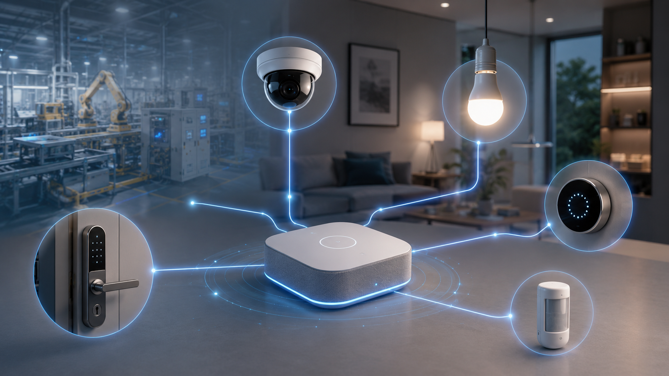
What Is Edge Computing?
Edge computing means processing data close to where it’s generated, rather than sending everything to a distant server for analysis. The “edge” refers to the outermost point of a network (the device itself or a local hub nearby), as opposed to a centralized data center that could be hundreds of miles away.
Think of it like the difference between a local branch manager and a distant corporate headquarters. The branch manager handles day-to-day decisions on the spot. Headquarters only gets involved for bigger strategic questions. Edge computing gives your devices their own branch manager, one that can act immediately, without waiting on the cloud.
In plain English: edge computing means your smart device does more thinking at home and less waiting on the Internet.
This matters because latency (the delay between an event happening and a system responding) is the enemy of real-time intelligence. When your motion sensor triggers an alert, or your thermostat decides whether to adjust the temperature, a round trip to a cloud server and back can add hundreds of milliseconds. For some applications, that delay is barely noticeable. For others, it’s the difference between a system that feels genuinely smart and one that feels sluggish.
How Edge Computing Connects IIoT and Smart Homes
Edge computing did not become important because of smart homes. It became especially valuable in demanding industrial and infrastructure environments – the world of the Industrial Internet of Things – where sensors, machines and connected equipment power manufacturing plants, energy grids, oil platforms and logistics networks.
In those environments, the stakes of cloud dependency are extremely high. An offshore drilling platform can’t afford to wait for a cloud server to confirm whether a gas pressure reading is dangerous. A factory assembly line generating millions of sensor readings per hour can’t send every data point to a remote server without clogging its own network. A self-driving vehicle at highway speed cannot outsource collision detection to a data center that might respond in half a second.
IIoT engineers addressed these problems by pushing processing power to the edge, placing computing hardware at or near the machines themselves, so critical decisions happen locally and instantly. The cloud still plays a role, handling long term analysis and reporting. The edge handles the tasks that can’t afford to wait. That same architecture is now finding its way into consumer smart home devices, for very similar reasons.
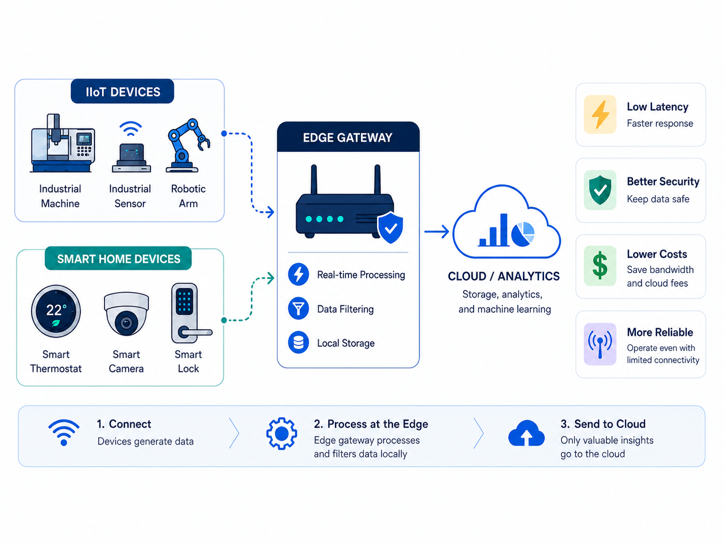
Why Edge Computing Matters for Your Smart Home
The same logic that makes edge computing essential on a factory floor applies – in a more everyday way – to a well designed smart home. Here’s how the core benefits translate from industrial to residential.
| Cloud-first smart home | Edge/local-first smart home |
|---|---|
| Depends more on Internet access | Can keep core automations local |
| May add latency to commands | Usually responds faster |
| Often sends more data off-site | Can reduce cloud data sharing |
| More vulnerable to service shutdowns | More likely to keep basic functions working |
Speed and Responsiveness
When you tap your phone to turn off the kitchen lights, what determines how quickly they respond? If your bulbs rely on a cloud server, the command has to leave your phone, travel to a data center, get processed, and return – all before anything happens. That’s fine for a simple on/off command in good conditions. But when you’re running complex automations – lights that respond to motion, a lock that triggers when your phone leaves the house – that latency compounds quickly.
Devices and hubs that process commands locally can respond in milliseconds, because they’re not waiting on a cloud round trip for every action. It’s the reason a well configured smart home hub running local automations can feel almost instantaneous compared to a cloud-dependent alternative.
Reliability When Your Internet Goes Down
Many cloud-dependent smart home devices lose some or all smart functionality when your Internet goes out. Automations fall silent, voice commands stop working, app control disappears. Edge-capable devices can continue operating when the problem is upstream, provided your local network, hub and devices are still running.
This is one of the key reasons the Matter protocol was designed with a local-first architecture. If your Internet connection drops but your router, controller and local network remain up, Matter devices can keep responding to local commands. It reflects the same reliability lesson that made edge computing valuable in IIoT. Critical actions shouldn’t depend on a distant server when they can happen locally.
Privacy Through Local Processing
In IIoT, keeping sensitive operational data off the public Internet is a security requirement. A factory doesn’t want its production metrics flowing through third-party cloud servers. The same logic applies at home, particularly to camera footage. A security camera that analyzes video locally does not need to send that footage to a cloud server for processing. The AI runs on the device or a local hub, and your data stays inside your home network.
It’s part of why platforms like Home Assistant have built dedicated communities of privacy-conscious users. The platform is built around local control and privacy, with the core running on your own hardware and no required cloud dependency.
Bandwidth Efficiency
A camera streaming continuous 4K video to the cloud consumes enormous bandwidth and generates ongoing storage costs. A camera with on-device processing only uploads clips when something meaningful is detected (a person at the door, an unfamiliar vehicle), instead of hours of footage showing nothing. Your router, your storage plan, and your monthly bill all benefit. It’s the same principle IIoT uses at scale. Filter at the edge, only escalate what counts.
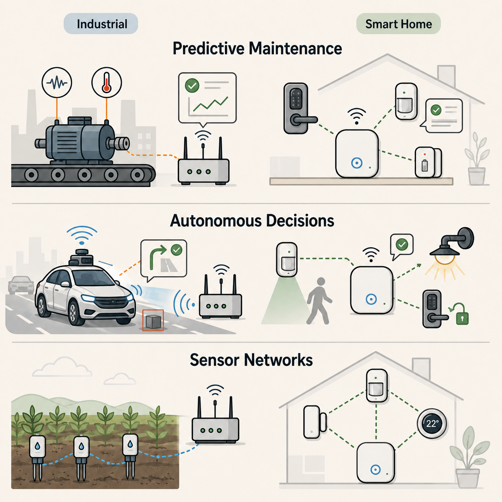
How Edge Computing Works in Practice
Predictive Maintenance: Factory Floor to Smart Hub
In industrial settings, edge devices run machine learning models that monitor vibration, temperature and acoustic signatures from heavy equipment, detecting subtle changes that indicate a component is about to fail, often days before a technician would notice. At home, the equivalent is a smart hub that flags anomalies locally without needing a cloud service to interpret them. Some platforms already alert you when a sensor’s battery is critically low, a lock fails to confirm closure, or a motion detector stops reporting. Simple examples, but they’re getting more capable as edge hardware improves.
Autonomous Decisions Without Asking Permission
Self-driving vehicles are the most dramatic example of edge computing in action. Every camera, radar and lidar sensor generates enormous volumes of data every second, and the system has to make split-second decisions (brake, steer, yield) with no ability to wait for a cloud server. All of that processing happens locally, on hardware embedded in the vehicle.
A motion-triggered security light that responds in under a second, or a front door that unlocks the moment your phone’s GPS enters a home zone – these work on the same principle. The hub made the decision locally, without phoning home first.
Sensor Networks That Don’t Need Constant Connectivity
Precision agriculture deploys thousands of soil and moisture sensors across fields with no reliable Internet coverage. Edge-capable sensors process readings locally and only transmit summaries or alerts. The system keeps working whether or not a cell tower is in range. Smart home sensor networks built on Zigbee, Z-Wave or Thread work the same way. Your door sensors and motion detectors communicate with a local hub over a mesh network. They just need to reach the hub, not the Internet. Build on local mesh protocols rather than cloud-dependent Wi-Fi devices and your sensor coverage becomes much more resilient to Internet disruptions.
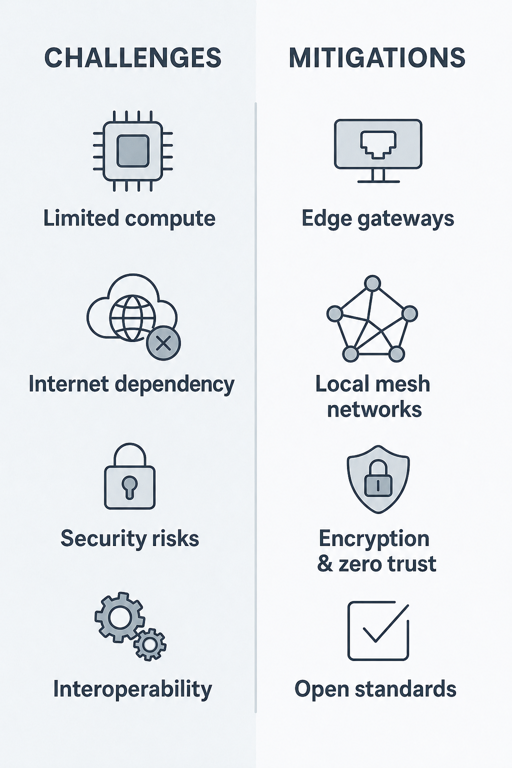
The Challenges Are Real, and Worth Understanding
Limited On-Device Processing Power
An edge device can’t match the raw computational power of a cloud data center. Industrial deployments handle this by prioritizing time-sensitive tasks locally and offloading deeper analytics to the cloud in batches. Consumer devices handle it by running smaller, more efficient AI models (a category called TinyML) that can operate on modest hardware without constant cloud connectivity.
When a product claims on-device AI processing, it’s worth understanding what that covers. Running a person detection model locally is well within current smart camera capabilities. Running a large facial recognition database against thousands of faces is far more demanding and may require cloud support or tighter operational limits. Good manufacturers are transparent about what happens locally versus in the cloud.
Cloud-dependent devices often benefit from the security infrastructure of large providers – encryption in transit, monitored infrastructure, centralized threat response. Pushing processing to the edge increases the number of devices that need their own security hardening. Each one needs strong authentication, encrypted communications and regular firmware updates, because a compromised local device has direct access to your home network.
Local processing improves privacy by keeping data off the public Internet, but it shifts security responsibility to the device owner. Keeping firmware updated, using strong passwords, and isolating IoT devices on a separate network segment are all part of using edge-capable devices safely. My smart home security guide covers this in more depth.
Interoperability Still Requires Attention
IIoT environments grapple constantly with getting devices from different manufacturers to communicate reliably – different protocols, data formats, vendor APIs. The smart home world has faced the same problem for years, and Matter is the industry’s most serious attempt to solve it at the consumer level. If local reliability is a priority, choosing devices that support established local protocols and standards, such as Zigbee, Z-Wave, Thread and Matter, gives you the best chance of a system that doesn’t depend on any single manufacturer’s cloud service staying available.
What to Look for When Buying Smart Home Devices
Understanding edge computing gives you a practical lens for evaluating products beyond spec sheets and marketing language. Here are the questions worth asking.
Does it work without Internet? The clearest test of local processing capability. If the manufacturer says “no” or “limited functionality only”, the device is heavily cloud-dependent. This is not necessarily a dealbreaker, but important to know.
Where does the AI processing happen? For cameras and security devices this matters most. On-device processing means the analysis can happen locally, though some cameras may still upload clips for storage, alerts or remote access. If the device requires an ongoing subscription for its core intelligence features, that’s usually a signal the processing is happening in the cloud.
What protocol does it use? Devices using Zigbee, Z-Wave or Thread communicate over local mesh networks that don’t require Internet connectivity to function. Wi-Fi devices vary. Some manufacturers support local control, others don’t. Matter-certified devices are designed with local-first control as a core requirement of the standard.
What happens if the company shuts down? Products built entirely around a proprietary cloud service can lose much of their functionality if that service changes or disappears. Edge-capable devices using open standards are more likely to retain useful local functionality regardless of what happens to the company that made them.
Where Edge Computing Is Heading
In IIoT, edge computing is evolving toward Edge AI, running machine learning inference directly on edge hardware instead of relying on cloud-based models. The practical result is systems that can make smarter decisions locally without needing a constant cloud connection, because compact, purpose-built AI models are efficient enough to run on edge hardware. A machine on a factory floor runs a trained model that knows what “normal” vibration looks like and flags anomalies on its own embedded hardware. No cloud round trip required.
The same trajectory is underway in consumer devices. Smart cameras with on-device neural processing chips (increasingly common in higher end products) can run features like person detection and package detection without sending footage to the cloud for analysis. Some smart speakers are beginning to handle more voice processing locally, improving both speed and privacy. As the Matter ecosystem matures, more devices are being designed from the ground up with local-first intelligence as a baseline.
The gap between industrial and consumer edge computing is narrowing every year. The efficiency breakthroughs driven by IIoT requirements (smaller chips, more efficient AI models, better local mesh networking) are trickling into the devices that sit on your shelf, answer your voice commands, and keep your home running while your Internet is down.
Intelligence Closer to Home
Edge computing is one of those concepts that rewards understanding, because once you see it, you start noticing its presence – or absence – in every smart home product you encounter. The camera that keeps core detection features working without a subscription. The hub that keeps your automations running during an outage. The lock that responds in under a second. The protocol designed to work locally by default. These aren’t random design decisions. They’re all expressions of the same underlying principle – the closer intelligence is to the thing being controlled, the faster, more reliable, and more private the result.
IIoT developed that principle under pressure, in environments where failure had real consequences. Your home deserves the same thoughtfulness – and increasingly, the best consumer products are delivering it.