
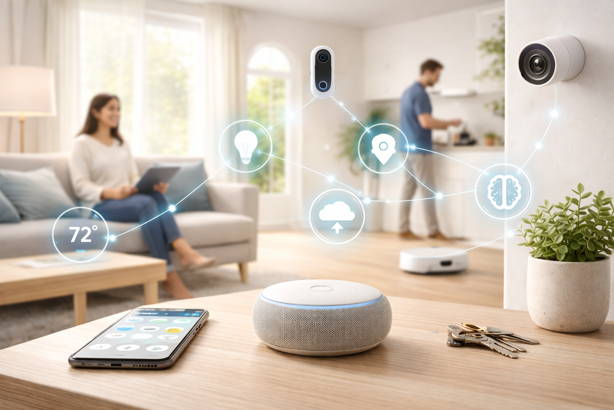
Your thermostat learns when you wake up. Your smartwatch notices subtle changes in your heart rate. The security camera at the front door can tell the difference between your regular delivery driver and an unfamiliar face lingering outside.
These aren’t just connected gadgets anymore. They’re part of something bigger – the Artificial Intelligence of Things, or AIoT. And it’s already reshaping how we live at home, how industries operate, and how the devices around us make decisions. Not in some distant future sense. Right now, in your thermostat, your fitness tracker, your IoT connected security camera.
The difference between regular smart devices and AIoT comes down to one thing – whether a device only reports data, or can also interpret it and act on it. A standard IoT device collects data and reports it. An AIoT device collects data, analyzes it using machine learning models, and can trigger automated actions – without requiring constant human input. Your Nest thermostat can do more than just respond to a schedule you set. It can proactively learn your routines, factor in occupancy and weather forecasts, and adjust your home before you’ve even thought about it. That’s AIoT.
Understanding AIoT Basics
To understand AIoT properly, it helps to understand what each half brings to the table on its own.
AI refers to systems that can learn, reason and make decisions in ways that approximate human intelligence – from recognizing a face to predicting when a piece of machinery is about to fail. IoT describes the network of physical devices connected via the Internet, continuously collecting and sharing data from the world around them. Thermostats, sensors, cameras, wearables and industrial equipment – anything with connectivity and the ability to send data qualifies.
On their own, each technology has real limitations. IoT devices generate enormous volumes of data but typically rely on external systems or predefined rules to interpret it meaningfully. AI is powerful at analysis but needs a continuous feed of real world information to act on. AIoT closes that loop. The data collected by connected devices becomes the raw material for AI decision making, and the resulting actions feed back into the physical world in real-time.
How AIoT Works
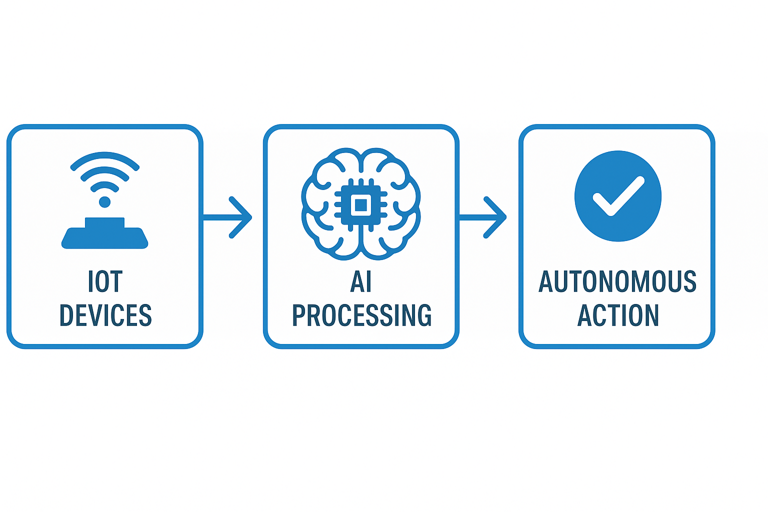
The process follows a fairly consistent path. Sensors embedded in connected devices collect real world data, such as temperature, motion, sound, and biometric signals like heart rate or blood oxygen. That data is transmitted to a processing system, either a cloud platform or a local edge computing device. AI algorithms then analyze the incoming stream, identifying patterns, making predictions and triggering automated responses. The more relevant data the underlying models are trained on, the more accurate those responses can become over time.
The result is a system that genuinely improves with use. Don’t worry – we’re talking about helpful thermostats, not Skynet.
Why AIoT Represents a Genuine Shift
Traditional IoT devices are essentially data collectors. They measure and report, but humans must interpret the information and decide what to do next. AIoT changes that dynamic by pairing IoT’s continuous data flow with AI’s ability to act on it autonomously.
Consider two security cameras. A standard IoT camera records footage for later review. In this scenario, you react after something has already happened. An AIoT security system identifies suspicious activity in real-time, alerts you instantly and can trigger door locks automatically. One is reactive. The other is proactive. That gap in capability is what makes AIoT a meaningful step forward rather than just a marketing rebrand of existing smart home tech.
The Main Components of AIoT Architecture
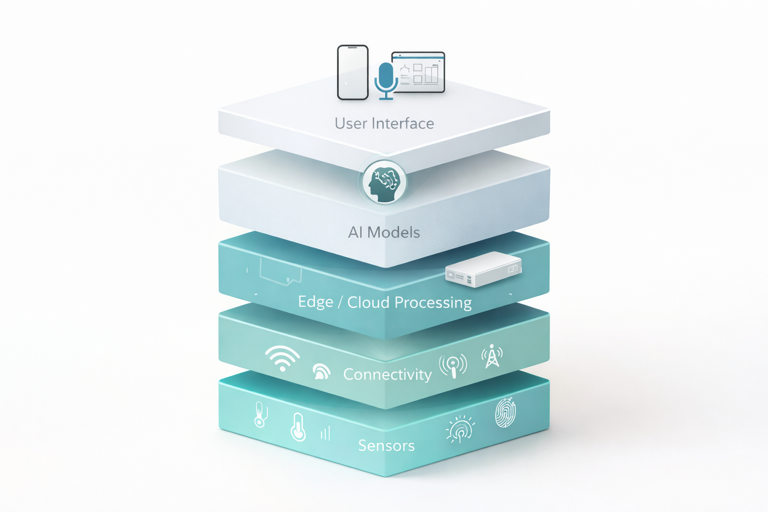
An AIoT ecosystem is built from several interconnected components, each serving a specific function. Understanding how they fit together helps clarify why AIoT systems behave differently from the smart devices most people are already familiar with.
Sensors: The Eyes and Ears
Sensors are the data collection layer of any AIoT deployment. They capture real world information. A sophisticated AIoT setup usually employs several sensor types at once, building a more complete picture of the environment than any single sensor could provide.
Common types include temperature sensors that track climate conditions continuously, proximity and motion sensors that detect presence and movement, biometric sensors that read fingerprints or vital signs, and environmental sensors that measure air quality, humidity or light levels.
Connectivity: The Nervous System
Even the most capable sensors are useless if they can’t transmit data reliably. AIoT systems rely on a range of connectivity options suited to different requirements. Bluetooth handles short range, low power connections. Wi-Fi covers high bandwidth local networks. 5G enables fast wide-area connectivity. And specialized protocols like LoRaWAN or NB-IoT support long range, battery powered devices in remote or low power scenarios.
The right choice depends on certain factors, including how far data needs to travel, how much battery life matters, how much data needs transmitting, and how quickly responses are required.
Data Processing: Cloud vs. Edge
Once collected, data needs to be processed. Where that happens matters more than you might expect.
Large scale AIoT implementations have traditionally relied on cloud computing, where remote servers handle the heavy analytical work. But there’s a strong and growing shift toward edge computing, where data is processed close to its source rather than sent to distant servers. For time sensitive applications, this distinction is critical. When a self-driving car needs to brake in a fraction of a second, there’s no time to send data to a cloud server and wait for a response. Processing has to happen locally, at the edge.
Most modern AIoT systems use a hybrid approach, where urgent decisions get handled at the edge, while richer data gets sent to the cloud for deeper analysis and long term learning.
AI Algorithms: The Brain
This is where the real intelligence lives. Sophisticated AI algorithms analyze data streams, recognize patterns, make predictions and trigger actions. And critically, the more relevant data these models are trained on, the more accurate and useful their predictions can become over time.
A well trained AI model can distinguish between a person, a pet and a car entering a driveway, triggering different responses for each – a doorbell notification for a visitor, ignoring familiar pets, and an alert if an unfamiliar vehicle lingers. That kind of contextual decision making isn’t possible with standard rule based smart home automation.
User Interface: The Control Layer
For all this intelligence to be useful, people need accessible ways to interact with it. Modern AIoT interfaces range from smartphone apps and web dashboards to voice commands and augmented reality displays. The best ones feel intuitive. They surface the right information at the right time, without overwhelming you with complexity or raw data.
AIoT Applications: From Your Home to Entire Industries
The real power of AIoT becomes clear when you see it in context.
Smart Homes and Connected Buildings
Your alarm goes off and before you’re fully awake, the coffee maker has already started brewing. The thermostat has adjusted to your morning preference. Your car is warming up in the garage because the system knows you leave at 7:15 AM. You haven’t pressed a single button, yet everything’s ready exactly when you need it.
That’s the practical reality of AIoT in the home. Smart thermostats like Nest and Ecobee are probably the most familiar examples. They learn your temperature preferences and daily routines, adjusting settings automatically to balance comfort and energy cost.
What makes the current generation of AIoT home devices meaningfully different from earlier smart home tech is interoperability. The Matter standard and device protocols like Zigbee make it far easier for devices from different manufacturers to communicate reliably (a prerequisite for genuine whole-home intelligence). A thermostat that can’t talk to your occupancy sensors, or a security camera that operates in isolation from your lighting system, can’t deliver the kind of coordinated, autonomous decision making that AIoT promises. Interoperability is what transforms a collection of individual smart devices into an actual AIoT ecosystem.
Smart bird feeders extend the same AIoT logic into the backyard. Devices like Bird Buddy and Birdfy use motion triggered cameras paired with on-device and cloud AI to identify visiting species in real-time – a compact example of the sense-analyze-respond loop that defines AIoT. My Bird Buddy vs Birdfy comparison covers how the two leading models approach that challenge in their different ways.
In commercial buildings, AIoT extends further still. Predictive maintenance systems detect equipment issues before failures occur, saving money and preventing costly disruptions.
Healthcare
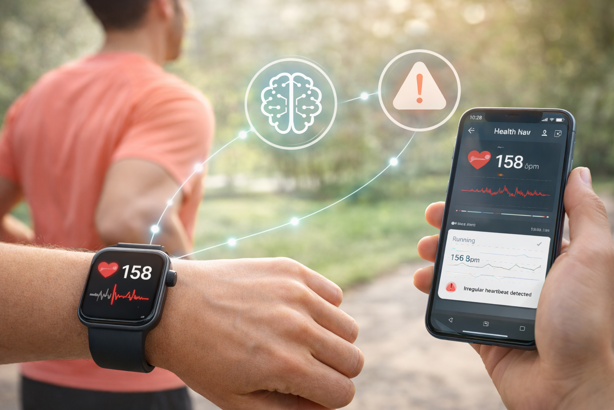
Healthcare is one of AIoT’s most consequential application areas. Wearable devices now track far more than steps. Trackable metrics include heart rate, blood oxygen, sleep quality, stress levels, and increasingly early indicators of conditions like atrial fibrillation or sleep apnea. AI algorithms analyze this continuous stream of health data, detecting patterns and flagging concerns for both patients and providers before they become serious.
In hospital settings, AIoT enables remote patient monitoring at scale, allowing medical staff to oversee multiple patients simultaneously. Smart medication dispensers ensure adherence. Predictive models help doctors anticipate complications before they escalate. The potential to catch health problems earlier – and manage chronic conditions more effectively – is significant.
Industrial Manufacturing
Factories equipped with AIoT systems operate with a level of efficiency that wasn’t achievable even a decade ago. Sensors monitor equipment health continuously, predicting maintenance needs before breakdowns occur, which in a production environment can mean the difference between a scheduled service visit and an unplanned shutdown. AI-powered quality control systems inspect products at speeds no human workforce could match, identifying defects with high accuracy.
Collaborative robots (cobots) work alongside human workers, with AIoT systems running real-time safety checks and coordinating handoffs smoothly. Smart factories can also adjust production schedules dynamically based on demand forecasts, equipment availability and live supply chain data.
Transportation, Agriculture and Retail
Beyond the home and factory floor, AIoT is reshaping several other sectors worth knowing about. In transportation, fleet management systems track locations, monitor driver behavior, predict maintenance needs and optimize routes in real-time. Autonomous vehicles represent AIoT at its most complex, processing vast volumes of sensor data every second to navigate safely.
In agriculture, soil sensors monitor moisture, nutrients and pH. Weather data feeds into AI models that optimize irrigation automatically. Drones with multispectral cameras identify crop health issues invisible to the human eye.
In retail, Amazon’s Just Walk Out technology (originally developed for its now closed Amazon Go stores) is a strong example of AIoT at its most consumer-visible. Sensors and computer vision track what customers pick up and charge their accounts automatically when they leave. While Amazon’s own cashierless stores have now closed, the technology itself continues to expand into third-party locations, including stadiums, airports and hospitals, where it demonstrates how AIoT can remove friction from everyday transactions entirely.
Security, Privacy and the Challenges Worth Understanding
AIoT’s potential is real, but so are the considerations that come with deploying systems that collect continuous streams of personal data such as voice patterns, health metrics, location and behavioral habits. Without proper safeguards, that data represents a considerable privacy exposure. Organizations implementing AIoT need to prioritize encryption, adopt zero-trust security frameworks, and maintain compliance with regulations like GDPR and CCPA. The interconnected nature of AIoT systems also means a vulnerability in one device can create exposure across an entire network, making strong cybersecurity practices especially important.
Implementation at scale also requires meaningful upfront investment in sensors, networking infrastructure and processing platforms. There’s a skills gap too. Organizations need people across data science, IoT engineering and cybersecurity to deploy these systems responsibly. As AIoT devices make increasingly autonomous decisions, questions around accountability become more pressing, particularly in regulated sectors like healthcare and finance.
That said, none of this is a reason to be pessimistic. Technology costs are falling, best practices are constantly improving, and consumer AIoT devices are becoming easier to set up and manage than ever. But there are legitimate considerations for anyone thinking seriously about AIoT adoption, at home or at scale.
Where AIoT Is Headed
A few trends are worth watching as AIoT continues to evolve. Edge AI is probably the most notable near-term shift. Processing intelligence closer to the device rather than relying on cloud round trips reduces latency, improves privacy and makes AIoT systems more resilient. As chips become more capable and more affordable, expect this to become the norm rather than the exception.
On the connectivity side, while 5G is still expanding across much of the country, 6G research and standards work are already underway, with the long term aim of enabling ultra-low latency wireless communication and much higher device density in the years ahead. The AIoT applications that infrastructure will eventually support are hard to fully imagine today.
Perhaps the most interesting long term direction is hyper-personalization. Future AIoT systems will adapt healthcare treatment plans to your real-time biometrics, tailor educational experiences to how your attention patterns shift throughout the day, or adjust a vehicle’s behavior based on your current stress level rather than just your driving history.
The Age of Intelligent Things
We’ve moved into an era where everyday objects can sense, learn and respond intelligently. AIoT is already quietly shaping homes, workplaces and cities – not in a speculative future sense, but in the devices a lot of us are already using.
Intelligence is moving into the world around us. Not replacing people, but extending what’s possible in how we already live and work. The privacy and security considerations are real and worth taking seriously. But approached thoughtfully, the benefits are substantial, and they’re only going to become more tangible as the technology matures.
Your future self will probably thank you for paying attention now. And who knows – your smart home might already be one step ahead of you.