
Shopping for a smart toilet or bidet seat means wading through spec sheets filled with terminology that isn’t always explained. What does oscillating spray actually do? Is a self-cleaning nozzle the same as a self-cleaning bowl? Does every powered seat include a deodorizer?
This guide explains the major features found on powered bidet seats and integrated smart toilets, so you can read a product listing with confidence instead of confusion.
Non-electric bidet attachments, which use household water pressure and require no outlet, are a simpler, cheaper alternative outside the scope of this guide. Most provide an unheated wash, although some warm water models also connect to a nearby sink’s hot water line.
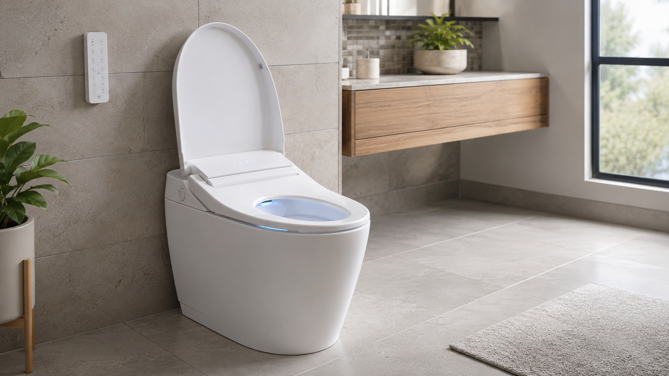
Smart Toilet Features at a Glance
| Feature | Powered Bidet Seat | Integrated Smart Toilet |
|---|---|---|
| Posterior wash | Nearly universal | Common |
| Feminine wash | Nearly universal | Common |
| Water temperature control | Nearly universal | Common |
| Water pressure control | Nearly universal | Common |
| Nozzle position adjustment | Nearly universal | Common |
| Oscillating spray | Most models | Common |
| Pulsating spray | Mid-range and above | Common |
| Self-cleaning nozzle | Nearly universal | Common |
| Heated seat | Nearly universal | Common |
| Warm air dryer | Most models | Common |
| Night light | Mid-range and above | Common |
| Deodorizer | Common on powered bidet seats | Common |
| Auto-flush | Some models (requires matched system) | Common |
| Auto open/close lid | Higher-end models | Common |
| Occupancy/approach sensor | Most models | Common |
| Eco mode | Most models | Common |
| User memory presets | Mid-range and above | Common |
| Remote control | Most models | Common (usually wall-docked) |
| Self-cleaning bowl | No | Select models only |
| Tankless flushing | No | Premium models |
| Bowl pre-mist | Select models only | Select models only |
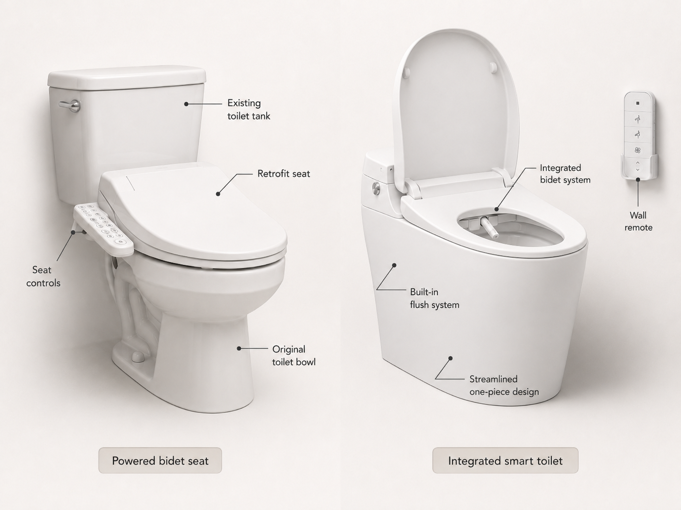
Core Washing Features
Posterior and Front Wash
Posterior and front wash modes are standard on powered bidet seats and common on integrated units. Front wash is often labeled “feminine wash” on product listings. “Rear”, “bidet” and “soft rear” are also used, but the overall function is the same – a retractable nozzle delivers a targeted water stream.
Most Brondell Swash seats use a single retractable nozzle that changes position and spray pattern between modes, while the Swash 1000 and 1400 use two separate nozzles – one for posterior, one for feminine wash. TOTO’s Washlet S7 uses a multifunction wand instead of separate nozzles. For hygiene, automatic rinsing, nozzle shielding and material quality count for more than whether the seat uses one nozzle or two.
Select TOTO Washlet models include a “soft rear” mode – a gentler posterior wash at lower pressure – for anyone who prefers a milder cleanse.
Water Temperature Control
Powered seats heat wash water electronically. Most models offer three to four temperature settings. The Brondell Swash 1400 lists low, medium and high at 90°F, 95°F and 100°F respectively, with an off setting that defaults to incoming water temperature. The TOTO Neorest NX2 spec sheet lists a wash water temperature range of 86°F-104°F.
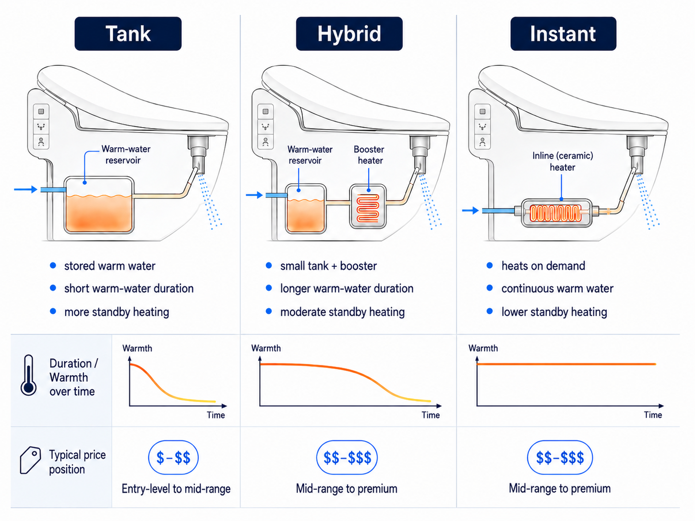
The heating system type affects the experience as much as the temperature range itself. Brondell identifies three heating system types across their Swash range. Tank reservoir models maintain warm water for around 20-40 seconds before cooling, hybrid systems extend that to around 60-90 seconds, and instant ceramic systems heat water on demand (in approximately 10 seconds on Brondell’s instant models), providing continuous warm water regardless of wash duration. Entry-level seats more commonly use tank systems, while hybrid and instant heating become more common as prices rise.
Water Pressure Control
Adjustable water pressure is nearly universal on powered bidet seats and common on integrated units, though the number of levels varies by model. The Brondell Swash 1400 offers three pressure levels. Pressure preference is highly individual, and a seat with very limited adjustment can feel uncomfortable for some users. The TOTO Washlet S7 lists a wash-water flow of approximately 0.08-0.11 gallons per minute. Total water use therefore depends on the length of the wash rather than being fixed per cycle.
Nozzle Position Adjustment
The nozzle moves forward and backward along a fixed track to accommodate different body types. The Brondell Swash 1400 offers seven positions per nozzle. TOTO’s Washlet models offer comparable adjustability.
Oscillating and Pulsating Spray
Oscillating spray is found on most powered seats. Pulsating spray is more common from mid-range models upward. These are two distinct modes layered on top of the standard wash.
Oscillating spray moves the nozzle back and forth during the wash cycle, cleaning a wider area than a fixed stream. Pulsating spray alternates water pressure rhythmically, increasing and decreasing in a massage-like pattern. Both are comfort and coverage additions rather than hygiene essentials.
Self-Cleaning Nozzle
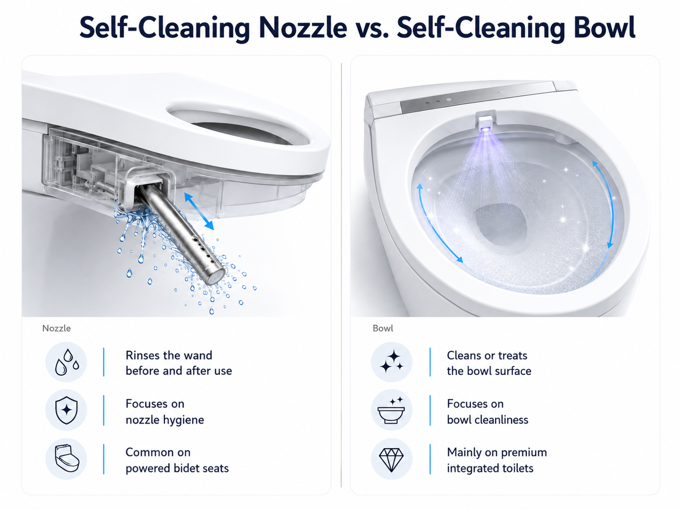
Nearly universal on powered bidet seats and common on integrated units. The nozzle retracts and rinses automatically before and after each use, with no user action required. Stainless steel nozzles, commonly found on mid-range and above models including the Brondell Swash 1400, are generally durable and easy to wipe clean, although automatic rinsing and regular maintenance are still important. TOTO’s eWater+ system goes further, using electrolyzed water to mist the wand before and after each use. This is covered in more detail below.
Comfort Features
Heated Seat
A heated seat is one of the defining features of most powered bidet seats and integrated units. The seat contains a low-wattage heating element that maintains a set temperature while active. Brondell’s Swash 1400 spec sheet lists maximum heated seat power consumption at 50W. The Swash 1400 lists low, medium and high settings at 89°F, 93°F and 97°F respectively. Maintaining the selected seat temperature contributes to standby consumption, so many models include eco modes that reduce heating during periods of non-use.
Warm Air Dryer
A low-volume fan directs warm air to dry after washing. The Brondell Swash 1400 offers three dryer temperature levels. Drying usually takes several minutes, and performance varies enough that some users still blot with a small amount of paper. Those who commit to using the dryer typically reduce toilet paper use substantially.
Night Light
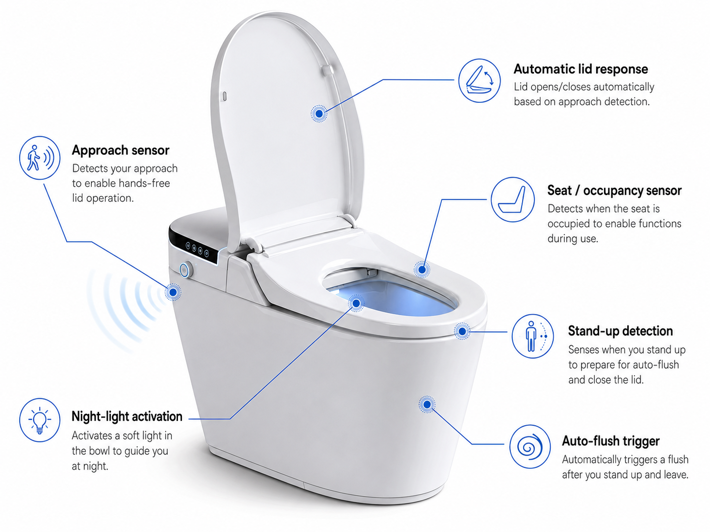
A low-output LED illuminates the bowl, seat or floor area for nighttime use. Some models remain enabled until switched off manually, while others activate as part of an approach-sensor sequence. Common on mid-range and higher-end powered seats and many integrated units.
Auto Open/Close Lid
A sensor detects approach and opens the lid automatically. After use, the lid closes after a set delay. Standard on most integrated smart toilets and available on some higher-end bidet seats. TOTO’s Washlet S7A includes it, but the base S7 does not.
User Memory Presets
Available on mid-range and above powered seats and standard on most integrated units. Stores each user’s preferred water temperature, pressure, nozzle position, seat temperature and spray width, so their configuration loads at the press of one button. The Brondell Swash 1400 supports two user profiles, while the TOTO Washlet S7 supports four. The difference is most noticeable in multi-person households. Without presets, every user adjusts settings manually on each visit.
Remote Control vs Side Panel
Lower-priced electric seats commonly use a fixed side panel built into the seat arm. It is always within reach, with no remote to locate. Premium seats more commonly include a wireless remote with more buttons and greater flexibility. The Brondell Swash 1400 includes a wireless remote with a magnetic docking station. TOTO’s Washlet S7 uses a remote control.
Integrated smart toilets typically include a wireless remote stored in a wall-mounted holder, keeping controls accessible without adding a side panel to the unit.
Hygiene and Odor Features
Deodorizer
Common on powered bidet seats and most integrated units. An internal fan draws air through an activated carbon filter, neutralizing odor, as opposed to just masking it. The Brondell Swash 1400 uses a replaceable carbon cartridge with a recommended replacement interval of six months. Activation varies by model. Some run automatically on occupancy, while others require a button press on the remote.
Bowl Pre-Mist
Found on select powered bidet seats and integrated units across multiple brands. Before each use, the water supply mists the bowl interior, creating a wet surface that aids waste elimination. TOTO calls their implementation PREMIST. Their documentation states it helps eliminate waste approximately 80% better than a dry bowl. The PREMIST name is exclusive to TOTO, though other brands offer comparable bowl pre-mist functions.
eWater+ and Electrolyzed Water Systems
Available on select TOTO Washlet seats and Neorest integrated units. EWATER+ uses electrolysis of chloride ions in ordinary tap water to produce electrolyzed water. Depending on the model, it automatically cleans the wand and may also mist the bowl and underside of the seat after use. TOTO notes that EWATER+ requires no added chemicals and returns to regular tap water over time.
The practical result is automatic wand and bowl cleaning that helps control buildup and reduce routine cleaning. It is a TOTO-specific technology. Brondell and other brands address nozzle hygiene through self-rinse cycles and stainless steel nozzle materials instead.
Self-Cleaning Bowl and UV Technology
Found on select integrated units, from mid-range to premium. TOTO’s ACTILIGHT technology (currently found on select premium Neorest models, most notably the NX2) combines a UV light built into the lid with a photocatalytic glaze on the bowl surface. When activated by the UV light, the glaze breaks down organic waste at a molecular level. The bowl also features TOTO’s CEFIONTECT ceramic glaze, a separate technology that creates an exceptionally smooth surface to help prevent waste and residue from sticking in the first place. ACTILIGHT reduces (though does not totally eliminate) the need for manual cleaning.
Auto-Flush
A sensor detects when the user stands and triggers a flush automatically. This is a standard feature on most integrated smart toilets. On retrofit bidet seats, auto-flush requires either a matched toilet and seat system (such as TOTO’s Washlet+ lineup, where the seat and toilet are designed to communicate), or an optional auto-flush kit. The TOTO Washlet S7 can support automatic flushing when paired with an optional kit and a compatible TOTO toilet. Auto-flush on a bidet seat is not a universal feature that works on any toilet. Integrated units have no such limitation since the flush system is built in.
Smart and Energy Features
Occupancy and Approach Sensors
Powered bidet seats may use different sensors for different functions. A seat sensor prevents the wash from activating when nobody is seated. On the Brondell Swash 1400, this uses skin conductivity detection. Models with automatic lids may use a separate approach or infrared (IR) sensor. Brondell’s Swash 1400 documentation separately identifies an IR sensor and a body/seat sensor. On integrated units, the control system combines presence, seat occupancy and timing information to determine when to open the lid and trigger an automatic flush.
Eco Mode
On Brondell’s Swash 1400, eco mode affects seat heating only, dropping it to the low temperature setting when the seat sensor and remote have been inactive for around ten minutes. On some models with tank or hybrid water heaters, eco mode may also lower the stored-water temperature during periods of non-use. The energy benefit of eco mode is greatest on models with tank-type heaters, where standby draw is highest.
Tankless Flushing
Found on integrated smart toilets only, tankless flushing is not available on retrofit bidet seats. Instead of storing water in a tank, tankless flushing connects directly to the supply line and delivers water via electronically controlled valves. The TOTO Neorest NX2 uses this in combination with its Tornado Flush system, achieving dual-flush performance at 1.0 GPF (gallons per flush) and 0.8 GPF. The practical benefits are a streamlined tank-free appearance and no conventional cistern refill delay. The trade-off is greater dependence on adequate supply pressure, something particularly worth checking in older homes. The Neorest NX2 spec sheet lists a minimum flowing pressure of 7.25 PSI.
Before You Take the Plunge
The best smart toilet features are the ones you will notice every day – reliable warm water, adjustable washing, a comfortable seat and controls that are easy to use. Extras such as automatic lids, bowl cleaning systems and app-like presets can improve the experience, but they should support the fundamentals rather than distract from them.
Choose the model that gets the essentials right for your bathroom, household and budget. A longer feature list may look smarter on paper, but the better toilet is the one that makes every visit simpler without leaving you to pay for functions you rarely use.
Not sure whether the upgrade makes sense? The smart toilet worth it guide covers costs, payback, and when to skip the upgrade. When you’re ready to compare specific models, the best smart toilets roundup evaluates the top powered seats and integrated units across all price points.