Smart plugs are safe when they carry genuine third-party safety certification and stay within their rated amperage and wattage limits. The risk worth worrying about has nothing to do with the “smart” part. It comes from cheap, uncertified hardware that skips the safety testing certified products go through, and from people plugging high-draw appliances into plugs that were never designed to handle that load.
Read on to learn what certification verifies, where the fire risk actually comes from, and what amperage and wattage limits mean for your appliances. You will also find out why standby power draw is a different conversation entirely from electrical safety.
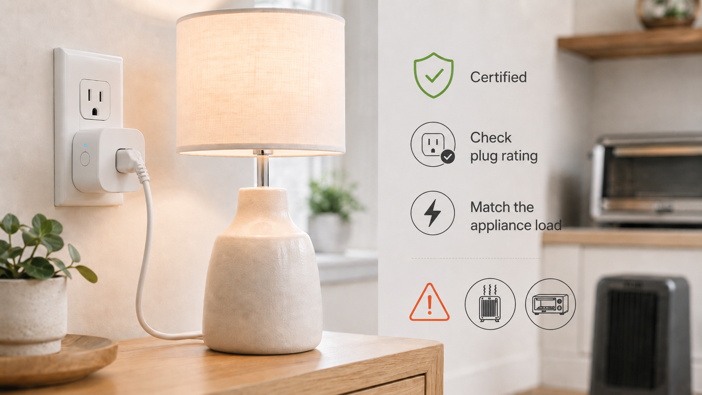
What “Smart Plug Safety” Really Means
Two separate questions get tangled together under this search. One is electrical safety – can the hardware catch fire, shock you, or damage your wiring? The other is digital security – can someone hack the Wi-Fi connection or firmware? This guide covers the electrical side, since that’s the literal meaning of the question. It’s also the side with hard data behind it, including certification standards, amperage ratings, and a public recall record. For the hacking and weak password side, the guide to securing connected devices explains fundamentals that apply to a smart plug exactly as much as a camera or a lock.
UL, ETL and Intertek: What Certification Verifies
The advice for smart plug safety almost always comes down to “make sure it’s certified”. That’s correct, but worth unpacking. The marketplace is full of products with fake or copied certification marks.
A genuine certification means an accredited, independent lab evaluated the product against a defined electrical safety standard. That lab also keeps auditing the manufacturer’s factory to confirm production units match what it originally tested. In the US, this kind of lab is a Nationally Recognized Testing Laboratory, or NRTL. UL Solutions is the most familiar by reputation, but Intertek, which issues the ETL Listed mark, holds equivalent regulatory standing. Neither mark is a lesser version of the other.
The standard a plug is tested against depends on its internal design. A basic relay-switch plug and one with built-in energy monitoring may fall under different UL or ETL standard numbers. For a buyer, the practical takeaway is simpler than memorizing standard numbers. Look for a recognized NRTL mark from a company like UL or Intertek, rather than trying to verify which exact standard applies.
| Mark | Certifying Body | What It Confirms |
|---|---|---|
| UL Listed | UL Solutions | Independently tested against the applicable UL safety standard, with ongoing factory audits |
| ETL Listed | Intertek | Equivalent NRTL certification to UL, with the same US regulatory recognition |
| FCC ID | Federal Communications Commission | Confirms radio and wireless emissions compliance (not an electrical safety certification) |
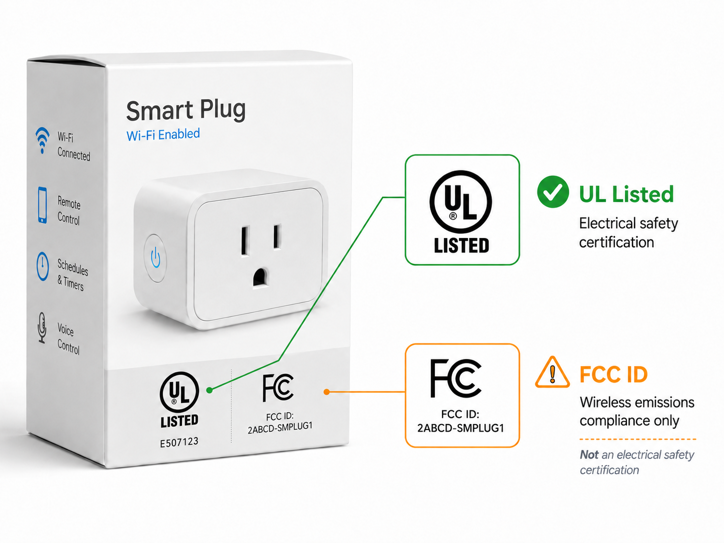
Why the FCC ID Isn’t the Mark You’re Looking For
Plenty of online discussion treats an FCC ID as proof of safety, but it isn’t. An FCC ID confirms a device’s wireless radio meets emissions rules. It says nothing about whether testers checked the wiring, contacts or housing for fire or shock risk. A smart plug can carry a valid FCC ID and no electrical safety certification at all. The mark that answers the safety question is UL Listed or ETL Listed.
Amperage and Wattage Limits: Where Risk Shows Up
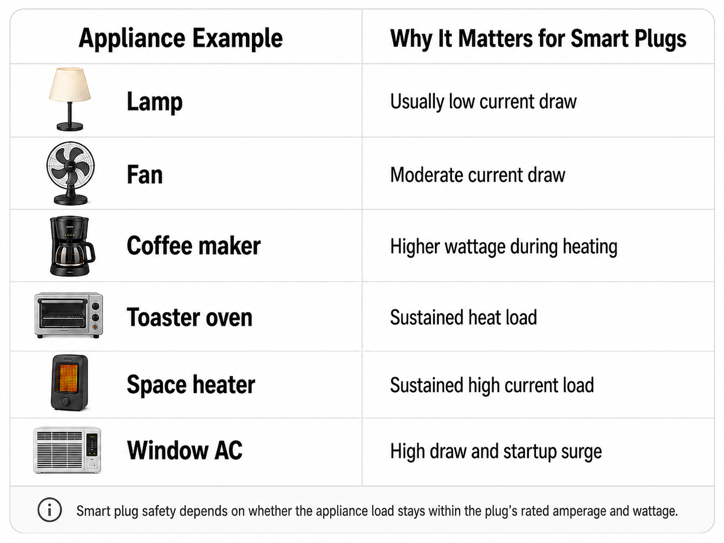
Most smart plugs sold for US households carry a maximum rating of 15 amps, matching the most common general-purpose outlet rating in living rooms and bedrooms. On a nominal 120 volt circuit, 15 amps works out to roughly 1800 watts. Most manufacturers rate at or below that ceiling to leave a safety margin. Kitchens, bathrooms and laundry areas are a partial exception. The National Electrical Code requires the specific outlets meant for countertop and appliance use in those areas to run on dedicated 20 amp circuits, since they’re expected to handle higher-draw devices. A 15 amp smart plug will still physically fit a 20 amp outlet, but its own rating doesn’t change with the circuit behind it. It’s still limited to 15 amps either way.
That number is important because exceeding a plug’s rated current on a sustained basis is what drives heat-related failure in the first place. Every electrical contact has some resistance, and resistance generates heat in proportion to the current passing through it. Manufacturers build a plug rated for 15 amps with contacts and housing material sized for the heat that current level generates. Push significantly more current through those same contacts for hours at a time, and the heat will exceed what the design accounted for. That’s why a high-draw device running continuously is a meaningfully different situation than the same plug switching a lamp on and off.
Space heaters, window air conditioners and high wattage kitchen appliances like toaster ovens routinely come up as a poor match for standard smart plugs, regardless of brand or certification. It isn’t a smart plug-specific quirk. It’s the same electrical math that applies to any device on a standard 15 amp outlet. The “smart” part doesn’t add headroom a regular outlet wouldn’t have.
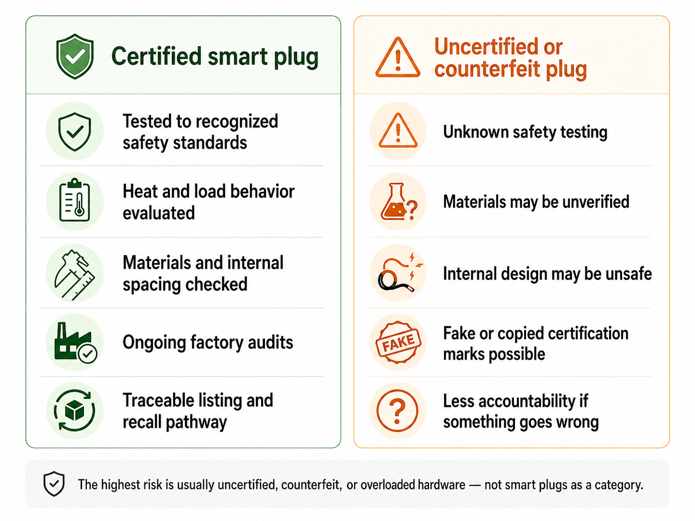
The Real Fire Risk Profile: Certified vs. Uncertified
This is the section most existing content skips, and the one where precision matters most.
The clearest documented example for certified, established-brand smart plugs is Emporia’s 2023 recall of roughly 80,000 North American smart plugs. The CPSC found units weren’t properly grounded, creating a shock and fire risk. The company had received two consumer reports, with no injuries. The recall covered units sold between July 2022 and May 2023 for $12 to $35. This was a manufacturing defect in a certified product from an established brand. Consumer reporting and CPSC oversight caught it before it caused documented injury – not a smart plug catching fire, and not evidence that smart plugs are inherently dangerous as a category. Two reports and no injuries suggest the recall system caught the defect before it became a documented pattern of harm.
A search of CPSC’s public recall records doesn’t surface a large, recurring pattern of smart plug fire recalls. That’s nothing like the dozens of recalls and hundreds of reported incidents tied to lithium-ion battery packs or space heaters in recent years. Still, it’s worth reading that absence carefully instead of treating it as proof of anything absolute. CPSC’s search isn’t exhaustive, and product naming conventions vary. A thin search result supports “no large documented pattern” as opposed to “zero risk”. The clearest example remains the Emporia recall above, centered on a grounding and shock defect rather than a documented pattern of fires during normal use.
The Uncertified and Counterfeit Problem
Uncertified and counterfeit smart plugs are where the risk profile changes. Sellers most often move these through third-party marketplace listings, sometimes carrying counterfeit UL or ETL marks the certifying body never verified. Skipping certification testing means skipping the checks designed to catch problems before they reach a customer. Those checks cover housing materials that resist combustion, adequate spacing between conductive parts to prevent arcing, how the device handles heat buildup under load, and whether a fault escalates. A plug that skips that testing isn’t guaranteed to fail. But if it does, it’s missing the safeguards designed to contain that failure. That’s the genuine, documented gap between certified and uncertified hardware.
Standby Power Draw Is a Different Issue Entirely
A lot of smart plug content, including some of my own buyer’s guides, talks about standby power draw or “phantom load”. That’s the small amount of electricity a plug uses to stay connected to Wi-Fi and listen for the next command. It draws that power even when switched off. That’s a legitimate phenomenon, and a smart plug with energy monitoring is a very useful way to discover how much standby power a game console or older appliance is quietly using.
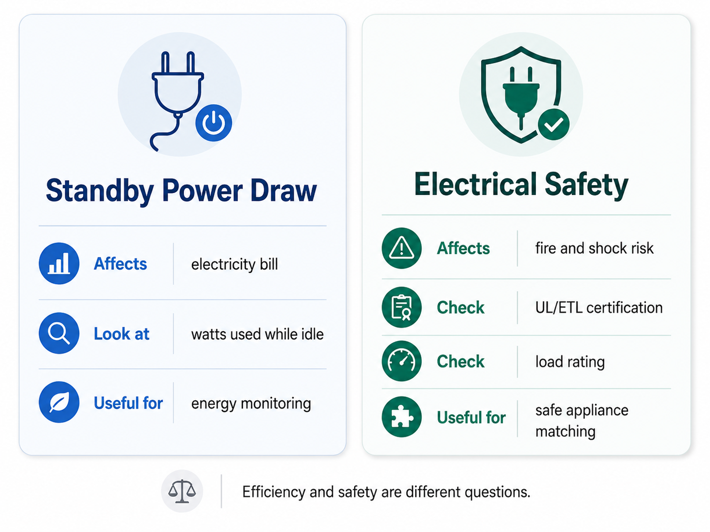
It’s also a completely separate question from electrical safety. Standby draw affects your electricity bill, not your fire risk. A plug with higher standby draw than another model isn’t a “less safe” plug, it’s a slightly less efficient one. ENERGY STAR ratings and “kills phantom power” marketing describe efficiency, not safety, although the phrasing sometimes blurs the two. If you’re asking whether a plug is a fire risk, standby wattage isn’t the place to look. If you’re asking whether it’s wasting electricity, it’s exactly the right place. Keeping those two questions separate clears up most of the confusion around this topic.
How to Verify a Certification Mark Is Genuine
Because counterfeit certification marks on marketplace listings are a documented problem, a UL or ETL logo on a product page isn’t proof by itself. Both UL and Intertek maintain searchable public databases for verifying a certification by its file number. UL’s Product iQ database allows lookup by company, product category, or certification number. Intertek maintains an equivalent directory for ETL-certified products. For confirmation that both companies are recognized testing labs in the first place, OSHA’s current NRTL list includes both UL and Intertek alongside about twenty other accredited labs. If a certification number appears on the packaging, checking it takes a couple of minutes and removes any doubt.
This matters more for unfamiliar brands sold primarily through marketplace listings than for established manufacturers with a long public track record, where counterfeit certification rarely happens in the first place.
The Short Version
A smart plug should be treated as a control device, not a power upgrade. Its real value is convenience – turning lamps on from your phone, scheduling small appliances, tracking standby draw, and making everyday devices easier to manage. The safety decision still comes down to the same fundamentals as any plug-in electrical product – certified hardware, a suitable load, and a little common sense about what belongs on a small outlet adapter.
If you’re deciding which smart plug to buy, this guide to Matter smart plugs with energy monitoring covers specific certified options. And for what’s happening inside the device beyond the certification label, how a smart plug works breaks down the mechanics in plain terms.