
You’re shopping for a smart ceiling fan and keep seeing “Matter-certified” next to some models. The marketing says it works with everything – Apple Home, Google, Alexa – all from one fan. But some Matter fans still cost noticeably more than proprietary Wi-Fi models, while newer budget options are starting to close the gap. Does the universal compatibility actually deliver? Or are you paying extra for a protocol that doesn’t change how you use the fan? And if you already own smart fans, should you replace them?
This guide explains what Matter certification means for ceiling fans in particular, which models currently support it, and whether the cross-platform benefits justify the cost versus sticking with standard smart fans you can buy today.
What Matter Certification Means for Ceiling Fans
Matter is a universal smart home protocol developed by Apple, Google, Amazon, Samsung and hundreds of other companies to solve the compatibility nightmare that plagued earlier smart home devices. Before Matter, buying a Zigbee ceiling fan meant it only worked with certain hubs. A Wi-Fi fan locked you into the manufacturer’s app and their chosen voice assistant partnerships.
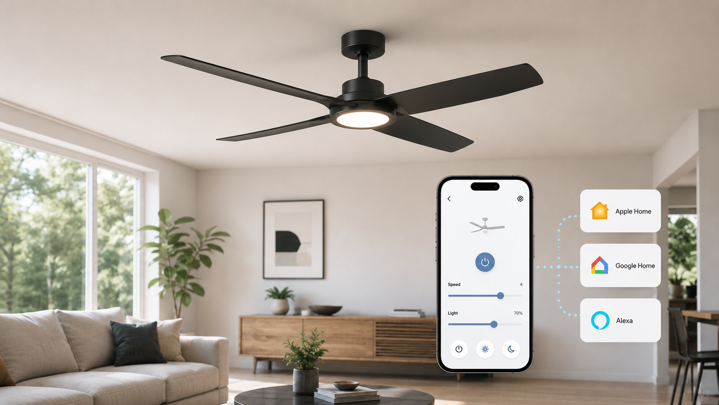
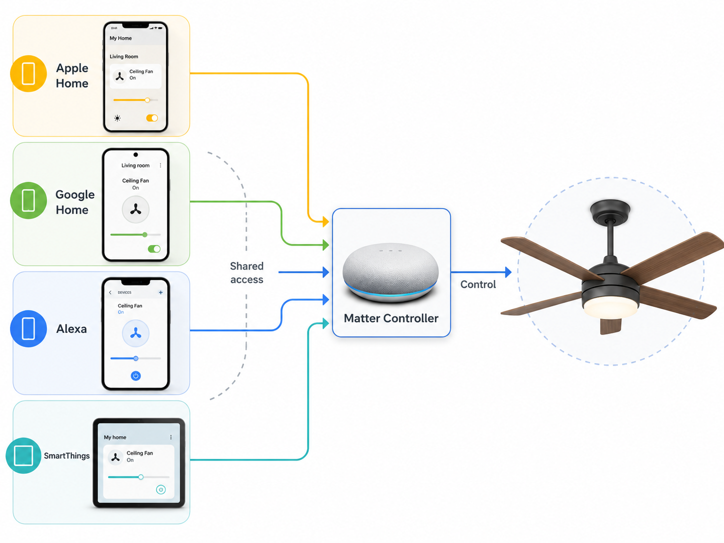
Matter-certified ceiling fans speak a common language that the major smart home platforms are designed to understand. One Matter fan works with Apple Home on your iPhone, Google Home on your Android tablet and Alexa on your Echo – all at the same time, with no juggling between apps or setting up separate integrations for each platform.
In the case of ceiling fans, Matter certification means the fan includes a communication module that supports the Matter protocol over Wi-Fi, Thread or Ethernet. Most ceiling fans arriving in 2026 use Matter over Wi-Fi, connecting to your 2.4GHz network like any Wi-Fi smart device but with standardized control interfaces that work across platforms.
The Matter setup process shows the practical difference immediately. With a proprietary Wi-Fi fan, you download the manufacturer’s app, create an account, add the fan, then separately integrate it with Alexa or Google, if supported. With a Matter fan, you scan a QR code during setup, choose which controller to add it to (Apple Home, Google Home, Alexa, SmartThings), and it’s immediately available in that ecosystem with core fan and light controls. Some brand-specific features may still require the manufacturer’s app.
Matter’s multi-admin capability means you can add the same fan to multiple platforms simultaneously. If one person in your household uses Apple Home on their iPhone and another person uses Google Assistant on a smart display, both control the same fan through their preferred interface without conflicts.
Local Control: The Practical Benefit You’ll Actually Notice
Most proprietary smart ceiling fans route commands through cloud servers. You tap “turn on fan” in the app, the command goes to your router, travels across the Internet to the manufacturer’s servers, then bounces back through the Internet to your fan. When your Internet connection drops or the manufacturer’s servers go down for maintenance, your smart fan becomes frustratingly dumb.
Matter ceiling fans support local control by design. Commands stay on your home network. Your phone talks directly to your Matter controller (Apple TV, Google Nest Hub, Echo with Matter support), which talks directly to your fan. As a result, response times are generally faster, and basic controls may keep working when your Internet goes out.
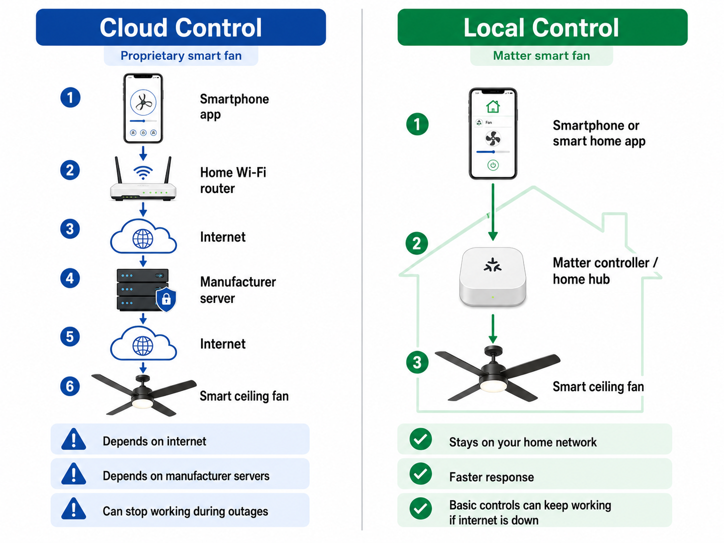
This matters in real everyday use, not just on paper. If you live in an area with occasional Internet outages, or you’ve experienced frustration when a smart device stops responding because a server somewhere is having issues, local control delivers tangible reliability improvements.
There is a catch, though. Not all Matter features work locally. Basic operations like turning the fan on or off, adjusting speed and controlling the integrated light usually work locally. Advanced automations that depend on cloud services (like triggering your fan based on weather forecasts or outdoor air quality data from Internet services) still require Internet connectivity since that data doesn’t exist on your local network.
Current Matter Ceiling Fan Options
Fan support was added to Matter with Matter 1.2 in late 2023, but certified ceiling fan products took longer to appear in the market than lights, plugs, switches and sensors. Ceiling fans required additional development to properly handle combined fan and light control, speed adjustment and directional control.
As of spring 2026, several paths exist to get Matter ceiling fan control.
Budget Friendly and Mid-Range Options
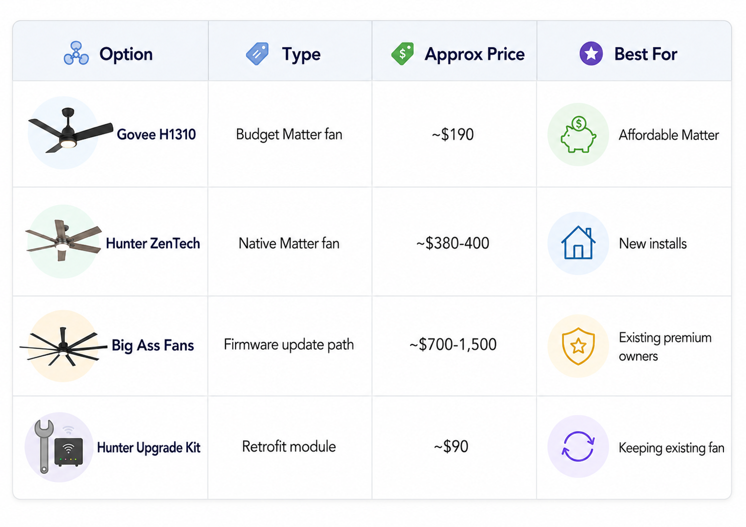
Govee 52 Inch Ceiling Fan with Lights (H1310): Govee entered the Matter ceiling fan market with a budget friendly option in April 2026. The H1310 model delivers 5,000 CFM airflow with six speed settings, reversible DC motor operation and dual-zone LED lighting with adjustable color temperature. At $189.99 on Amazon at the time of writing, it is one of the lowest priced Matter-certified ceiling fans currently available in the US, making Matter accessibility less dependent on premium pricing.
Hunter ZenTech series: Hunter debuted the ZenTech ceiling fan line at CES 2026 with native Matter support from day one. ZenTech fans use a DC motor that Hunter claims is 43% slimmer than previous designs, enabling lower profile installation for rooms with limited ceiling height. Available styles include traditional bladed fans and bladeless models. Pricing sits at $380-400 for most models. ZenTech fans ship with Energy Star certification and integrated LED lighting with adjustable color temperature.
Premium and Retrofit Options
Big Ass Fans with firmware update: Big Ass Fans rolled out Matter support across their entire residential lineup through firmware updates starting in late 2024 and continuing through 2025. Models including Haiku, Haiku L, Haiku Coastal, i6, es6, Turbo6 and Speakeasy now support Matter over Wi-Fi. These fans generally cost around $700-1,500 depending on size and features, positioning them in the premium category. Existing Big Ass Fans owners with supported models received Matter capability through a free firmware update rather than needing to replace working fans.
Hunter Smart Fan Upgrade Kit: For people who want Matter control without replacing existing ceiling fans, Hunter offers a retrofit module that installs inside most AC ceiling fans (Hunter or other brands) to add Matter capability. You swap the fan’s internal receiver module, reuse existing wiring and pair the upgraded fan into Matter ecosystems. At $89.99, this approach costs considerably less than buying a new fan and generates less waste, though availability remains limited as the product is newly released.
Matter vs Proprietary Smart Fans: The Real Differences
Functionally, both Matter and proprietary smart ceiling fans turn on, adjust speed, control lighting and integrate with voice assistants. The differences show up in how they accomplish those tasks and what happens at the edges of typical use.
Platform Flexibility and Setup
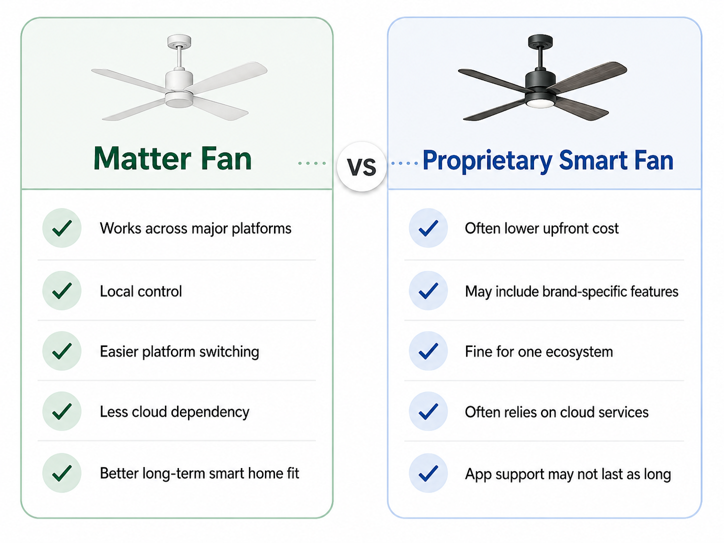
Platform flexibility: Proprietary fans lock you into a particular ecosystem. A fan that works beautifully with Alexa might have no Google Home support. Or it might require a separate integration that provides limited functionality. Fans using Matter are designed to work across the major platforms through a shared standard. Exact controls exposed can still vary by fan model and ecosystem. Switching from Android to iPhone and moving from Google Home to Apple Home? A Matter fan should be easier to bring across than a proprietary device, especially when it supports Matter multi-admin.
Setup complexity: Proprietary fans generally require downloading a manufacturer app, creating an account, and adding the device to that app. Then you separately integrate with your smart home platform if supported. With Matter, you use a standardized onboarding process – scan a QR code or enter a setup code, choose your controller and you’re done. The difference is modest for one fan but compounds when you’re building out a smart home with devices from different manufacturers.
Long Term Support and Performance
Long term support: When a company discontinues support for a proprietary smart fan, the smart features often stop working even though the fan motor itself remains functional. When a manufacturer shuts down cloud servers or stops maintaining apps, you’re left with a ceiling fan that’s lost its smart capabilities. Devices using Matter communicate through standardized protocols that aren’t dependent on any single company’s servers continuing to run. This offers better long term reliability.
Response time: Matter’s local control architecture generally delivers faster response than cloud-dependent proprietary fans, though the difference is usually measured in fractions of a second. You’re unlikely to notice during normal operation, but the cumulative effect of slightly snappier controls creates a more responsive feel.
Feature availability: Some proprietary fan apps offer manufacturer-specific features that aren’t available through Matter yet. Advanced scheduling tied to certain weather conditions, proprietary breeze simulation modes, or detailed energy monitoring might only work through the manufacturer’s app. Matter provides core control functionality, but manufacturers may still offer additional features through their own apps for users who want them.
Matter Over Wi-Fi vs Thread: Does It Make a Difference for Ceiling Fans?
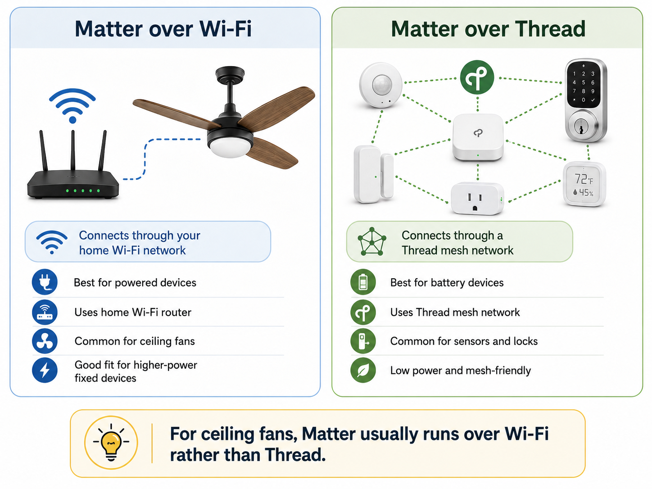
The Matter protocol supports multiple underlying network technologies – Wi-Fi, Thread and Ethernet. Current consumer Matter ceiling fan options appear to use Matter over Wi-Fi rather than Thread, and for ceiling fans, this choice makes practical sense.
Thread is a low power mesh networking protocol that’s ideal for battery powered devices like sensors and locks. Each device can act as a router, extending the network range and creating redundant paths for communication. These devices use minimal power, making them perfect for door sensors that need to run on batteries for years.
Ceiling fans are line powered devices hardwired to your home’s electrical system. They don’t need Thread’s power efficiency benefits because they have constant power. They’re also fixed in place. Your ceiling fan isn’t moving around the house, so the mesh networking benefits of Thread provide less value than they would for portable or battery powered devices.
Wi-Fi offers higher bandwidth than Thread, which doesn’t matter much for basic fan control (turning on/off and speed adjustment use minimal data) but becomes relevant if manufacturers add features like firmware updates over the air, or integration with cameras or sensors built into premium fan models.
The practical takeaway is that Matter over Wi-Fi works fine for ceiling fans. If you’ve carefully built a Thread mesh network throughout your home with battery powered sensors and smart locks, your Matter ceiling fans won’t join that mesh. They’ll sit on your Wi-Fi network instead.
When Matter Ceiling Fans Make Sense
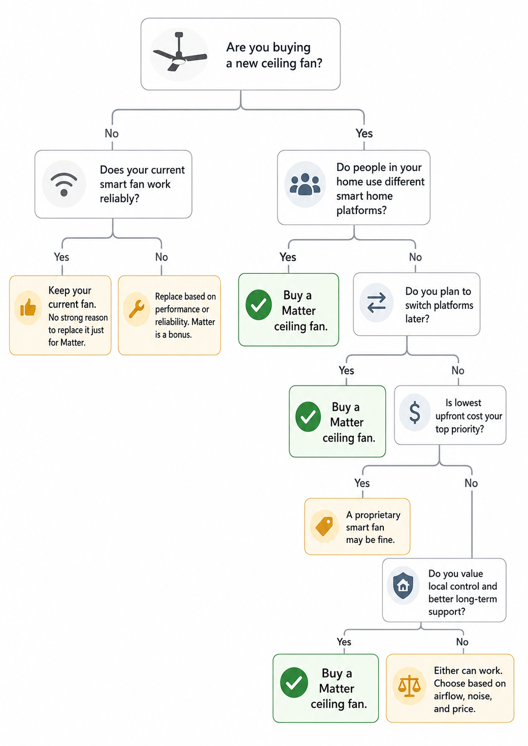
Multi-platform households: If different people in your home use different smart home ecosystems, Matter handles this smoothly. One person controls fans through Apple Home on their iPhone, another uses Google Assistant on a smart display, and both work without conflict or complex integrations.
Platform switching plans: If you’re currently using Google Home but considering switching to Apple Home in the future, or vice versa, Matter fans continue working seamlessly after the switch. Proprietary fans might lose functionality or require replacement.
Reliability priority: If you’ve experienced frustration with cloud-dependent smart devices going offline during Internet outages or server maintenance, Matter’s local control architecture delivers more consistent operation.
Long term ownership: If you plan to keep ceiling fans for 10-15 years, Matter’s manufacturer-independent operation provides better insurance against discontinued app support compared to proprietary systems.
Simplified smart home: Building out smart home infrastructure means managing multiple devices. Matter lets you control everything through one unified interface instead of juggling separate manufacturer apps for different device categories.
When Proprietary Smart Fans Still Work Fine
Single ecosystem commitment: If you’re fully committed to one smart home platform (all Apple, all Google, or all Alexa) and have no intention of switching, proprietary fans that work well with your chosen ecosystem deliver essentially the same daily experience as Matter fans.
Budget constraints: Matter ceiling fans span a wide price range. Basic Matter-certified options now start around $190, while premium models can reach $1,500+. Many proprietary Wi-Fi ceiling fans cost $150-250, so the Matter premium varies depending on which models you’re comparing. If budget is the primary concern and you just need functional smart fan control within one ecosystem, proprietary options can deliver that at lower cost.
Manufacturer-specific features: Some fan manufacturers offer proprietary features through their apps that exceed what Matter currently supports. If you need advanced breeze simulation modes, detailed energy monitoring, or manufacturer-specific automation triggers, the proprietary app might offer capabilities Matter doesn’t yet standardize.
Existing working fans: If you already own proprietary smart ceiling fans that work reliably, there’s no compelling reason to replace them just for Matter support. The practical benefits of Matter come into play when you’re buying new fans or when your existing fans are due for replacement anyway.
Limited smart home scope: If you only have a couple of smart devices and aren’t building an extensive smart home system, the cross-platform compatibility benefits of Matter offer less value than they would for someone coordinating dozens of devices across multiple categories.
Practical Considerations Before Buying
Hardware and Network Requirements
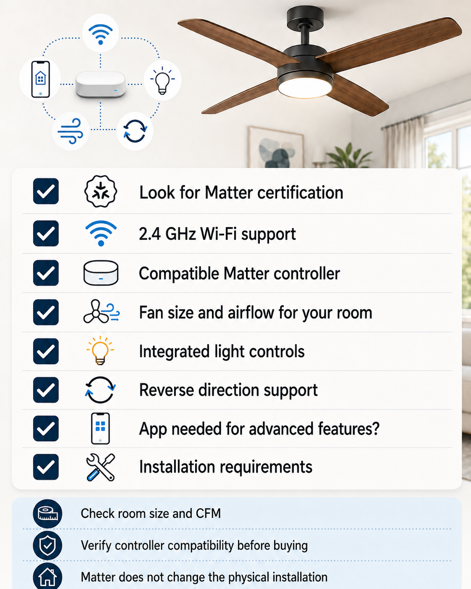
Controller requirements: Most Matter setups work best with a Matter controller. Some platforms require one for adding accessories, automations or remote control. For Apple Home, a HomePod or Apple TV is the safest recommendation if you want the best experience, including remote access and automations. Apple no longer supports iPad as a home hub on the latest Apple Home architecture. Some Matter accessories can be added and controlled from an iPhone without a hub on newer iOS versions, but a home hub is still the better setup for a whole-home smart system. For Google users, compatible controllers include Nest Hub, Nest Hub Max, Nest Audio, and Nest Wi-Fi Pro. For Amazon users, many Echo devices (4th gen or later) and some Eero routers support Matter. If you don’t already have a compatible hub, factor that cost into your Matter ceiling fan budget.
Network requirements: Matter over Wi-Fi ceiling fans require a 2.4GHz Wi-Fi network. If your router only broadcasts 5GHz, or if you’ve disabled 2.4GHz for security reasons, you’ll need to adjust your network configuration before Matter fans will connect.
Features and Installation
Feature availability timing: Matter is an evolving standard. Not all features are available at launch for every device type. Ceiling fans might gain additional capabilities through future Matter specification updates and corresponding firmware updates from manufacturers. What you can’t do today might become possible next year as the standard matures.
Installation requirements: Matter certification doesn’t change installation requirements. Matter ceiling fans install exactly like non-Matter fans – same wiring, same junction box requirements, same mounting process. The Matter functionality is entirely in the communication protocol, not in the physical installation.
A Fan of Future-Proofing
Matter ceiling fans make the most sense when flexibility matters – mixed Apple, Google and Alexa households, future platform switching, local control, or long term smart home plans. In those cases, Matter gives you more room to grow and reduces your dependence on one manufacturer’s app.
Still, buy the fan first and the protocol second. Airflow, noise, size, lighting and build quality matter more than the badge on the box. A good proprietary fan that works well in your home is usually better than a weaker fan with Matter.
When two models are close on performance, price and design, choose the Matter option. Ceiling fans tend to stay installed for years, so future-proofing the smart side is worth it when the fan itself already gets the fundamentals right.
Looking for specific recommendations? My best smart ceiling fans guide covers top models across different protocols and price points. For broader smart home context, the smart ceiling fans overview explains how fans integrate with automation systems. And if you’re deciding between AC and DC motors, the AC vs DC motor comparison covers the energy and noise differences.