
You’ve tried the usual sleep advice. No screens before bed. A cooler room. The same bedtime every night. And yet you still lie there, mind running, waiting for sleep to arrive. Essential oils won’t fix a sleep disorder, but many people find that certain scents help them unwind more easily – not by forcing sleep, but by creating an environment where it becomes more likely.
This guide covers which essential oils are most commonly used for sleep, what the research says about them, how to use them safely, and how to build a simple diffuser routine that works without thinking about it.
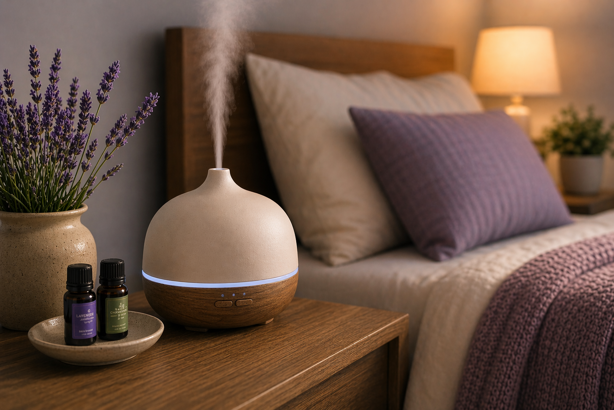
Quick Picks
😴 Most researched for sleep → Lavender
🌿 Best if your mind won’t switch off → Vetiver
🌸 Best floral alternative to lavender → Roman Chamomile
🌲 Best woody oil for bedtime blends → Cedarwood
📱 Using a smart diffuser for sleep → Smart Diffuser Tips
Who This Guide Is For
This guide is for you if: you want to understand which essential oils are commonly used for sleep and why, you’re looking for practical guidance on how to use them safely, or you want to build a simple diffuser routine around your bedtime.
Skip this guide if: you’re looking for ready-to-use blend recipes. Those are in the essential oil diffuser blends guide, which includes four sleep blends with drop counts. If you haven’t set up your diffuser yet, the how to use an essential oil diffuser guide covers the full setup and timing routine first.
A note on claims: Aromatherapy research is ongoing and results vary between individuals. Nothing in this guide should be taken as medical advice or a substitute for professional treatment of sleep disorders. If you have persistent sleep problems, speak with a healthcare provider.
How Essential Oils May Support Sleep
Essential oils don’t induce sleep the way a medication would. The proposed mechanism is indirect. Certain scents are processed through the olfactory system, which has unusually direct connections to brain regions involved in emotion, memory and stress response. Some researchers suggest this pathway may help lower arousal or support relaxation, making it easier to transition into sleep.
The evidence is mixed. Several small studies show promising results for certain oils, particularly lavender, but most are limited in scale, methodology or generalizability. What’s reasonably consistent in the literature is that people who use certain scents as part of a regular bedtime routine often report feeling more relaxed before sleep. Whether that reflects a direct physiological effect, a conditioned response, or simply the benefit of having a consistent wind-down ritual is difficult to separate.
For practical home use, the distinction matters less than the experience. Used thoughtfully, essential oils can become a useful part of a pre-sleep environment without making claims beyond what the evidence supports.
Essential Oils Commonly Used for Sleep
| Oil | Best for | Scent profile | Note type |
|---|---|---|---|
| Lavender (Lavandula angustifolia) | General sleep support, most researched for sleep | Floral, soft | Middle |
| Roman Chamomile (Chamaemelum nobile) | Gentle calming, stress-related sleeplessness | Apple-like, floral | Middle |
| Cedarwood (Cedrus atlantica) | Grounding, blends well with lavender | Warm, woody | Base |
| Bergamot (Citrus bergamia) | Lighter evening blends, floral citrus alternative | Soft citrus, floral | Top |
| Vetiver (Chrysopogon zizanioides) | Deep grounding scent, used sparingly in blends | Earthy, smoky | Base |
| Frankincense (Boswellia carterii) | Meditative wind-down, pairs with cedarwood | Resinous, warm | Base |
| Sandalwood (Santalum album) | Smooth base note, blends with florals and citrus | Creamy, woody | Base |
| Clary Sage (Salvia sclarea) | Emotional tension, evening relaxation blends | Herbal, slightly sweet | Middle |
Lavender (Lavandula angustifolia)
Lavender is the most researched essential oil in the context of sleep and relaxation, and the one most likely to appear in clinical aromatherapy literature. Several small studies have found associations between lavender inhalation and improvements in self-reported sleep quality and relaxation, with some also reporting reduced nighttime waking or lower anxiety scores before bed. The active compounds most often cited are linalool and linalyl acetate. Some researchers believe these may have mild sedative-adjacent properties at low concentrations.
In practice, lavender is also the most forgiving oil to work with. The scent is familiar to most people, it blends well with almost everything, and it’s widely available in reliably pure form. It’s a reasonable first oil to try if you’re new to using essential oils for sleep.
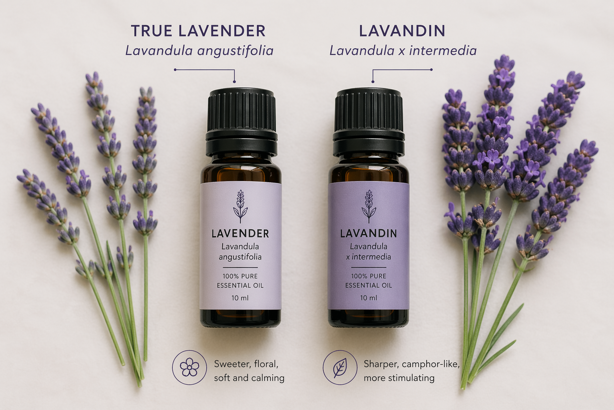
The Latin name matters here. Lavandula angustifolia (true lavender) is the variety most represented in sleep research and aromatherapy guidance. Lavandin (Lavandula x intermedia) is a hybrid with a sharper, more camphorous scent that some people find stimulating – the opposite of what you want at bedtime. Check the label before buying.
Roman Chamomile (Chamaemelum nobile)
Roman chamomile has a gentle, apple-like floral scent that most people find calming. It’s often used in aromatherapy blends aimed at reducing anxiety and promoting relaxation, and it tends to appeal to people who find lavender too floral or intense.
The research base is thinner than for lavender, but Roman chamomile appears regularly in aromatherapy practice for sleep support, particularly for people whose sleep difficulties are rooted in anxiety or rumination. It’s also one of the gentler oils. That makes it a reasonable choice in households with children, though standard caution applies for very young children.
Note the distinction between Roman chamomile (Chamaemelum nobile) and German chamomile (Matricaria chamomilla). Both are used in wellness contexts, but they have different chemical profiles and different scent characteristics. Roman chamomile is the one most commonly used in sleep-focused aromatherapy.
Cedarwood (Cedrus atlantica)
Cedarwood has a warm, woody, grounding scent that many people find easier to settle into than floral oils. It’s often used as a base note in sleep blends precisely because it’s slow to evaporate and anchors a blend with depth without being sweet or heavy.
Some research has looked at cedrol, a compound found in cedarwood oil, in connection with sedative-adjacent effects in animal studies. Human research is limited, but cedarwood appears consistently in sleep-focused aromatherapy practice and pairs particularly well with lavender. The two complement each other in a way that’s become a standard combination in diffuser blends for bedtime.
Cedrus atlantica (Atlas cedarwood) is the variety most commonly used in aromatherapy. Virginia cedarwood (Juniperus virginiana) is also used and has a similar profile, though it’s from a different botanical family. Either works for sleep-focused diffusion.
Bergamot (Citrus bergamia)
Bergamot is a citrus oil with an unusual quality. Unlike lemon or grapefruit, which most people find energizing, bergamot has a softer, more floral citrus character that lends itself to evening use. It contains linalool and linalyl acetate, the same compounds found in lavender, which may contribute to its reputation as a calming rather than stimulating citrus.
It works well as a top note in sleep blends for people who dislike heavily floral or woody scents. The citrus brightness fades relatively quickly, leaving the middle and base notes to carry the blend through the session.
Vetiver (Chrysopogon zizanioides)
Vetiver is one of the most distinctive oils in aromatherapy – deep, earthy, smoky and complex in a way that divides opinion. People either find it immediately grounding or initially strange. If you’ve never smelled it before, the first encounter can be surprising.
Its use in sleep-focused aromatherapy is primarily experiential, not strongly evidenced. One animal study found vetiver inhalation actually increased wakefulness instead of promoting sleep, while separate research found anxiolytic effects in animal models. Human research remains limited. What’s consistent is that many people who use vetiver in evening blends report finding the scent deeply settling. It works best as a single drop alongside other sleep oils. The anxiety-reducing associations, rather than any direct sleep effect, are probably the more defensible explanation for why it appears in sleep blend recommendations.
Vetiver is also notably thick and viscous compared to most essential oils. It dispenses slowly and can be difficult to get the last drops from the bottle. Warming the bottle briefly in your hands before adding drops often helps.
Frankincense (Boswellia carterii / Boswellia serrata)
Frankincense has a resinous, slightly sweet, meditative quality that many people associate with slowing down and being present. It’s used widely in contexts involving mindfulness and breathwork, which makes it a natural fit for a pre-sleep routine focused on mental deceleration.
It works particularly well as a base note in blends designed for people who find floral sleep scents too sweet or who want something more understated. Paired with cedarwood, it creates a deeply grounded combination. Paired with bergamot, it softens into something warmer and more approachable.
Sandalwood (Santalum album / Santalum spicatum)
Sandalwood has a smooth, creamy, woody character that most people find immediately calming. Some research has looked at alpha-santalol, a compound in sandalwood oil, in connection with sedative properties, though the evidence in humans remains limited.
From a practical standpoint, sandalwood is one of the most universally appealing base notes for sleep blends – warm without being heavy, woody without being sharp. It also blends exceptionally well with both floral and citrus oils, making it versatile across different sleep blend combinations.
A note on sourcing – Santalum album (Indian sandalwood) is the traditional variety and the one most studied, but it’s expensive and often mislabeled. Santalum spicatum (Australian sandalwood) is a more sustainable and reliably available alternative with a similar, though slightly drier character. Both are appropriate for diffusion.
Clary Sage (Salvia sclarea)
Clary sage has a herbal, slightly sweet, somewhat unusual scent that some people find deeply settling and others find takes some getting used to. It appears in aromatherapy practice for sleep and stress relief, particularly for situations involving emotional tension or hormone-related restlessness.
It’s commonly avoided during pregnancy. If this applies to you, leave it out. Outside of that context, clary sage at low concentrations (two drops in a blend is usually sufficient) adds a herbal complexity that rounds out sleep blends without dominating them.
How to Diffuse Essential Oils for Sleep
An ultrasonic diffuser is the most practical way to use essential oils for sleep. Add water to the fill line, add your drops directly to the water, replace the lid and run the diffuser for 30 to 45 minutes before bed. That’s normally enough to scent a bedroom and create the environment you’re looking for without oversaturating the air overnight.
Running a diffuser continuously through the night in a closed bedroom generally isn’t recommended. Oil concentration builds up in an enclosed space and can become irritating for some people, particularly those with respiratory sensitivities. If you want the scent to be present as you fall asleep, set a timer to stop the diffuser 30 minutes after lights out.
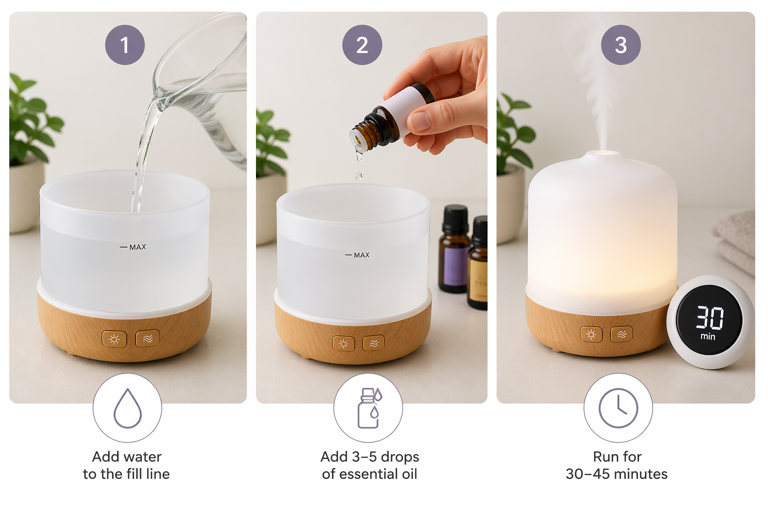
For drop counts, a good starting point is 3 to 5 drops per 100ml of water. Sleep oils like lavender and cedarwood tend to work well at this range. Stronger oils like vetiver or clary sage are better used at the lower end – one or two drops in a blend.
What to Avoid
Don’t add essential oils to a nebulizing diffuser and run it overnight. Nebulizing diffusers disperse undiluted oil at higher concentration than ultrasonic models, and prolonged overnight exposure in a closed room is not advisable. Don’t use energizing oils like peppermint, eucalyptus or rosemary in your sleep routine. These are better suited to morning and focus contexts and can make it harder to wind down.
Building a Sleep Routine with a Smart Diffuser
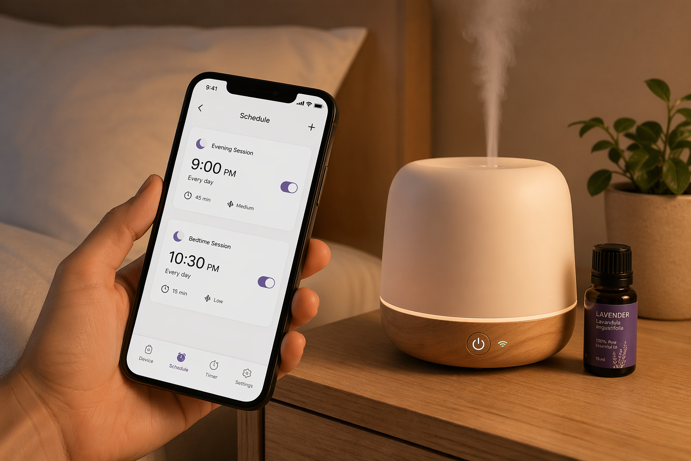
A smart diffuser with app scheduling turns a manual habit into an automated one. Once the schedule is set, the diffuser starts on its own at the same time every evening without you having to remember to fill it, add drops or press a button. That consistency is key. Scent works partly as a conditioned cue. The more consistently your bedroom smells a certain way before sleep, the more reliably your body may start associating that scent with the transition to rest.
A Simple Sleep Schedule
A practical example would be setting two scheduled sessions. The first runs for 30 to 45 minutes starting around an hour before your target bedtime. That’s long enough to scent the room before you get into bed, but short enough that you’re not still running it as you try to sleep. The second runs for 15 minutes just after lights out, which extends the scent into the room without running all night.
Most smart diffuser apps let you set these as separate schedules on a recurring weekday or daily basis. Set them once and leave them. The goal is to remove decision fatigue from the routine entirely. The diffuser handles its part, so you don’t have to think about it.
Intensity for Sleep
For sleep sessions, low to medium mist intensity is usually sufficient. A bedroom is a contained space and you’re not trying to fill a large open area. You want the scent to be present and noticeable without being the thing you’re most aware of when you lie down. If you can smell it clearly the moment you walk in, the intensity is probably right. If it’s the first thing you think about when you’re trying to fall asleep, it may be slightly too strong.
Rotating Your Sleep Oils
Olfactory adaptation – where your brain stops registering a familiar scent – happens faster than most people might expect. If you use the same oil or blend every night for several weeks, you may find the scent stops registering as strongly. That reduces whatever cue effect it was providing. Rotating between two or three different sleep oils or blends across the week (or seasonally) keeps the scent perceptible and maintains the associative signal. The essential oil diffuser blends guide has four sleep blends (Classic Calm, Smoky Retreat, Quiet Garden and Restless Night), which are well suited to this kind of rotation.
Safety: What to Know Before You Start
General
Always diffuse in a well ventilated room and keep sessions to a reasonable length. If you notice headaches, throat irritation or watery eyes during or after a session, decrease the number of drops and shorten the session length. More oil is not better – in fact, it’s often worse. Household members can react differently to airborne scent, particularly children and anyone with respiratory sensitivities.
Pregnancy
Several oils commonly used for sleep are often avoided during pregnancy, including clary sage, rosemary and cinnamon. Lavender, chamomile and frankincense are generally considered lower risk options, but individual circumstances vary. Always check with your healthcare provider before using essential oils during pregnancy.
Children
For children under two, many sources recommend avoiding diffusion entirely or using only very gentle oils like lavender at very low concentrations in a well ventilated room. For older children, still start with fewer drops than you’d use for adults and ensure the room is ventilated. Peppermint and eucalyptus are specifically flagged as oils to be avoided around young children, as they can cause respiratory distress in infants. Always check with your pediatrician if you have any concerns.
Pets
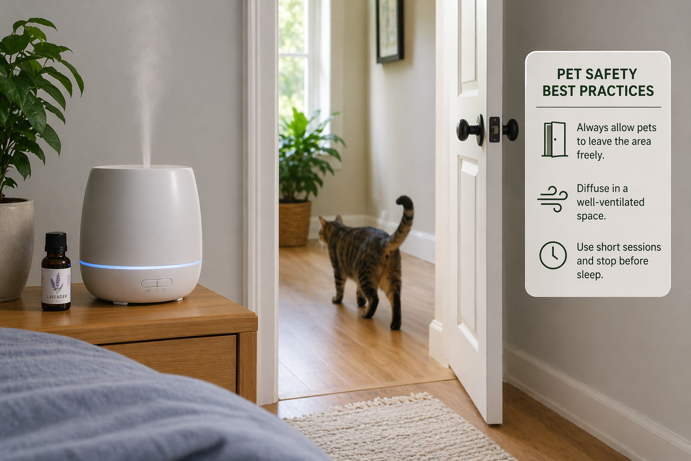
Cats require more careful consideration than the general pet safety guidance might suggest. Cats lack certain liver enzymes that humans use to metabolize many essential oil compounds, meaning even low-level airborne exposure may carry some risk. When a diffuser is running in a room, microdroplets can settle on a cat’s fur and be ingested during grooming – a critical consideration beyond simple inhalation.
The Tisserand Institute’s position – one of the more measured in aromatherapy safety – is that low-level, intermittent diffusion in a well ventilated room where the cat can leave freely is unlikely to be harmful. However, the Pet Poison Helpline and most veterinary sources take a more cautious stance, particularly for extended sessions in enclosed spaces like bedrooms overnight. Running a sleep diffuser in a bedroom where a cat sleeps through the night is a much higher risk scenario than occasional daytime diffusion in an open room.
If you share a bedroom with a cat, the safest approach is to diffuse before bed in a ventilated room, ensure the cat can leave, and stop the diffuser before sleeping. For a full breakdown by oil and species, see the essential oils pet safety guide.
Choosing Your Oils: What to Look For
Oil quality matters more for sleep use than for air freshening, because you’re diffusing in an enclosed bedroom for extended sessions. Poor quality oils – diluted with synthetic compounds, carrier oils or undisclosed additives – may smell similar to pure versions but deliver a different airborne chemical profile.
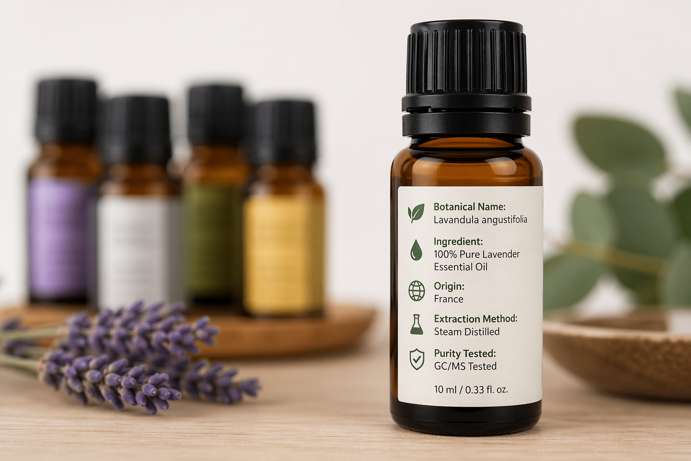
When reading labels, look for the Latin botanical name (e.g. Lavandula angustifolia, not just “lavender”), a statement of 100% purity, the country of origin and the extraction method. GC/MS testing (gas chromatography/mass spectrometry) on the batch is the strongest indicator of verified purity, and reputable brands make these results available. Avoid anything labeled “fragrance oil”, “perfume oil” or “aromatherapy blend” without a clear purity statement. Also avoid oils priced significantly below the market rate for that botanical – some plants (like true sandalwood or rose) are genuinely expensive to produce.
For more detail on what to look for by oil and which brands meet these standards consistently, read the essential oils for diffusers guide.
Where Essential Oils Fit in a Wider Sleep Routine
Essential oils work best as part of a broader wind-down routine rather than as a standalone intervention. The scent itself is one signal among several that your body uses to recognize that it’s time to transition toward sleep. The more consistent those signals are – same time, same light level, same temperature, same scent – the more reliably the body responds to them over time.
That’s the strongest practical case for using a smart diffuser with a scheduled routine instead of manually diffusing when you remember to. A diffuser that starts automatically every evening at the same time becomes a reliable environmental cue in a way that sporadic use never quite does.
If you’re still choosing a diffuser for bedroom use, the smart diffuser guide covers the best options across various budgets, including hands-on testing of the ASAKUKI, a 500ml model well suited to overnight scheduling with an auto shut-off feature.
Scent to Sleep
The best sleep routine is the one you can repeat without wrestling with it. A diffuser helps because it gives the evening a clear signal: the day is ending, the room is settling, and your mind has permission to follow.
Start small. Choose one oil, use less than you think you need, and let consistency do more of the work than intensity. Over time, the scent becomes less about the oil itself and more about what it marks: a boundary between the noise of the day and the quiet you are trying to protect.
Sleep rarely arrives because you chase it harder. More often, it comes when you make the way softer.