
You step on your bathroom scale, and it tells you your weight. Then, a second later, it tells you your body fat percentage. That second number is where things get complicated, and where a lot of people reasonably wonder whether they can trust what they’re seeing.
The short answer is: it depends on what you mean by accurate. Body fat scales can be genuinely useful, but not quite in the way most people assume. This guide explains how they work, what affects their readings, what the research says, and where smart scales fit into all of this.
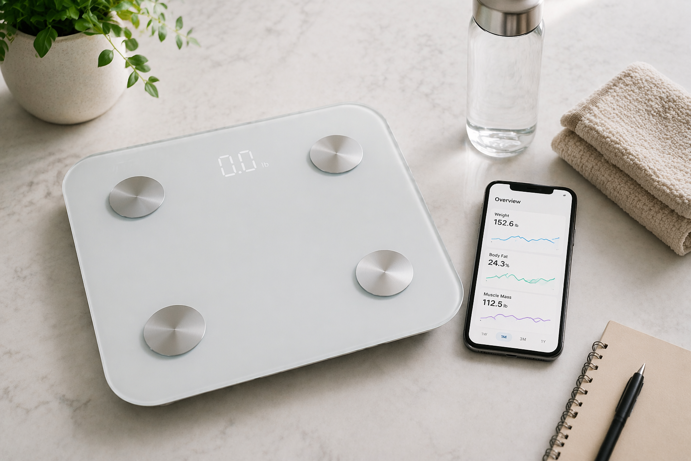
How Body Fat Scales Work
Body fat scales use a technology called bioelectrical impedance analysis (BIA). When you step on the scale barefoot, a weak electrical current is sent up through your body via the foot electrodes. You can’t feel it. The scale measures how much resistance (or impedance) the current encounters as it travels through your tissue.
The reason this works, at least in principle, is that fat and muscle conduct electricity differently. Muscle contains a lot of water and is a good conductor. Fat contains very little water and resists the current. The scale uses the impedance reading, combined with the personal data you enter when setting up (height, age, biological sex), to estimate what proportion of your body is fat versus lean mass.
The keyword here is estimate. BIA is a prediction model, not a direct measurement. The scale never directly sees your fat tissue. It infers its presence from the behavior of an electrical current. Everything after that point is an algorithm.
What Affects the Accuracy of Body Fat Scales
Because BIA relies on fluid levels and electrical conductivity rather than physical measurement, a wide range of everyday factors can shift the reading significantly, sometimes by several percentage points on the same day.
Hydration is the biggest variable. A dehydrated body has less water in the muscle tissue, which increases impedance and causes the scale to overestimate body fat. Being well hydrated can push the reading in the opposite direction. Consuming alcohol, which is dehydrating, can also skew results.
Recent exercise makes readings less reliable, though not always in the same direction. Intense exercise depletes glycogen and water from muscle tissue, which tends to raise body fat estimates. However, it also increases peripheral blood flow, which can lower impedance in some individuals. The net effect varies, which is why readings taken within a couple of hours of a hard workout are difficult to interpret meaningfully.
Food and drink timing is more important than most people realize. A meal or large drink taken shortly before stepping on the scale adds mass and changes fluid distribution. Most manufacturers recommend weighing first thing in the morning, before eating or drinking.
Skin temperature influences electrical conductivity. A hot shower or a cold environment can both affect the reading. Cold skin is a poorer conductor, which tends to increase impedance and inflate the body fat estimate.
Menstrual cycle phase causes natural fluid retention that shifts BIA readings for women, sometimes by several percentage points across the cycle.
Electrode position and foot placement make a difference too, particularly on four-electrode scales where the current only travels through the lower body. Scales with eight electrodes (including hand contacts) provide a more complete picture of whole body impedance, which can improve consistency.
What the Research Says
Independent research consistently finds that consumer BIA scales are reliable for measuring weight, but considerably less reliable for body fat percentage when compared against clinical methods like DEXA (Dual Energy X-ray Absorptiometry) scanning – a medical imaging technique considered the gold standard for body composition measurement. Error margins of ±3-8 percentage points compared to DEXA are common, and the gap tends to widen at the extremes – very lean or very high body fat individuals tend to see the largest discrepancies, where consumer BIA prediction equations are generally less reliable.
A validation study comparing three connected smart scales to DEXA found that body weight error was typically under one kilogram, while fat mass and muscle mass estimates showed considerably larger errors, leading the authors to conclude that smart scales should not replace DEXA for medical body composition testing.
That sounds damning, but there’s a more useful way to read it. The same research consistently shows something else. When used in a controlled, consistent way over time, BIA scales are good at detecting the direction and relative magnitude of change. If your body fat is trending downward over twelve weeks, your scale will likely reflect that. The absolute number at any given point may be off, but the trend is usually honest.
This distinction matters a great deal for how you use the data. A reading of 24.1% body fat on a Tuesday tells you very little by itself. A chart showing 12 weeks of consistent morning readings trending from 26% to 23% tells you something genuinely useful, even if the true starting and ending values were different.
So Are Body Fat Scales Worth Using?
Yes, if you treat them as trend tools rather than diagnostic instruments. They’re not a substitute for a DEXA scan if you need clinical precision. But for the purposes most people have – understanding whether a diet or training approach is moving their body composition in the right direction – a consistently used body fat scale gives you information that a weight-only scale simply can’t.
The consistency point is worth dwelling on. The value of BIA scales comes from repeated, controlled measurements taken the same way every time. Step on it at the same time of day, in the same physical state, on the same surface. The absolute number matters less than its movement over weeks and months.
Where Smart Scales Fit In
A basic BIA scale gives you a number. A smart scale turns that number into context, adding history, trends, and depending on the model, integration with the rest of your health data.
The consistency habit that makes BIA data actionable is much easier to maintain when the scale handles everything automatically. You step on, the data syncs to the app, the trend chart updates. No manual logging, no spreadsheet. The app shows you whether your body fat reading has been trending up, down or flat over the last month, and how that aligns with your weight curve over the same period. That kind of at-a-glance context is difficult to replicate with a basic scale and a notebook.
Smart scales also tend to use better hardware. Better electrode design, ITO coating for improved surface conductivity and reduced sensitivity to foot placement – and in higher end models, dual-frequency BIA which uses two electrical frequencies to refine the impedance estimate and may improve consistency compared to basic single-frequency models. Eight-electrode designs that include hand contacts can improve consistency for whole body estimates compared to foot-only models, though they don’t eliminate the underlying limitations of BIA.
Multi-user support means the entire household can maintain separate profiles without manual switching. App integrations with Apple Health, Google Fit, Fitbit and similar platforms mean your weigh-in data sits alongside your other health metrics. For the purpose of building a sustainable tracking habit, this really does come in handy.
Smart Body Fat Scales Worth Considering
Three scales cover the realistic range for most people tracking body composition at home. All are widely available across major US retailers, and prices fluctuate – the RENPHO in particular is regularly discounted.
How I evaluated these: I tested the RENPHO Elis 1 hands-on over seven consecutive daily morning weigh-ins and draw on that direct experience throughout its section below. The Wyze Scale X and Withings Body Smart are evaluated through research, verified specifications and customer feedback. Where relevant, I’ve noted which is which.
RENPHO Elis 1
Price range: $25-$35 (Hands-On Tested)
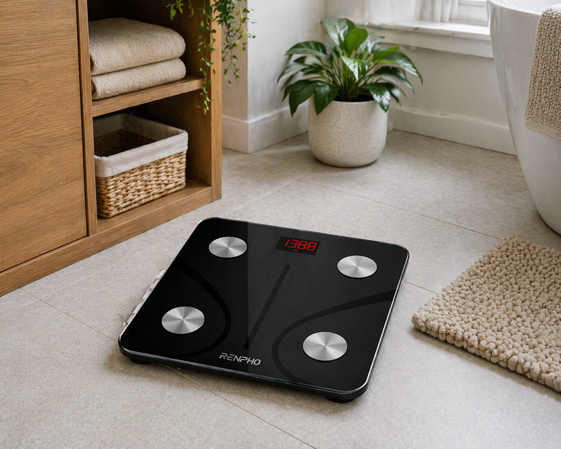
The RENPHO Elis 1 is one of the most-reviewed body fat scales on Amazon, with hundreds of thousands of five-star ratings and consistently strong placement in independent roundups. For the price, it’s hard to argue with what it delivers – 13 body composition metrics tracked via the RENPHO Health app, including body fat percentage, visceral fat, skeletal muscle, bone mass, BMI and metabolic age.
App integrations include Apple Health, Samsung Health and Fitbit. Four high-precision sensors provide consistent weight readings. Capacity is 400 lbs in 0.2 lb increments. FSA/HSA eligible.
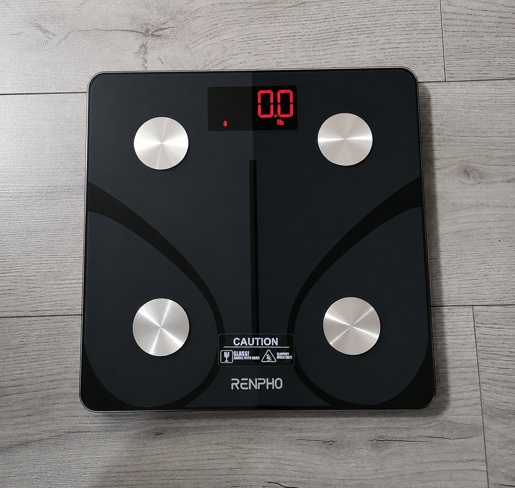
Having tested the Elis 1 hands-on, setup was faster than expected. The app discovered the scale automatically via Bluetooth. No manual pairing steps required. The onboarding flow is well structured, walking you through goal selection, initial weight confirmation with live BMI feedback, and reminder scheduling before your first weigh-in. From unboxing to first reading took under ten minutes, and the measurement unit syncs automatically from your app profile.
What I Found in Testing
Over seven consecutive daily morning weigh-ins, weight readings were consistent under the same conditions. The body fat trend chart in the app’s weekly view showed a clear directional picture, with day-to-day variation present but the overall arc easy to read.
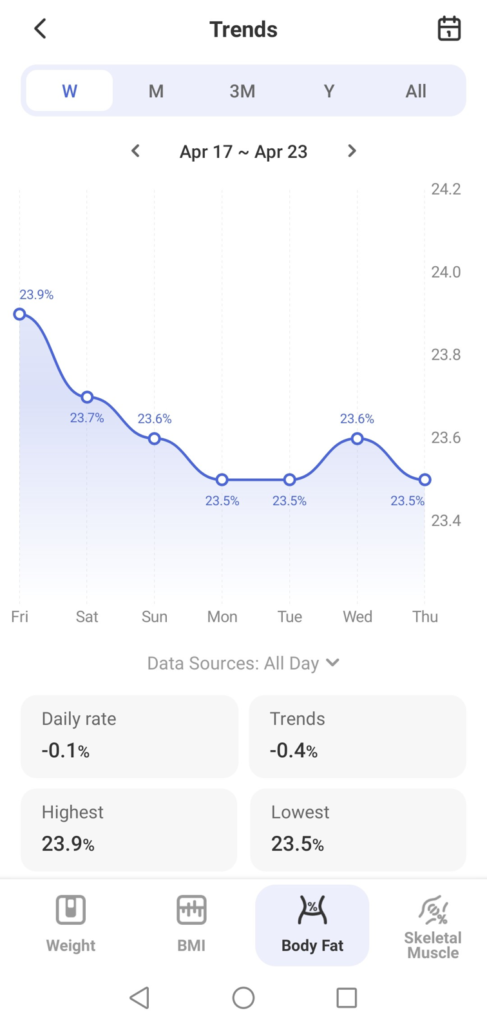
Notably, skeletal muscle percentage trended slightly upward over the same period that body fat trended down – the kind of nuance a weight-only scale would miss entirely.
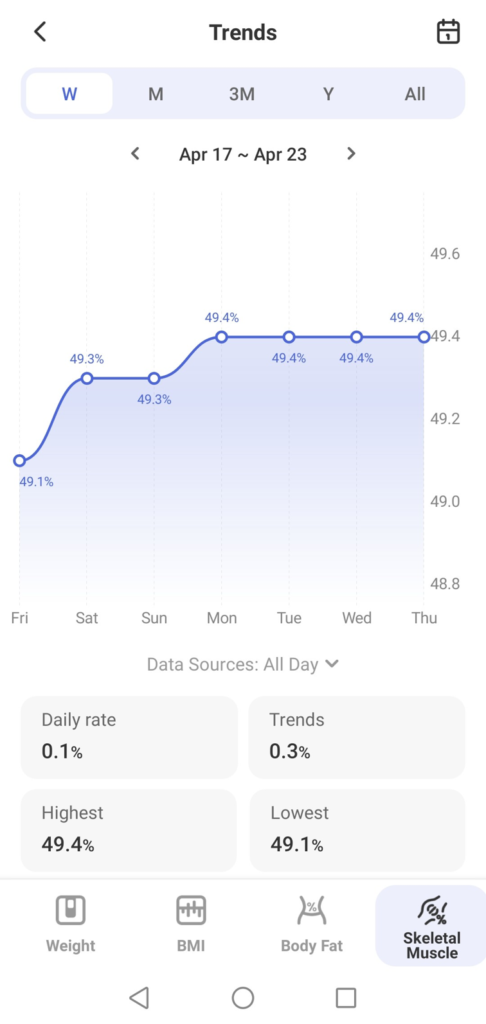
The app’s comparison view shows all 13 metrics side by side with how each has changed over the week, making the trend story concrete rather than theoretical.
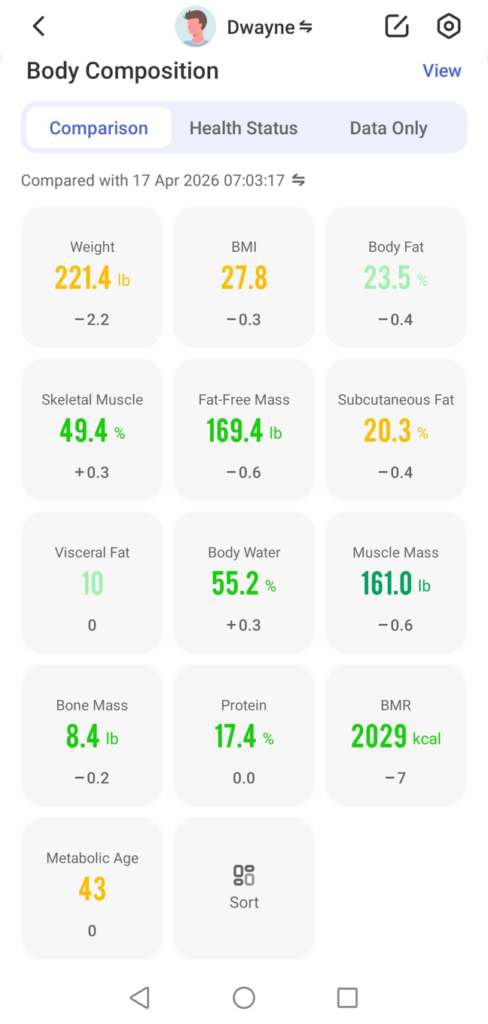
Worth Knowing: The scale display cycles through weight, BMI and body fat percentage at each weigh-in, so the three most-checked metrics are visible without opening the app. For the full set of 13 metrics, you’ll need your phone nearby. The Elis 1 uses four foot-only electrodes rather than eight, which is standard at this price point and a reasonable trade-off for most users.
Wyze Scale X
Price range: $35-$50 (Research Based Evaluation)
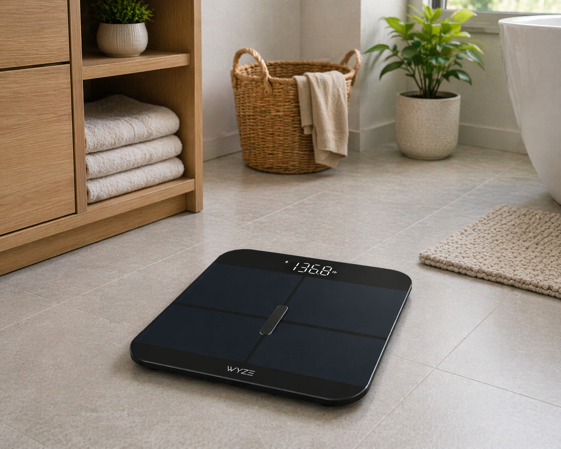
The Wyze Scale X sits just above the RENPHO on price and adds a few features that justify the step up for the right user. Most notably, it displays weight and body fat percentage simultaneously on the scale’s LED screen as a persistent reading, rather than cycling through metrics at weigh-in. It tracks 13 body composition metrics via the Wyze app, supports up to eight user profiles, and includes baby, pet, luggage and pregnancy modes. ITO glass electrode coating provides full-surface measurement, and heart rate is trackable via the app separately from the weigh-in. Battery life is rated at up to 22 months. Syncs with Apple Health, Fitbit and Health Connect.
Worth Knowing: The Wyze app is functional but shows its budget origins. Each metric comes with a basic explainer, but there’s limited contextual guidance on what your readings mean for your health. You’ll likely find yourself looking things up externally when interpreting numbers for the first time. No Wi-Fi sync, Bluetooth only, so your phone needs to be nearby for data to sync, although the scale can store readings and upload them later.
Withings Body Smart
Price range: $120-$130 (Research Based Evaluation)
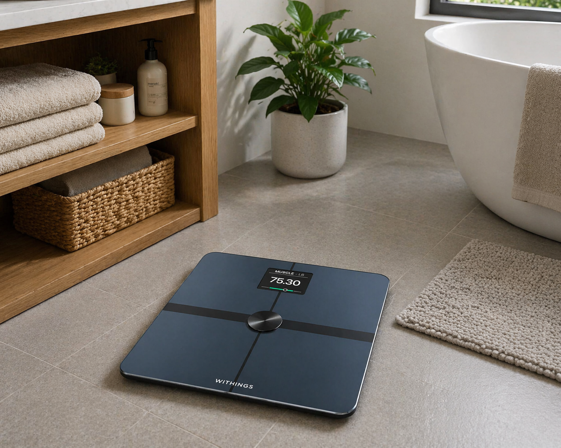
If you’re tracking body composition seriously and want a scale that does the whole job well, the Withings Body Smart is frequently highlighted in independent testing and expert roundups. It tracks eight body composition metrics including visceral fat index, fat and muscle mass, bone mass, water percentage and standing heart rate. The high-resolution color screen displays your metrics directly, without requiring the app for a quick check. Multi-frequency BIA can improve the consistency of the impedance calculation compared to single-frequency models.
Wi-Fi sync means data uploads automatically, whether your phone is in the room or not – a practical advantage for households where consistent tracking is the goal. Supports up to eight named user profiles with individual health histories. Battery life is rated at 15 months. The Withings Health Mate app is well regarded across the board, with clearly designed, well explained metrics, and integration with Apple Health, Google Fit, MyFitnessPal and Samsung Health (via supported integrations). Available in black or white. FSA/HSA eligible.
Worth Knowing: Some advanced app features, including the Health Improvement Score and guided coaching features, sit behind a Withings+ subscription at $9.95/month or $99.50/year. The core scale functionality and standard app experience are fully usable without it, and the free tier offers considerably more than most competing apps at any price. A few reviewers note occasional connectivity hiccups with the app, though these are not consistent across units.
Tips for Getting More Consistent Readings
Since consistency is what makes BIA data meaningful, your measurement routine is just as important as the scale itself. A few simple practices significantly reduce the noise in your readings.
Weigh first thing in the morning, after using the bathroom and before eating or drinking anything. This is the most reproducible state your body is in from day to day. Step on barefoot and stand still. Movement or shifting weight between feet introduces error. Place the scale on a hard, flat surface, not carpet.
Don’t weigh immediately after exercise, a hot shower or a large meal. Give yourself at least a couple of hours if possible. If you travel and your sleep or hydration patterns have been disrupted, treat those readings with more skepticism than usual.
Look at weekly or monthly averages rather than individual daily readings. Most smart scale apps provide trend views for exactly this reason. A single reading that jumps up two percentage points tells you almost nothing on its own. A four week trend tells you quite a lot.
If you have a pacemaker, other implanted medical devices, or are pregnant, follow the manufacturer’s safety guidance and consult your healthcare provider before using BIA features. Most manufacturers advise avoiding BIA use entirely with implanted medical devices.
Which Scale Should You Choose?
For most people starting out or working with a tight budget, the RENPHO Elis 1 delivers what you need – reliable weight measurement, 13 tracked metrics, and a solid app with broad third-party integration – all for under $35.
If you want a persistent on-scale display showing both weight and body fat simultaneously (instead of cycling through at weigh-in), along with a few more practical features without a considerable spend, the Wyze Scale X is the logical next step, particularly for households that want baby and pet weighing modes alongside the body composition tracking.
Those who want the most complete smart scale experience – better app, Wi-Fi sync, multi-frequency BIA, heart rate, and a color display – will find the Withings Body Smart worth the price premium. It’s the option that makes consistent long term tracking easiest.
Worth Your Weight in Context
A body fat scale earns its place in your bathroom when you ask it the right question. Not “Is this number perfect?” but “Is this trend telling me something useful?” Used casually, BIA can be noisy. Used consistently, it becomes a practical feedback tool.
That makes the real value surprisingly simple. A smart body fat scale will not diagnose you, settle your exact body fat percentage, or replace clinical testing. What it can do is help you spot whether your routine is moving you in the right direction before the mirror or the waistband makes it obvious.
If you weigh under similar conditions, ignore the daily drama, and pay attention to the longer arc, the data becomes most useful. Not perfect. Useful. And for most people trying to make better decisions week by week, that’s the number that counts.
For more on building a connected health routine, check out my smart home wellness devices guide, smart home devices for elderly guide, and Smart Home Hub overview.