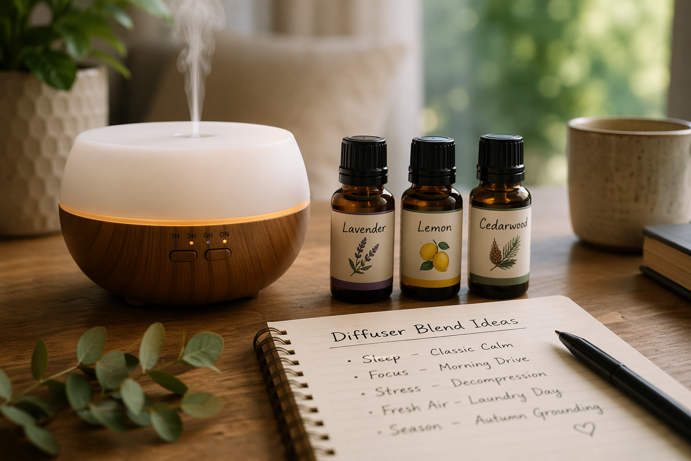
You own the oils. You have the diffuser. But every time you go to blend something, you reach for the same two bottles or end up guessing until the room smells like a health food store rather than somewhere you want to be.
Good diffuser blends benefit from a little structure. The right combination creates a layered, evolving scent that can support winding down, help you feel more focused, or simply make a room smell clean – without reaching for aerosol sprays.
The recipes below are organized by goal. Each includes drop counts per 100ml of water as a starting point. For larger tanks, you don’t always need to scale up proportionally. Many people find lower total drop counts work better in bigger spaces. The tank size reference at the end of this guide has suggested totals. You can always add another drop, but you can’t take one out.
How to scale these recipes: Use the tank size reference at the end of this guide for suggested drop totals rather than straight multiplication. If a blend feels too strong, reduce each oil by one drop rather than adding more water. These blends are for diffusion only (not for ingestion or direct skin application).
Always diffuse in a well ventilated space, and be mindful that household members can react differently to airborne scent, particularly children and anyone with respiratory sensitivities.
For a full guide to individual oils, tank sizes and diffuser maintenance, see the essential oils for diffusers guide.
Quick Picks
💤 Best for sleep → Classic Calm
🧠 Best for focus → Morning Drive
😮💨 Best for stress → Decompression
🏠 Best for freshening → Fresh Start
🌿 Best all-rounder → Laundry Day
Who This Guide Is For
This guide is for you if: you already own a diffuser but default to the same oils on repeat, you want structured blend recipes rather than guesswork, or you’re looking to build a scenting routine that actually fits your day.
Skip this guide if: you’re looking for medical aromatherapy advice or therapeutic claims. That’s not what this is. These are home scenting recipes for mood, atmosphere and everyday use.
If you haven’t set up your diffuser yet, the how to use an essential oil diffuser guide covers everything from first fill to daily routine.
Best Essential Oil Diffuser Blends for Sleep
These blends are built for the hour or two before bed. Run them in short scheduled bursts (30 to 45 minutes) rather than continuously through the night. If you use a nebulizing diffuser, be aware that it uses undiluted oil and delivers a more concentrated output than water-based models, so review the overnight diffusing guidance before setting a sleep timer.
Classic Calm
| Oil | Ratio (per 100ml) |
|---|---|
| Lavender (Lavandula angustifolia) | 3 |
| Cedarwood (Cedrus atlantica) | 2 |
| Roman Chamomile (Chamaemelum nobile) | 1 |
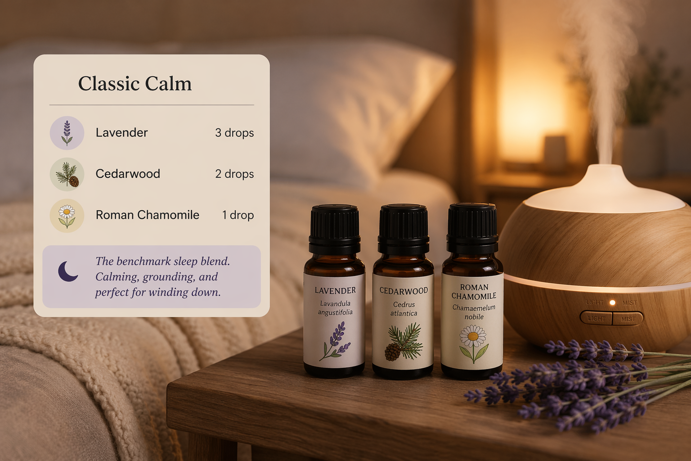
The benchmark sleep blend. Lavender anchors it, cedarwood adds a grounding base, and chamomile smooths the edges without adding sweetness. Works well on its own or as a starting point to build from.
Smoky Retreat
| Oil | Ratio (per 100ml) |
|---|---|
| Frankincense (Boswellia carterii) | 3 |
| Cedarwood (Cedrus atlantica) | 2 |
| Vetiver | 1 |
Deeper and more resinous than Classic Calm. Good for anyone who finds floral sleep scents too light or who wants something more meditative. Pairs well with low light and a book you’re not planning to finish.
Quiet Garden
| Oil | Ratio (per 100ml) |
|---|---|
| Lavender (Lavandula angustifolia) | 3 |
| Bergamot (Citrus bergamia) | 2 |
| Sandalwood | 1 |
Bergamot here plays the calming role it takes in evening blends, not the bright citrus note it contributes in the morning. Softer and slightly floral without tipping into perfume territory. A strong option if cedarwood-heavy blends feel too woody.
Restless Night
| Oil | Ratio (per 100ml) |
|---|---|
| Roman Chamomile (Chamaemelum nobile) | 3 |
| Clary Sage (Salvia sclarea) | 2 |
| Lavender (Lavandula angustifolia) | 1 |
Useful for nights when your mind won’t settle. Clary sage has a herb-like scent that some people find mentally settling. Often avoided during pregnancy. Check with your healthcare provider.
Smart diffuser tip: Schedule any of these to run for 30 minutes starting 45 minutes before your target sleep time. A second 15-minute burst after lights-out is plenty. Continuous overnight diffusion wastes oil and can oversaturate a closed bedroom.
Diffuser Blends for Focus and Concentration
Run these in 20-minute cycles with breaks rather than continuously. Scent fatigue kicks in faster than you’d expect. Your brain simply stops registering it. Intermittent diffusion helps keep the scent noticeable. Most Bluetooth app diffusers let you program interval cycles directly in the scheduler.
Morning Drive
| Oil | Ratio (per 100ml) |
|---|---|
| Lemon (Citrus limon) | 3 |
| Peppermint (Mentha piperita) | 2 |
| Rosemary (Rosmarinus officinalis) | 1 |
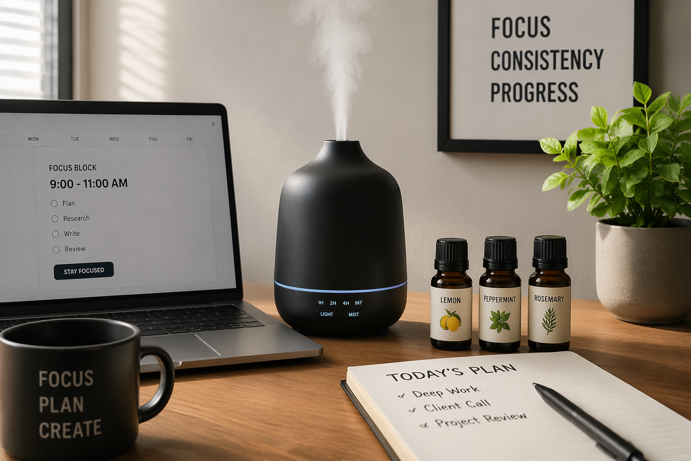
A classic focus stack. Lemon lifts the room immediately, peppermint adds a sharper alerting note without tipping into toothpaste territory, and rosemary grounds the blend with something more sustained. Run this when you need to get started, not when you’re already deep in something.
Steady State
| Oil | Ratio (per 100ml) |
|---|---|
| Rosemary (Rosmarinus officinalis) | 3 |
| Eucalyptus (Eucalyptus radiata) | 2 |
| Lemon (Citrus limon) | 1 |
Quieter than Morning Drive, and easier to run during calls or meetings where a sharp mint note would distract. Rosemary leads and Eucalyptus radiata keeps the air feeling open without becoming medicinal.
Afternoon Reset
| Oil | Ratio (per 100ml) |
|---|---|
| Peppermint (Mentha piperita) | 3 |
| Wild Orange (Citrus sinensis) | 2 |
| Frankincense (Boswellia carterii) | 1 |
For the 2pm slump specifically. Wild orange is brighter than lemon here, and frankincense anchors the blend so it doesn’t feel like you’re reaching desperately for energy. Keep peppermint at 3 drops maximum.
Deep Work
| Oil | Ratio (per 100ml) |
|---|---|
| Cedarwood (Cedrus atlantica) | 3 |
| Rosemary (Rosmarinus officinalis) | 2 |
| Lemon (Citrus limon) | 1 |
An unusual focus blend that works well for writing, analysis or anything requiring sustained concentration rather than fast startup. Leading with cedarwood – a base note doing the work of an anchor – makes this slower and more grounding than the others in this section.
Essential Oil Blends for Stress Relief
These are transition blends, for the gap between work and evening, for difficult days, or for any moment where the room needs to feel different from how it currently does. None are substitutes for professional mental health support, but scent can act as a cue that the context has changed.
Decompression
| Oil | Ratio (per 100ml) |
|---|---|
| Sweet Orange (Citrus sinensis) | 3 |
| Frankincense (Boswellia carterii) | 2 |
| Lavender (Lavandula angustifolia) | 1 |
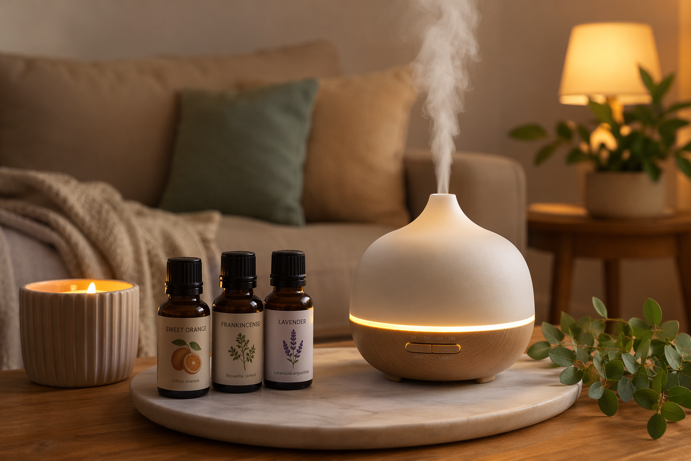
The workhorse of this section. Sweet orange is uplifting without being energizing, frankincense is grounding without being sedating, and lavender softens everything into something that just feels easier. Run this in the first hour after work.
Still Water
| Oil | Ratio (per 100ml) |
|---|---|
| Bergamot (Citrus bergamia) | 3 |
| Cedarwood (Cedrus atlantica) | 2 |
| Ylang Ylang (Cananga odorata) | 1 |
Ylang ylang is deliberately kept to one drop. A heavy hand tips this from calming into overwhelming very quickly. At this ratio, it adds soft floral complexity without dominating. A strong option for genuinely difficult days.
Sunday Reset
| Oil | Ratio (per 100ml) |
|---|---|
| Clary Sage (Salvia sclarea) | 3 |
| Geranium (Pelargonium graveolens) | 2 |
| Lemon (Citrus limon) | 1 |
Works well on days when emotional flatness rather than acute stress is the issue. Geranium adds a gentle floral note that keeps it from feeling heavy.
Warm Down
| Oil | Ratio (per 100ml) |
|---|---|
| Sandalwood | 3 |
| Bergamot (Citrus bergamia) | 2 |
| Roman Chamomile (Chamaemelum nobile) | 1 |
Slow, warm and slightly sweet. This bridges stress relief and sleep preparation, making it useful as a transitional evening blend when you want to move from unwinding to drifting off.
Diffuser Blends for Freshening the Air at Home
These blends prioritize a fresh, clean scent over wellness effects. They work well in kitchens, bathrooms, hallways and shared spaces where the goal is making a room smell looked after rather than creating a certain mood.
Fresh Start
| Oil | Ratio (per 100ml) |
|---|---|
| Lemon (Citrus limon) | 3 |
| Tea Tree (Melaleuca alternifolia) | 2 |
| Eucalyptus (Eucalyptus radiata) | 1 |
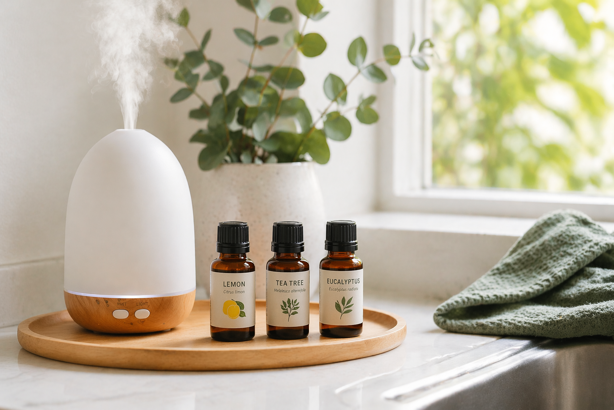
Sharp, clean and immediately effective on stale or cooking-affected air. Use extra caution in rooms where cats are present, and avoid diffusing entirely in rooms where pet birds are kept. Read the pet safety guidance before diffusing tea tree or eucalyptus around animals, particularly with prolonged or concentrated exposure.
Laundry Day
| Oil | Ratio (per 100ml) |
|---|---|
| Lemon (Citrus limon) | 3 |
| Lavender (Lavandula angustifolia) | 2 |
| Peppermint (Mentha piperita) | 1 |
That clean linen smell without any synthetic fragrance. Lighter than Fresh Start and more suitable for bedrooms or living spaces where you want the air to feel clean without smelling clinical.
After Cooking
| Oil | Ratio (per 100ml) |
|---|---|
| Lemon (Citrus limon) | 4 |
| Rosemary (Rosmarinus officinalis) | 2 |
| Eucalyptus (Eucalyptus radiata) | 1 |
Lemon gets an extra drop because cooking smells need more top note to cut through. Run this immediately after cooking rather than during, and open a window alongside the diffuser for faster results.
Winter Warmth
| Oil | Ratio (per 100ml) |
|---|---|
| Cedarwood (Cedrus atlantica) | 3 |
| Sweet Orange (Citrus sinensis) | 2 |
| Cinnamon Bark (Cinnamomum zeylanicum) | 1 |
Cinnamon is kept deliberately low. One drop is enough for warmth without making the room smell like a bakery or irritating airways. Works well from October through February. Use extra caution around cats.
Seasonal Diffuser Blends
Rotating blends seasonally prevents sensory adaptation (your brain simply stops registering scents it encounters constantly) and aligns your diffuser routine with what your environment needs at different times of year.
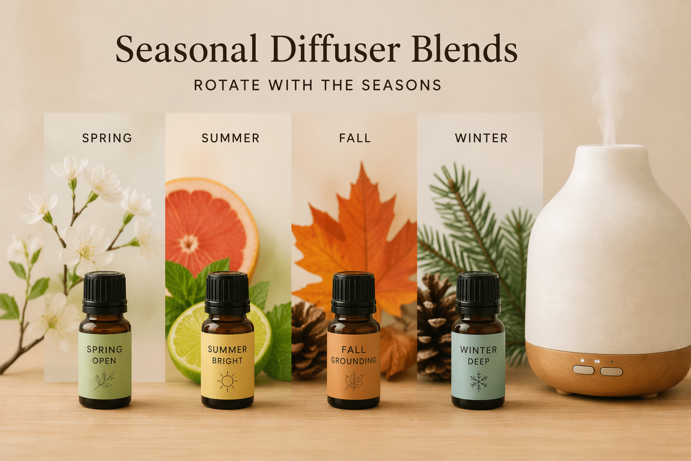
Spring Open
| Oil | Ratio (per 100ml) |
|---|---|
| Lemon (Citrus limon) | 3 |
| Geranium (Pelargonium graveolens) | 2 |
| Peppermint (Mentha piperita) | 1 |
Light, floral and fresh. Geranium adds something beyond citrus-and-mint without making the blend heavy. Good for the period when windows are opening again after winter.
Summer Bright
| Oil | Ratio (per 100ml) |
|---|---|
| Grapefruit (Citrus paradisi) | 3 |
| Spearmint (Mentha spicata) | 2 |
| Lime (Citrus aurantifolia) | 1 |
Spearmint rather than peppermint keeps this summery rather than cooling. All citrus, all uplifting. Good for mornings during warmer months when you want the room to match the energy outside.
Fall Grounding
| Oil | Ratio (per 100ml) |
|---|---|
| Cedarwood (Cedrus atlantica) | 3 |
| Sweet Orange (Citrus sinensis) | 2 |
| Cinnamon Bark (Cinnamomum zeylanicum) | 1 |
Warm, slightly spiced and comforting without being the full winter combination. Run this in the evenings as the light changes and the year starts to feel heavier.
Winter Deep
| Oil | Ratio (per 100ml) |
|---|---|
| Frankincense (Boswellia carterii) | 3 |
| Pine (Pinus sylvestris) | 2 |
| Cedarwood (Cedrus atlantica) | 1 |
Forest-like and deeply warming. Works well during the colder months when you’re spending more time indoors.
A Note on Pet Households
Several blends above include oils that warrant extra caution around cats, birds or other sensitive pets. Tea tree, eucalyptus, peppermint, cinnamon and ylang ylang are among the oils most commonly cited as higher risk for cats, particularly with prolonged or concentrated exposure. Because birds have very sensitive respiratory systems, avoid diffusing oils in the same room as pet birds. Before diffusing in a home with animals, review the full essential oils pet safety guide.
How to Build Your Own Blends
Every recipe above follows the same underlying logic. Understanding it means you can adapt any blend to the oils you have, fix combinations that aren’t working, and create new ones with a reasonable chance of success first time.
The Three-Note Structure
Essential oils are grouped by volatility into top, middle and base notes.
- Top notes evaporate quickly and are the first thing you smell. Citrus oils and peppermint are typical top notes – bright, immediate and relatively short-lived.
- Middle notes form the body of the blend and last longer. Lavender, rosemary, chamomile and geranium sit here.
- Base notes are the slowest to evaporate and the deepest in character. Cedarwood, frankincense, sandalwood and vetiver anchor a blend and give it staying power.
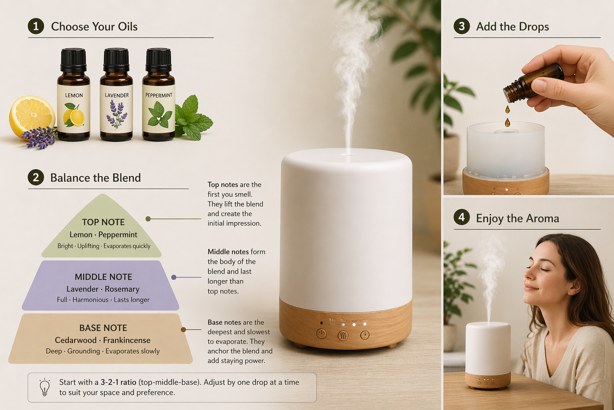
A stable blend normally uses more top note than base note. The 3-2-1 ratio used throughout this guide (three drops top, two drops middle, one drop base) is a useful starting point, not a rule. Some base notes like vetiver or ylang ylang are so concentrated that one drop goes a long way.
Adjusting for Strength
Does the blend smell flat? The top note probably needs an extra drop. If it’s overwhelming, reduce the base note first. If something smells actively unpleasant rather than just off-balance, check whether two of your oils share a note type and are competing rather than complementing. Citrus oils fade fastest. If you want a blend to maintain its brightness, add a second drop of your citrus oil 30 minutes into the session.
Tank Size Reference
| Tank size | Total drops for a 3-2-1 blend |
|---|---|
| 100ml | 6 drops |
| 200ml | 8-10 drops |
| 300ml | 9-12 drops |
| 400ml | 12-15 drops |
| 500ml | 15-20 drops |
Strong oils like peppermint, ylang ylang and cinnamon warrant fewer drops even at higher tank volumes.
Scent With Intent
A good diffuser blend does more than make a room smell pleasant. It can become part of the rhythm of your day – a cue to wake up properly, settle your thoughts, draw a line under work, or make home feel like home again.
That is where these blends become most useful. Not as a collection of recipes to scroll through once, but as small atmospheric tools you return to on purpose. Pick one blend for the start of your day, one for the end, and let them earn their place through repetition. Over time, the scent itself starts to signal what comes next.
Used that way, blending stops feeling like trial and error and starts feeling like a quiet form of design, shaping the mood of your space, a few drops at a time.
If you’re working out which diffuser to pair these with, the smart diffuser guide and the nebulizing diffuser guide cover scheduling, app control and what to look for depending on your room size and oil preferences. For keeping any diffuser running cleanly, the diffuser cleaning guide has the full maintenance routine.