
Your programmable thermostat does exactly what it’s supposed to. It sits on the wall, holds whatever temperature you last set, and asks nothing of you in return. The question isn’t whether it works. It’s whether spending $150-$280 more on a smart thermostat meaningfully changes anything that matters, like your energy bill, your comfort, or how much you think about your HVAC system at all.
This guide gives you a straight answer, including when a smart thermostat genuinely earns back its cost and when it doesn’t.
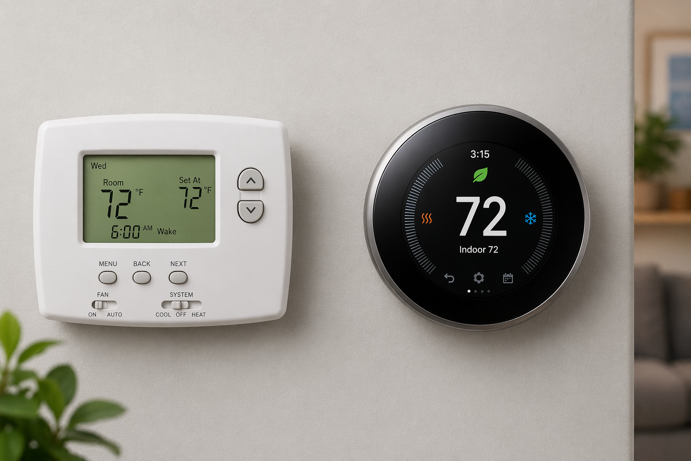
Smart vs Programmable Thermostat: At a Glance
| Feature | Programmable Thermostat | Smart Thermostat |
|---|---|---|
| Scheduling | Manual, set at the device | App-based, adjustable remotely |
| Remote control | No | Yes, via smartphone app |
| Learning | No | Some models (notably Nest) |
| Occupancy detection | No | Some models (motion sensor or geofencing) |
| Energy reporting | No | Yes |
| Smart home integration | No | Alexa, Google Home, Apple HomeKit (varies by model) |
| Wi-Fi required | No | Yes |
| Typical price | $30-$100 | $70-$280 |
| C wire | Not required | Often required (solutions exist) |
What a Programmable Thermostat Does
A programmable thermostat lets you set temperature schedules in advance. Typically, this would consist of different settings for weekday mornings, daytimes, evenings and weekends. You program it once at the device, it follows the schedule, and the heating or cooling system runs accordingly. No Wi-Fi, no app, no cloud dependency.
Done properly, this works. The Department of Energy estimates that dialing back the temperature 7-10°F for 8 hours a day can reduce heating and cooling costs by around 10%. A $50 programmable thermostat is technically capable of delivering meaningful savings.
But capability on paper means nothing without consistent use. Studies suggest many programmable thermostat owners either don’t use scheduling features or override them frequently. The interface is cumbersome, life doesn’t fit a fixed schedule, and the default setting stays put for months at a time. The thermostat holds the temperature you set when you installed it, which is often not the temperature you’d choose in every single situation.
What a Smart Thermostat Adds
A smart thermostat does everything a programmable thermostat does, plus several things it can’t.
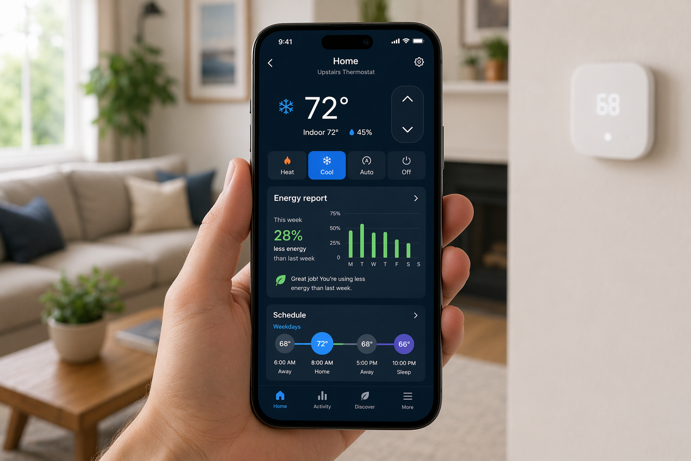
Remote control: You can adjust the temperature from anywhere via a smartphone app. Useful when you leave for vacation and realize you forgot to turn the heat down, or when you’re leaving work early on a cold day and want the house warm when you arrive.
Geofencing and occupancy detection: Many smart thermostats use your phone’s location or built-in motion sensors to detect when the house is empty and automatically switch to an energy saving mode. No manual adjustment needed. It turns temperatures down when you leave and back up before you return.
Self-learning: Models like the Nest Learning Thermostat observe your manual adjustments over the first week or two and build a schedule automatically. If you turn the heat down every night at 10 PM, it starts doing it for you. For households with irregular schedules, this closes the gap that defeats most programmable thermostat owners.
Energy reporting: Most smart thermostats track runtime hours and present them in the companion app, often with tips for reducing usage. Seeing that your furnace ran six hours yesterday makes the abstract concept of “energy bills” concrete in a way that a wall-mounted device never could.
Smart home integration: Smart thermostats connect to Alexa, Google Home, and on some models, Apple HomeKit, enabling voice control and inclusion in broader automations. A “goodnight” routine that locks the doors, turns off the lights and drops the thermostat to 65°F becomes a single command rather than three separate actions.
The Real Reason Smart Thermostats Win in Practice
On paper, a well-programmed $50 thermostat can match a $250 smart thermostat for energy savings. In practice, most people don’t program it well – or at all.
Smart thermostats remove the compliance problem. Geofencing adjustments happen automatically whether you remember or not. Schedules are set in an app rather than navigated through a small-button interface on the wall. Self-learning models eliminate the setup step entirely for households willing to make a few manual adjustments during the first week or so. The technology delivers better outcomes mainly because it actually gets used.
If you’re one of the minority who consistently programs and sticks to a thermostat schedule, you’ll see less incremental benefit from upgrading to a smart model. If you’re in the majority who sets it once and forgets it, a smart thermostat will usually reduce your energy use more than your current setup does.
Energy Savings: What the Data Says
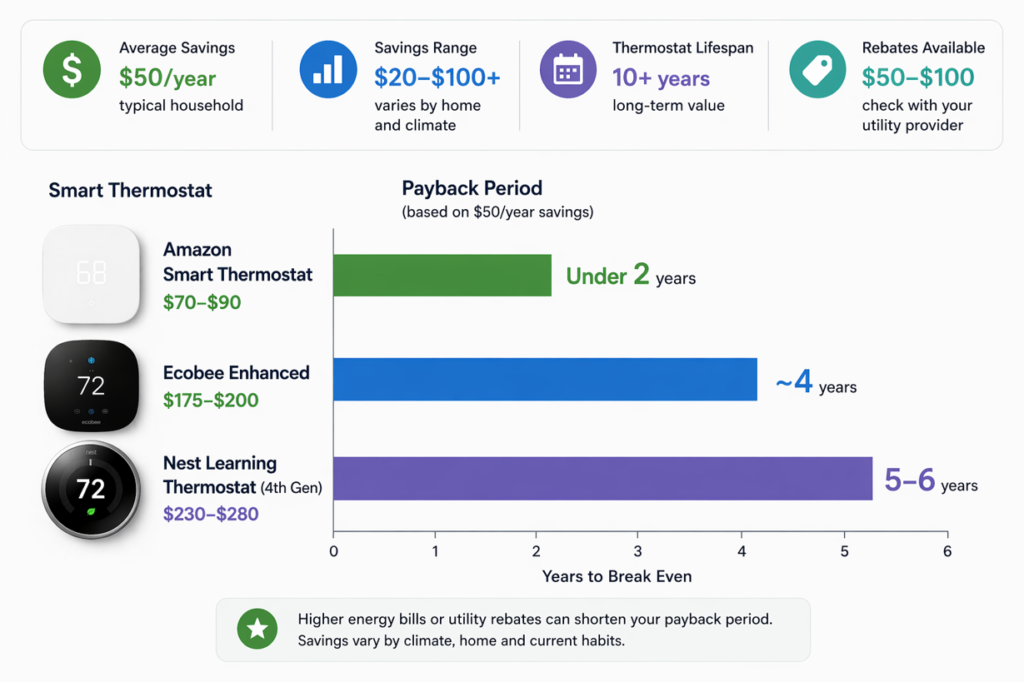
The EPA’s real world data, drawn from field installations of ENERGY STAR certified smart thermostats across the US, shows average savings of around 8% on heating and cooling bills (roughly $50 per year for a typical household). That figure reflects how these thermostats are used in homes, not a controlled lab estimate. Ecobee claims customers using its eco+ features save up to $284 per year compared to holding a constant 72°F (though that comparison is against a fixed temperature around the clock, not a properly used programmable thermostat).
A few factors determine how quickly a smart thermostat pays for itself.
Climate: Households in regions with harsh winters or hot summers run their HVAC systems harder and longer. The same 8% savings figure represents a larger dollar amount when the base bill is higher.
Current habits: If your programmable thermostat is currently set to a constant temperature around the clock, the savings potential from switching is higher. If you’re already diligent about setting the temperature whenever you leave your home or go to bed, the gap is smaller.
Utility rebates: Many US energy providers offer rebates (often in the $50-$100 range) for installing an ENERGY STAR certified smart thermostat. This can meaningfully shorten the payback period. Check with your utility company before purchasing. Some rebates must be claimed at the point of sale through the manufacturer’s website.
At a conservative $50/year savings, an ~$80 Amazon Smart Thermostat breaks even in under two years. A $200 Ecobee Enhanced takes around four years, while a $250 Nest Learning Thermostat takes five to six – both shorter if you factor in a rebate or live somewhere with high energy costs. These are reasonable timelines for a device rated to last a decade.
When a Smart Thermostat Isn’t Worth It
The “smart thermostat is always worth it” framing that dominates much of the coverage online glosses over some real situations where upgrading makes less sense.
Boiler systems with radiant heat or baseboard heaters: Steam and hot water heating systems respond slowly. Raising or lowering the temperature by a degree takes substantially longer than a forced-air system. Automated temperature adjustments don’t translate as efficiently because the system can’t react quickly enough to take full advantage. The energy savings case is much weaker here.
Heat pump systems: Heat pumps are generally efficient, but some smart thermostat temperature schedules can trigger auxiliary heat mode, an electric resistance backup that consumes considerably more power. If the thermostat calls for a large temperature recovery and the heat pump can’t keep up, the aux heat kicks in and potentially cancels out the savings. In some cases, large temperature swings can increase energy use rather than reduce it. Some thermostats (Ecobee and Nest Learning) include heat pump-specific logic to manage this. Budget models may not. Compatibility matters more with heat pumps than with any other system type.
Temperate climates: If your HVAC system runs lightly nine months of the year, the dollar value of 8% savings may be modest (potentially $20–$30 annually). The payback period extends accordingly.
Already-disciplined setters: If you manually adjust your thermostat morning and evening, turn it down when you leave and back up before you return, you’re already capturing much of the savings a smart thermostat automates. The convenience benefit remains, but the energy case is less compelling.
No C wire and a complex system: Most no C wire solutions work well for conventional forced-air systems. If you have a heat pump, multi-stage system or radiant heating, the combination of no C wire and a complex HVAC setup narrows your compatible options considerably.
Which Smart Thermostat to Buy
Three models cover the realistic range for most US households. All are available on Amazon and work with standard 24V forced-air systems.
Amazon Smart Thermostat
Price range: $70–$90
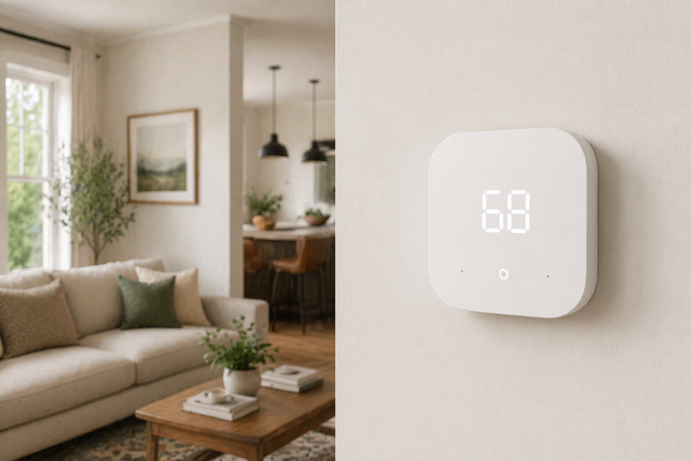
Built in partnership with Honeywell Home, the Amazon Smart Thermostat is the most accessible entry point into smart thermostat ownership. It handles scheduling, remote control and energy reports through the Alexa app, and integrates natively with Alexa Routines and Alexa Hunches – Amazon’s occupancy inference feature that can adjust temperature based on inferred activity patterns.
There’s no self-learning algorithm and no room sensor support, but for a household primarily using Alexa and wanting reliable remote access and scheduling without a large upfront cost, it does the job cleanly.
Worth Knowing: Requires a C wire or a separately purchased C wire adapter. No Apple HomeKit support. No Google Home support. Best suited to households already using Alexa as their primary smart home platform.
Ecobee Smart Thermostat Enhanced
Price range: $175–$200
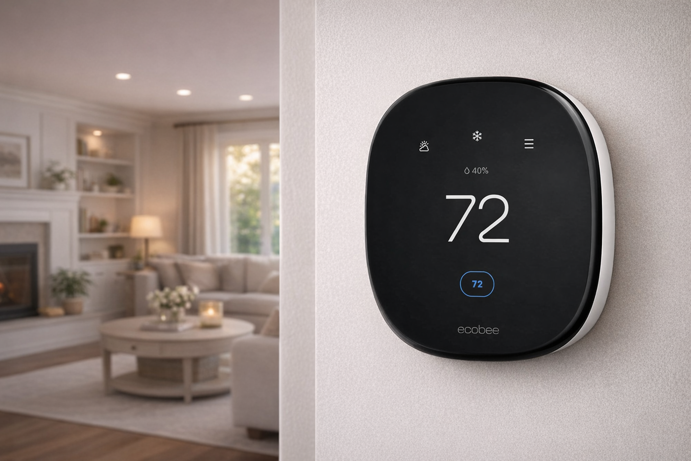
The Ecobee Enhanced sits at the mid-range and covers more ground than the price difference from the Amazon thermostat might suggest. It ships with the Power Extender Kit (PEK), which solves the C wire problem at the furnace board without running new wiring – a cleaner and more reliable solution than power-sharing approaches used by some competitors. Compatible with 90% of 24VAC systems including boilers and conventional heat pumps.
The app is polished, scheduling is straightforward, and the Ecobee’s radar-based occupancy sensing adjusts temperature based on whether anyone is in the home. It works with Alexa, Google Assistant, Apple HomeKit and SmartThings – the most complete ecosystem coverage on this list. HomeKit integration goes deeper than the Matter-based pass-through that some thermostats offer, exposing more controls natively within the Apple Home app.
Worth Knowing: Installation involves a second step at the furnace to fit the PEK. This is still DIY friendly, but takes slightly longer than a straight thermostat swap. Ecobee SmartSensors for room-level temperature and occupancy monitoring are sold separately. Run the Ecobee compatibility checker before purchasing. ENERGY STAR certified.
Google Nest Learning Thermostat (4th Gen)
Price range: $230–$280
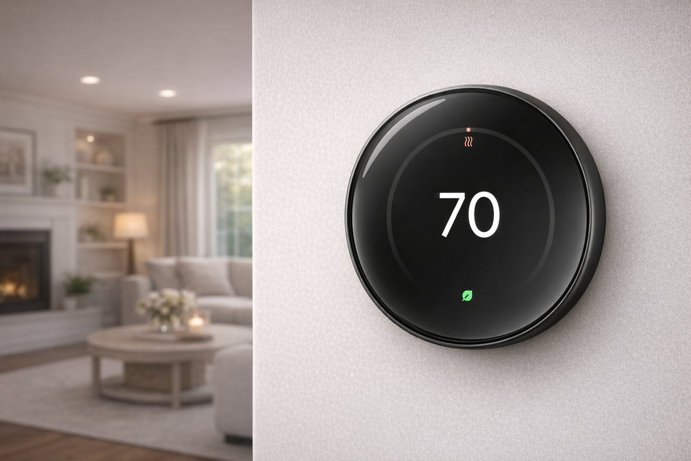
The Nest Learning Thermostat’s headline feature is self-programming. It observes your manual adjustments during the first week and builds a schedule automatically, so there is no setup required beyond installation. For households with irregular routines, or anyone who has struggled with the programming interface on a traditional thermostat, this removes the main barrier to capturing energy savings. The learning works best when you make consistent adjustments during that first week. Households that rarely touch the thermostat manually may still want to set a schedule themselves.
The fourth generation adds Matter support and a redesigned display that’s about 60% larger than the previous generation, with a bezel-free glass face and a stainless steel rotating dial. It includes a Nest Temperature Sensor in the box. For households already using Google Home, integration is more seamless than with third-party thermostats. Works with most 24V systems including heat pumps. Does not require a C wire in many installations, though some systems will need one or the Nest Power Connector. Use the compatibility checker to confirm.
Worth Knowing: No Apple HomeKit support in the traditional sense. Matter allows basic temperature and mode control in Apple Home, but advanced features including energy reports and learning adjustments remain in the Google Home app. Apple-primary households should consider the Ecobee Enhanced instead. ENERGY STAR certified.
The Verdict: Smart Upgrade or Not?
For most households, a smart thermostat makes sense – not because it adds new capabilities, but because it makes energy saving behaviour far more likely to happen consistently.
If your current setup is effectively holding a fixed temperature, or you adjust it irregularly, a smart thermostat will usually reduce energy use and improve comfort with minimal effort.
If you already use scheduling properly, have a stable routine, or your HVAC usage is low, the financial return may be minimal. In those cases, the upgrade is more about convenience than savings.
The decision comes down to how your home actually runs. Check compatibility, look for rebates, and be realistic about how often you interact with your thermostat now.
In most homes, the outcome depends more on how the thermostat is used than what model is on the wall.
Ready to choose a model? The thermostats covered above are a good starting point, but if you need more detail on C wire compatibility before buying, my smart thermostat without a C wire guide outlines some of the best options.