
Pick the wrong reptile thermostat and you’ll either spend more than necessary or end up with a controller that isn’t compatible with your heat source. Use an on/off controller with an incandescent basking bulb and you may see constant flickering and a dead bulb within weeks. Buy a basic heat mat controller for a bearded dragon, and its 108°F ceiling quickly becomes a problem.
This guide cuts through the confusion with six controllers matched to specific heating setups, species and budgets. The goal is to get you to the right controller for what you’re actually running, without overspending or buying something that falls short.
Not sure what type of heater you have? If it glows (incandescent basking bulb, halogen flood) → you need dimming or pulse proportional control. If it doesn’t glow (heat mat, ceramic heat emitter, radiant panel) → an on/off controller is generally fine. Getting this wrong is the most common (and most avoidable) thermostat purchasing mistake.
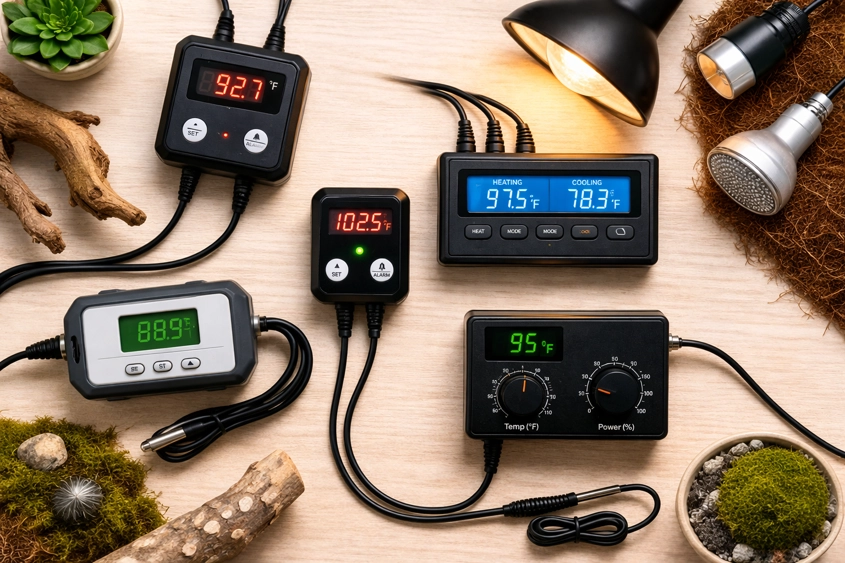
Quick Picks: Best Reptile Thermostats at a Glance
🏆 Best Overall: Inkbird ITC-608T – $50-60
Dual-stage, 12-period programmable temperature schedule, 1800W, ETL listed
📱 Best Wi-Fi / Smart Pick: Inkbird IPT-2CH – $35-40
App monitoring, dual zone, temperature alerts
⚙️ Best Proportional Control: Exo Terra Dimming & Pulse Proportional – $70-80
Purpose-built reptile brand, dimming and pulse modes, 5 year guarantee
🦎 Best Trusted Brand: Zoo Med ReptiTemp Digital RT-600 – $30-40
Built-in memory stores settings, heating and cooling modes, 600W
💰 Best Budget: BN-LINK Digital Heat Mat Thermostat – $15-25
40-108°F range, 1000W, ETL listed
🔬 Best Advanced / Multi-Zone: Spyder Robotics Herpstat 2 – $220-230
Pulse and dimming proportional, dual independent zones, built-in safety relay
30-Second Selector: Which Reptile Thermostat Is Right for You?
1. What’s your budget?
- Under $25 → BN-LINK (heat mats only, proven and reliable)
- $30-45 → Zoo Med RT-600 or Inkbird IPT-2CH (brand trust vs. Wi-Fi features)
- $50-65 → Inkbird ITC-608T (most capable mid-range option)
- $70-85 → Exo Terra Proportional (basking bulb precision)
- $200+ → Herpstat 2 (professional-grade, multi-zone control)
2. What heating device are you controlling?
- Heat mat or ceramic heat emitter → BN-LINK, Zoo Med RT-600 or Inkbird ITC-608T
- Basking lamp or incandescent bulb → Exo Terra Proportional or Herpstat 2 (dimming control required)
- Multiple heating devices independently → Inkbird IPT-2CH, Inkbird ITC-608T or Herpstat 2
3. What’s your situation?
- First enclosure, single heat mat → BN-LINK or Zoo Med RT-600
- Travel frequently, want remote alerts → Inkbird IPT-2CH
- Tropical species needing precision → Exo Terra Proportional or Herpstat 2
- Managing multiple enclosures or breeding → Herpstat 2
- Building a connected smart terrarium → Inkbird IPT-2CH
Who This Guide Is For (and Who Should Skip It)
This guide is a good fit if you: keep reptiles or amphibians in terrariums or rack systems, are upgrading from an analog dial thermostat or using no thermostat at all, want to understand the difference between on/off, dimming and proportional control before spending money, or are building or upgrading a smart terrarium with connected monitoring.
You can probably skip it if you: are looking for aquarium heater controllers (different product category with different requirements), need a thermostat for a full room or HVAC system rather than an enclosure, or are shopping for incubators specifically. Some of these controllers overlap but dedicated incubator thermostats have their own feature set.
Reptile Thermostat Comparison Table
| Model | Price Range | Control Type | Zones | Max Wattage | Wi-Fi | Best For |
|---|---|---|---|---|---|---|
| BN-LINK Digital | $15-25 | On/Off | 1 | 1000W | No | Budget / heat mats |
| Zoo Med RT-600 | $30-40 | On/Off | 1 | 600W heat / 150W cool | No | Beginners / trusted brand |
| Inkbird IPT-2CH | $35-40 | On/Off | 2 | 250W per outlet | Yes | Smart monitoring / dual zone |
| Inkbird ITC-608T | $50-60 | On/Off dual-stage | 2 | 1800W total | No | Programmable day/night temperature cycles |
| Exo Terra 300W | $70-80 | Dimming + Pulse | 1 | 300W | No | Basking bulbs / precision |
| Herpstat 2 | $220-230 | Dimming + Pulse proportional | 2 | 900W total | No | Advanced / multi-zone |
Best Reptile Thermostats for 2026
Whether you’re running a single heat mat or managing multiple enclosures with different species, there’s a controller below built for exactly that.
Inkbird ITC-608T
Best Overall | $50-60 | View on Amazon
Rating: 4.6/5
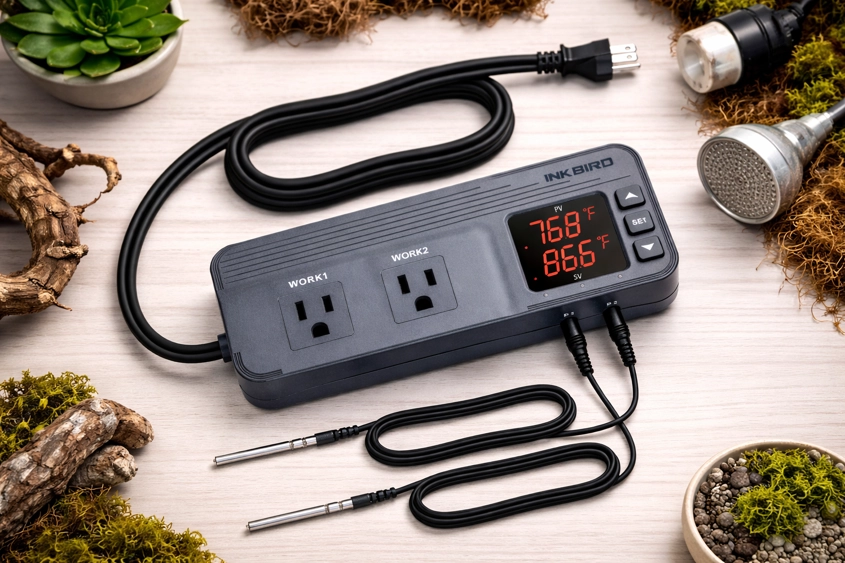
The ITC-608T earns its best overall position by packing programmable scheduling into a well-built, safety certified controller. Its 12-period time stage system lets you program different target temperatures across the day, providing genuine day/night cycling without manual intervention. It’s worth noting that this is a general purpose controller popular across reptile keeping, homebrewing and seedling setups, not a reptile-specific product. That broad user base contributes to its strong review volume and well-tested reliability.
Key Specs
- Control type: On/off dual-stage (heating + cooling)
- Temperature range: -40-212°F (-40-100°C) sensor range
- Max wattage: 1800W total (ETL listed)
- Zones / probes: 2 independent probes, 2 outlets
- Programmable periods: 12 time stages per day
- Connectivity: None (standalone)
- Alarms: High/low temperature alerts
- Compatible heat sources: Heat mats, heat tape, ceramic heat emitters, radiant heat panels
Worth Knowing
On/off control – not suitable for incandescent basking bulbs. No Wi-Fi – if remote alerts matter, the Inkbird IPT-2CH below handles that instead. The programming interface has a learning curve – read the manual before setup.
Best For
Keepers who want programmable day/night cycling without paying premium prices, ball python and boa keepers using under-tank heating or ceramic emitters, anyone running two enclosures from a single controller.
Inkbird IPT-2CH
Best Wi-Fi / Smart Pick | $35-40 | View on Amazon
Rating: 4.4/5
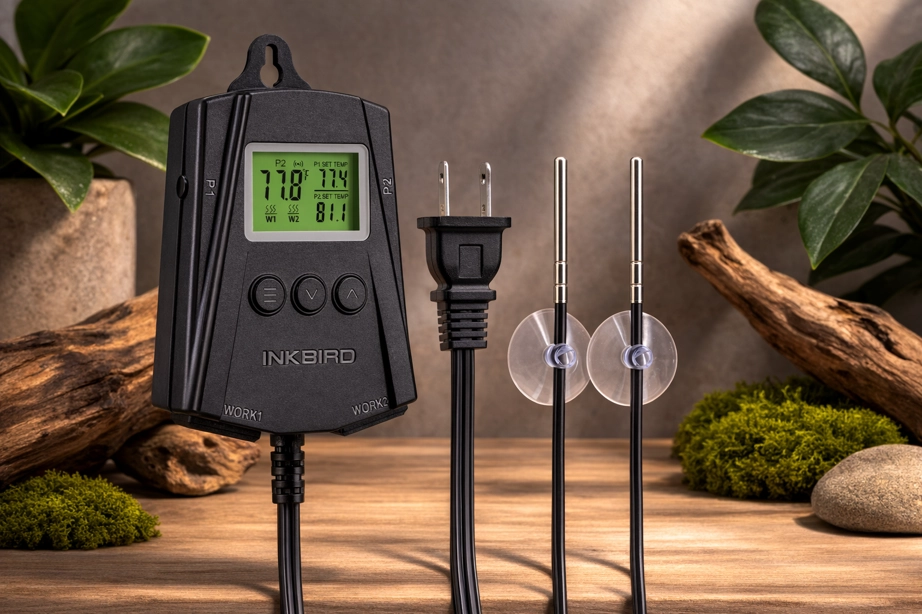
The IPT-2CH is the most affordable way to add genuine remote monitoring to a reptile setup. The Inkbird app (iOS and Android) shows live readings from both probes and sends push notifications when temperatures drift outside safe ranges – whether you’re at work, traveling or asleep. The dual-zone design runs two outlets independently, each with its own probe, and data logging generates temperature history charts that can catch gradual equipment degradation before it becomes a problem. For those building a connected smart terrarium, this is the natural starting point.
Key Specs
- Control type: On/off (heating only per outlet)
- Temperature range: 32-113°F (0-45°C)
- Max wattage: 250W per outlet (500W total)
- Zones / probes: 2 independent outlets, 2 probes
- Connectivity: 2.4GHz Wi-Fi, iOS and Android app
- App features: Live monitoring, temperature history charts, high/low alarms, probe error alerts, data export
- Compatible heat sources: Heat mats, ceramic heat emitters
Worth Knowing
The 250W per outlet limit is the key constraint. It’s fine for most heat mats and many ceramic heat emitters (typically 60-150W), but won’t handle higher wattage heaters or multi-heater setups. On/off control means it’s also not appropriate for visible basking bulbs, regardless of wattage. Some users report initial Wi-Fi pairing difficulties, usually resolved by ensuring a 2.4GHz-only connection during setup.
Best For
Keepers who travel or work long hours, anyone building a connected smart terrarium, those monitoring two enclosures or zones from a single app.
Exo Terra Dimming & Pulse Proportional Thermostat (300W)
Best Proportional Control | $70-80 | View on Amazon
Rating: 4.5/5
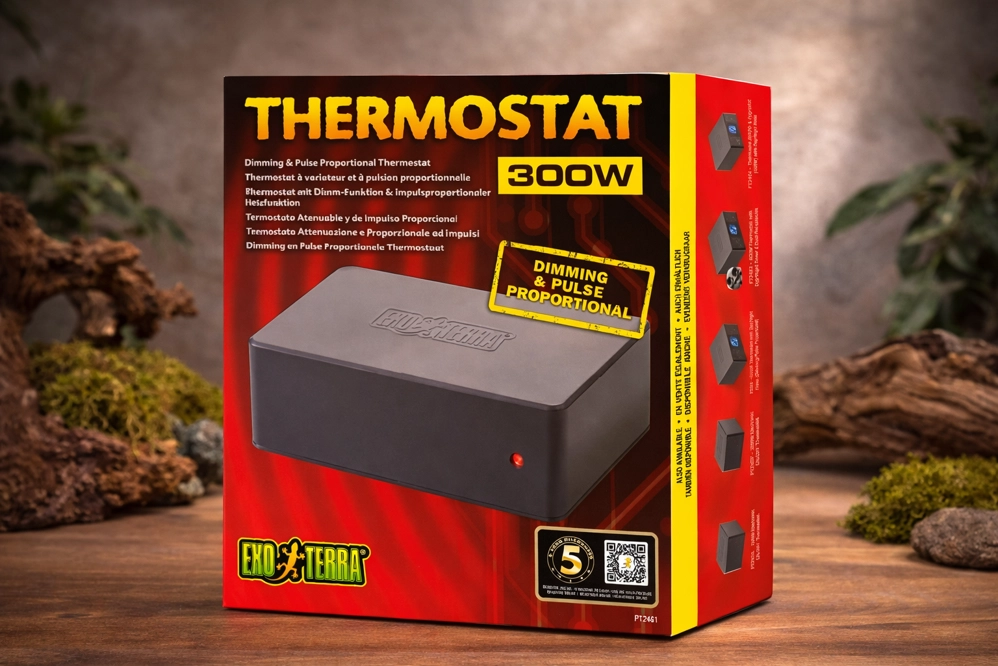
If you’re running any visible heat lamp (incandescent basking bulb, halogen flood), this is the controller type you need, and the Exo Terra is one of the few purpose-built reptile options that handles it properly. Dimming and pulse proportional control gradually adjusts power output rather than cycling the bulb on and off, producing a stable basking zone without flickering, and extending bulb life considerably. The 5 year guarantee and waterproof probe reflect genuine reptile-brand engineering rather than repurposed general hardware.
Key Specs
- Control type: Dimming and pulse proportional
- Temperature range: 64-100°F (18-38°C)
- Max wattage: 300W
- Zones / probes: 1 zone, 1 waterproof probe
- Connectivity: None (standalone)
- Warranty: 5 years
- Compatible heat sources: Incandescent heat bulbs, halogen floods, heat mats, heat cables, ceramic heaters
Worth Knowing
The 100°F ceiling refers to the probe target – the controlled measurement point. If you’re trying to control a basking probe location above 100°F, this unit tops out there. For bearded dragons or uromastyx needing 105-110°F controlled basking spots, you’ll need a higher-ceiling controller (the Herpstat 2 reaches 150°F).
Best For
Keepers running incandescent or halogen basking bulbs, tropical species setups where humidity-resistant probes matter, anyone upgrading from a basic on/off controller for the first time.
Zoo Med ReptiTemp Digital Thermostat (RT-600)
Best Trusted Brand | $30-40 | View on Amazon
Rating: 4.3/5
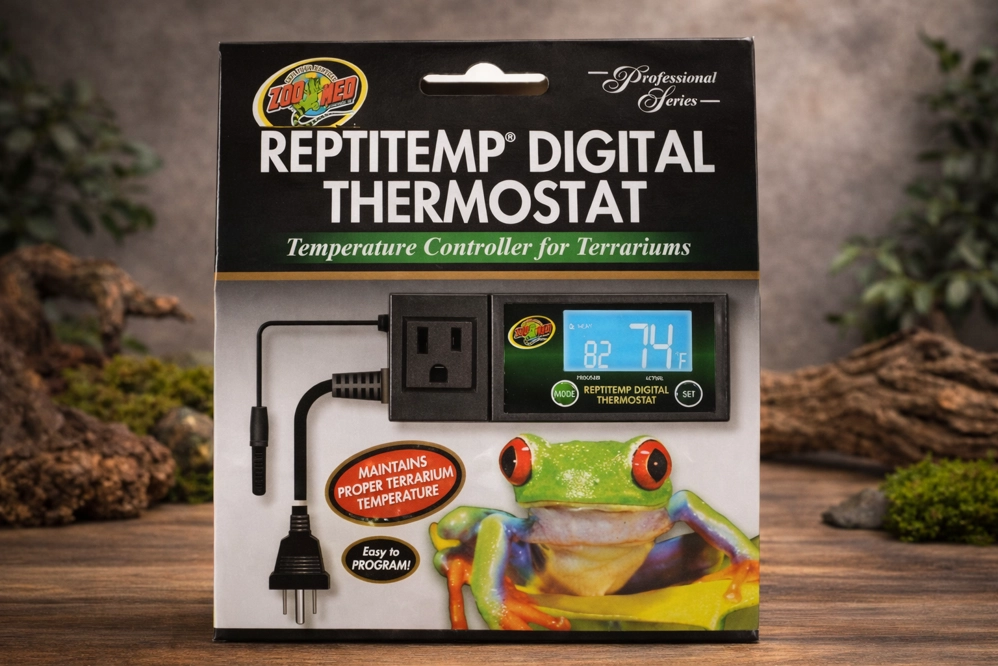
Zoo Med is one of the most recognized names in reptile care. The RT-600 maintains a single setpoint across a 50-122°F range, switches between heating and cooling modes, retains settings through power outages, and sounds an alarm when temperatures stray outside safe limits. No app, no scheduling, no Wi-Fi – and for many keepers, that simplicity is exactly what they want.
Key Specs
- Control type: On/off
- Temperature range: 50-122°F (10-50°C)
- Max wattage: 600W heating, 150W cooling
- Zones / probes: 1 zone, 6 foot probe
- Memory: Retains settings after power loss
- Alarms: High/low temperature audible and visual alert
- Compatible heat sources: Heat mats, ceramic heat emitters, under-tank heaters
Worth Knowing
On/off control only – not suitable for incandescent basking bulbs. Some users find cycling through settings to lower the target slightly cumbersome – a minor interface quirk, not a functional problem.
Best For
First time reptile keepers wanting a simple, reliable controller from a recognized brand, keepers using heat mats or ceramic emitters who don’t need scheduling or app connectivity.
BN-LINK Digital Heat Mat Thermostat Controller
Best Budget | $15-25 | View on Amazon
Rating: 4.2/5
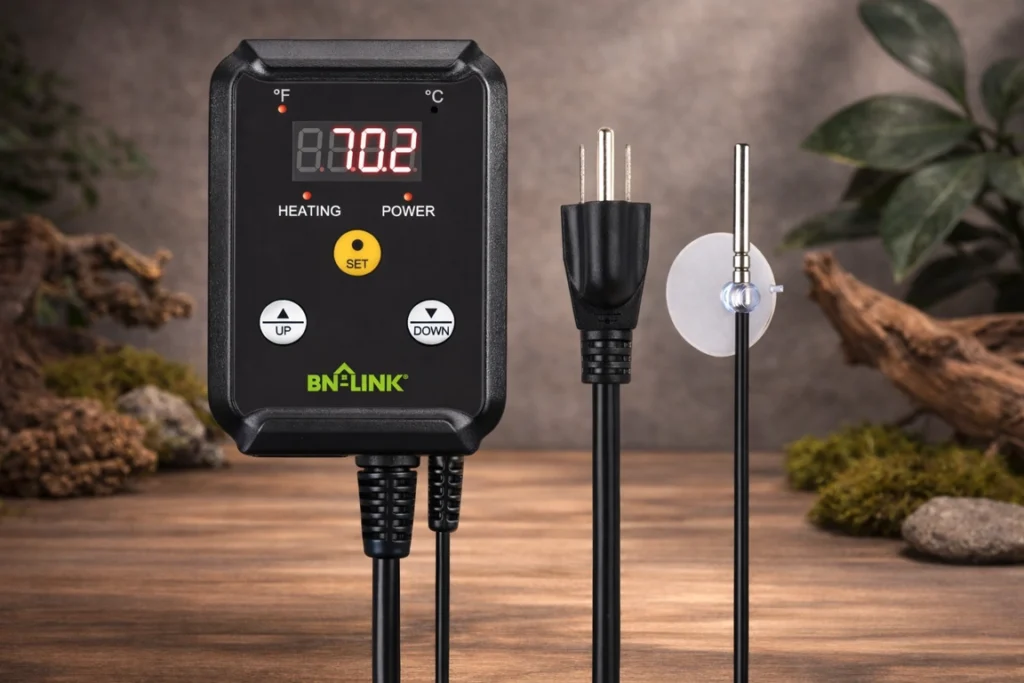
At under $20, the BN-LINK does exactly what a single heat mat setup needs – read the temperature, compare it to your setpoint, switch the mat on or off. ETL safety certification is worth noting at this price point, as it indicates independent safety testing – an important consideration when leaving a heating device running unattended.
Key Specs
- Control type: On/off (heating only)
- Temperature range: 40-108°F (4-42°C)
- Max wattage: 1000W (ETL listed)
- Zones / probes: 1 zone, 5 foot probe
- Display: LED with heating and power indicators
- Compatible heat sources: Heat mats only (heating mode only, no cooling)
Worth Knowing
The 108°F ceiling rules out bearded dragons (105-115°F basking), uromastyx (120°F+), and most monitor species. Strictly a heat mat controller. No cooling mode, no scheduling, non-waterproof probe.
Best For
First time keepers with a single heat mat setup, leopard gecko and corn snake setups, anyone testing whether thermostat control improves their enclosure before investing in a more capable unit.
Spyder Robotics Herpstat 2
Best Advanced / Multi-Zone | $220-230 | View at Spyder Robotics
Rating: 4.9/5
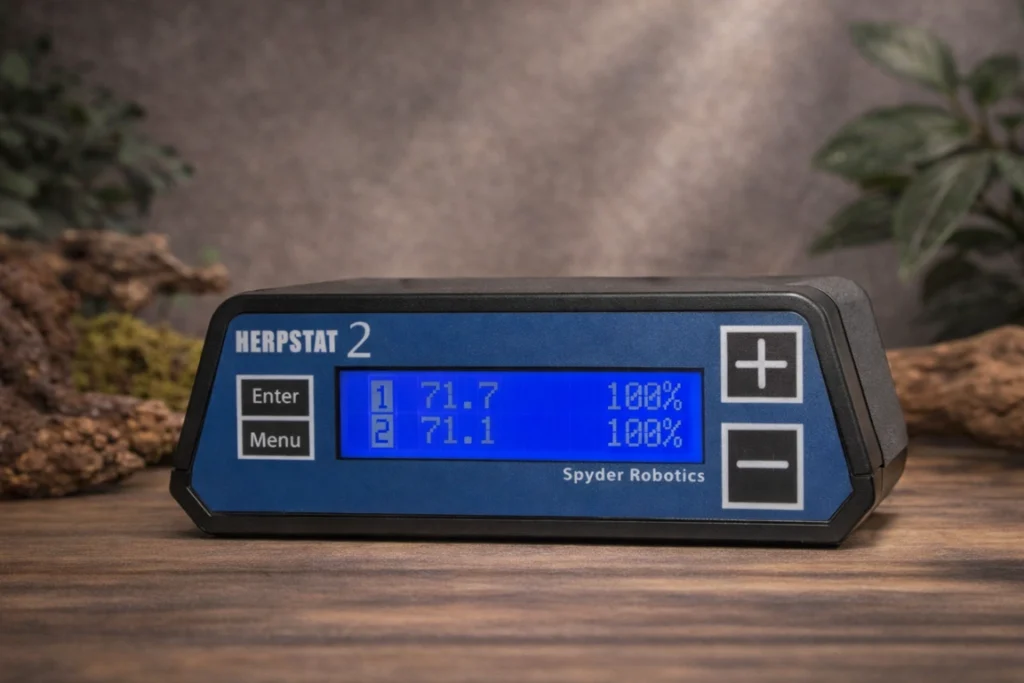
The Herpstat 2 is widely regarded among serious reptile keepers and professional breeders as the benchmark thermostat when cost is secondary to performance. Both dimming and pulse proportional modes are built in (selectable per outlet), a hardware safety relay physically disconnects power if solid state components fail, and the auto power matching algorithm continuously adjusts output to compensate for changes in ambient conditions. The two fully independent outlets allow genuinely complex setups, with up to 10-hour day/night temperature ramping per outlet. Temperature range reaches 150°F at 900W total capacity.
Key Specs
- Control type: Dimming and pulse proportional (selectable per outlet)
- Temperature range: 40-150°F (4-65°C)
- Max wattage: 900W total
- Zones / probes: 2 fully independent outlets and probes
- Connectivity: None
- Safety relay: Hardware relay disconnects all outlets if solid state failure detected
- Temperature ramping: Up to 10-hour day/night transitions per outlet
- Accuracy: ±0.9°F temperature resolution
- Warranty: 1 year limited
- Compatible heat sources: Incandescent bulbs, halogen floods, heat mats, ceramic emitters, deep heat projectors, heat tape, radiant heat panels
Worth Knowing
The price premium is substantial and only justified by use cases that require it. One leopard gecko on a heat mat doesn’t need a Herpstat – the BN-LINK or Zoo Med RT-600 will serve that animal just as well. The Herpstat earns its price for multiple enclosures, expensive or sensitive specimens, basking species requiring precise lamp control, or breeding projects where temperature consistency directly affects outcomes. The interface has a steeper learning curve than plug-and-play consumer controllers.
Best For
Serious collectors and breeders managing multiple enclosures, keepers of monitors, tegus or other species with demanding basking requirements, anyone who has experienced thermostat failures with valuable animals, rack system operators.
Other Reptile Thermostats Considered
Zoo Med ReptiTemp Dimming Thermostat (~$100): Newer touchscreen dimming controller with day/night programming and a 36-140°F range. Promising specs and a higher ceiling than the Exo Terra, but only 2 Amazon reviews at time of writing. Worth revisiting as it accumulates real world feedback.
Inkbird ITC-308 Wi-Fi (~$50): Popular single-zone Wi-Fi controller widely used by homebrewers that reptile keepers have also adopted. Competent unit, but the IPT-2CH is purpose-designed for reptile enclosures.
Vivarium Electronics VE-300 (~$130-150): Well-regarded proportional controller popular in the ball python community. Sold primarily through specialist retailers. The Herpstat 2 offers a broader feature set at a similar price tier.
Spyder Robotics Herpstat 1 (~$150): Single-zone version of the Herpstat 2. A logical step down if you only need one outlet.
Reptile Thermostat Buying Guide
On/Off vs Dimming vs Pulse Proportional: What’s the Difference?
On/off controllers work with heat mats, ceramic heat emitters and radiant heat panels. They are not ideal for use with incandescent basking bulbs or halogen lamps, as the constant power cycling causes visible flickering and dramatically shortens bulb life. Dimming and pulse proportional controllers are the correct choice for any visible basking lamp. When in doubt, check the manufacturer’s documentation for your particular heating device before purchasing a controller.
Wattage: Match Your Controller to Your Load
Add up the wattage of every heating device you plan to connect and choose a controller rated above that total, not right at the limit. Typical wattage ranges include: heat mats 15-45W, under-tank heaters 8-24W, ceramic heat emitters 60-150W, deep heat projectors 50-80W, halogen basking bulbs 50-100W, incandescent basking bulbs 40-100W. A 300W controller handles most single enclosure setups. Rack systems or high wattage basking combinations may need 600W+ capacity.
How Many Zones Do You Actually Need?
A single-zone controller manages one probe and one setpoint, which is sufficient for most beginner setups. Dual-zone controllers independently manage two heating devices, either in the same enclosure (hot end and cool end) or across two separate enclosures. Don’t pay for zones you don’t need, but don’t under-spec if your setup genuinely requires independent control.
Safety Features Worth Checking
Temperature alarms alert you when readings deviate beyond safe limits. Built-in memory retains settings after power loss, so the controller resumes correctly after an outage. Probe failure detection shuts down the heating device if the sensor malfunctions. At the premium end, hardware safety relays (as on the Herpstat) provide a physical failsafe if solid state components fail. ETL or UL certification indicates independent safety testing – worth prioritizing on lower priced units.
Probe Placement Fundamentals
Position the probe directly under the heat source at the level your animal basks – not on the glass wall, not buried in bedding. For under-tank heaters, place it on the enclosure floor above the mat. In high humidity setups, use a waterproof rated probe. Secure the probe so the animal cannot move it. A displaced probe can trick the thermostat into overheating the enclosure.
Frequently Asked Questions
Do I need a thermostat for a ceramic heat emitter (CHE)?
Yes. Without a thermostat, a CHE runs at full power continuously, and enclosure temperature is determined entirely by ambient room conditions and distance from the lamp. CHEs run very hot. A cool night or a warm room can push temperatures well outside your intended range. An on/off thermostat is the appropriate controller – dimming or pulse proportional control is not required for non-light heat sources.
What’s the difference between a thermostat and a thermometer?
A thermometer measures and displays temperature but takes no action. A thermostat measures temperature and controls a heating device based on that reading. Both are useful. A thermostat manages the heater, while a separate thermometer or infrared temp gun lets you verify actual temperatures at different points in the enclosure, independent of what the thermostat probe reads.
What’s the difference between dimming and pulse proportional control?
Both modulate power gradually rather than switching fully on or off. Dimming controllers decrease voltage to the heating device. Pulse proportional controllers maintain full voltage but cycle on and off at millisecond intervals, averaging to a reduced effective power level. Dimming is generally preferred for visible light sources as it produces smoother illumination. Both are significantly better for basking lamp longevity than on/off control.
Making Your Decision
The right thermostat comes down to three things – the type of heating device you’re running, the number of zones you need, and whether remote monitoring is crucial. Everything else follows from those fundamentals.
- Single heat mat, first enclosure: The BN-LINK gets the job done at minimal cost.
- Want a trusted name with heating and cooling modes: The Zoo Med RT-600 – simple, reliable, recognized brand.
- Travel frequently or want remote alerts: The Inkbird IPT-2CH – most affordable entry into app-based monitoring and dual-zone control.
- Want programmable day/night cycles: The Inkbird ITC-608T – 12-period scheduling and dual-stage control at a mid-range price.
- Running basking bulbs: The Exo Terra Proportional – dimming and pulse modes with a 5 year guarantee from a purpose-built reptile brand.
- Managing a collection, breeding project or demanding species: The Herpstat 2 – buy it once and stop thinking about your thermostat.
A Cooler Way to Control Heat
A thermostat turns a heat source into a controlled habitat. Temperatures stay steady, bulbs last longer, and the enclosure behaves the same on Tuesday afternoon as it does at midnight.
One important decision comes first – match the controller to the heater. Heat mats and ceramic emitters work well with simple on/off control. Basking bulbs and halogens perform best with dimming or proportional control. Once that pairing is right, the rest of the features are mostly convenience. Place the probe carefully, confirm temperatures with a separate thermometer, and the enclosure stops running on guesswork.
Reptiles depend on heat for nearly everything – digestion, activity, appetite, even immune function. Get the temperature right, and a surprising number of other things fall right into place.
For more on building a fully connected reptile setup, see my guides on automated humidity and misting systems and smart terrariums.