
A bearded dragon’s basking spot can drop to 72°F overnight while you sleep. Ball python enclosures can drop to 35% humidity during the winter heating season. Some rare gecko species need precise temperature gradients that analog thermostats may struggle to maintain. Traditional reptile keeping means constant monitoring, manual adjustments, and hoping your heat lamp doesn’t fail while you’re at work. If you’ve ever checked your enclosure three times before leaving the house, you’re not alone.
Smart terrariums solve these problems with automated climate control, real-time monitoring and remote alerts. These IoT-enabled enclosures maintain temperature, humidity and lighting on programmed schedules, adapting to your pet’s needs without constant intervention. Whether you’re keeping a single gecko or managing a collection of rare morphs, smart terrarium technology transforms reptile care from labor intensive guesswork into data driven precision.
What Is a Smart Terrarium?
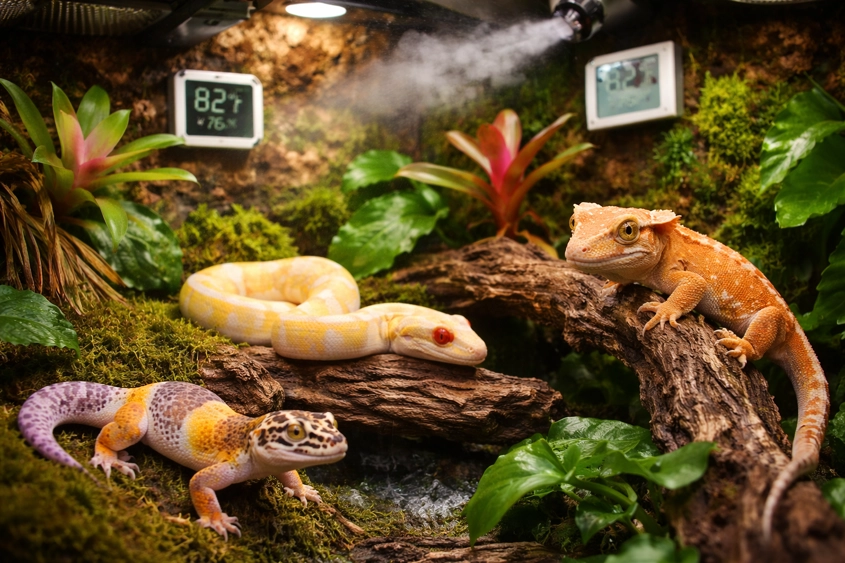
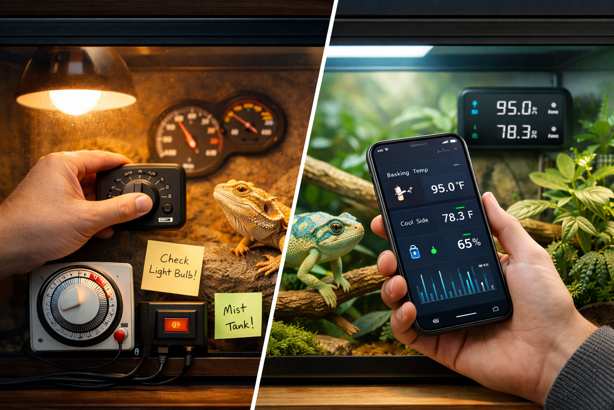
A smart terrarium is a reptile or amphibian enclosure equipped with connected sensors, controllers and automation that manage environmental conditions. Unlike basic setups with manual timers and analog thermostats, these automated reptile habitats continuously monitor temperature, humidity and lighting while making automatic adjustments to maintain optimal ranges.
The technology centers on advanced thermostats and environmental controllers that automate climate management. You set target parameters for your species, and the system handles the rest. If humidity drops below your specified range, a connected misting system activates. When basking temperatures exceed your set value, heating elements decrease power output. Wi-Fi models allow smartphone monitoring and send notifications when manual intervention is needed, while programmable controllers manage conditions through built-in displays and schedules.
Smart reptile enclosures range from DIY setups using individual smart components to fully integrated commercial systems. You might retrofit an existing enclosure with a Wi-Fi thermostat and humidity controller, or purchase a complete smart terrarium with built-in sensors and app control. Both approaches provide the same core benefit – precise environmental management with minimal effort.
Core Components of Smart Terrarium Systems
Smart Thermostats and Temperature Controllers
The foundation of any smart terrarium is temperature regulation. Controllers like the Inkbird ITC-608T (widely adapted by reptile keepers) or purpose-built systems like the Microclimate Evo Connected control heating devices with far greater precision than their analog alternatives.
These controllers typically offer three regulation methods:
- On/Off control: Simple power cycling, suitable for heat mats and ceramic heat emitters (±3-5°F accuracy)
- Dimming control: Gradual power adjustment for incandescent bulbs and deep heat projectors (±1-2°F accuracy)
- Pulse proportional: Rapid power pulsing for ultra-precise control with many heating elements (±0.5-1°F accuracy)
The accuracy ranges above are rough performance estimates under ideal conditions. Real world results will vary based on enclosure size, probe placement, airflow patterns and heat source characteristics.
Dimming thermostats are often preferred for visible basking bulbs because they deliver smoother light output and may extend bulb life compared to rapid on/off cycling.
Premium models support multiple zones simultaneously, managing both hot and cool ends of your enclosure independently. You can program day/night temperature drops, simulate seasonal variations, and receive alerts if temperatures drift outside safe ranges.
Humidity Monitoring and Control
Many reptiles and amphibians require specific humidity ranges that vary by species and life stage. Smart humidity controllers pair hygrometer sensors with automated misting systems, foggers or humidifiers to maintain target levels.
Controllers monitor humidity continuously, activating connected equipment when readings fall below your chosen setting. Advanced systems schedule misting sessions during certain hours to prevent oversaturation and allow proper drying periods between cycles.
Tropical species like chameleons, dart frogs and crested geckos benefit most from automated humidity control. Desert species with lower requirements may only need basic monitoring without active control.
For a full breakdown of the best automated misting systems and foggers for terrarium use, see our terrarium mister and reptile fogger guide.
Intelligent Lighting Systems
Reptiles need light cycles that match their natural habitat. Smart terrarium controllers manage UVB lamps, basking lights and nighttime heat sources on programmable schedules that can simulate dawn, daytime, dusk and night cycles.
Basic systems use digital timers with Wi-Fi connectivity for remote scheduling and status checks. Sophisticated setups gradually dim lights to mimic natural sunrise and sunset, reducing stress on light-sensitive species. Some controllers can even adjust day/night light cycles seasonally, extending daylight hours in summer and shortening them in winter to support natural breeding cycles.
How Smart Terrarium Technology Works
Sensor Networks and Data Collection
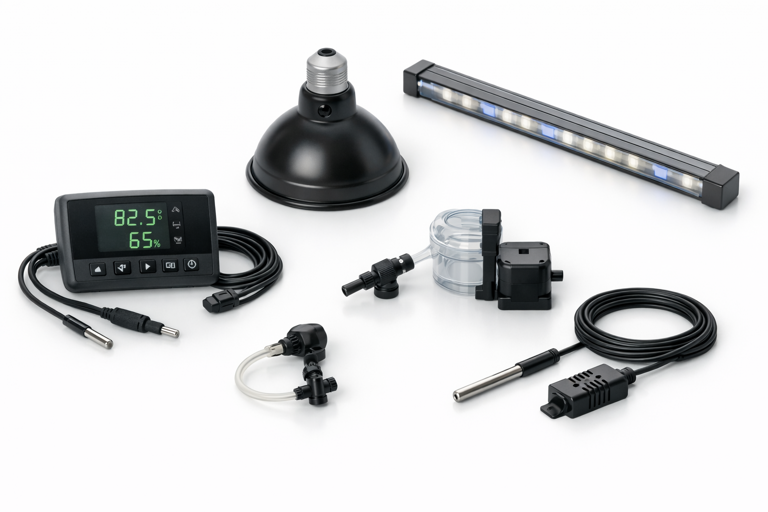
Temperature and humidity probes continuously measure conditions at critical locations – basking spots, cool zones and ambient air. These sensors transmit readings to controllers every few seconds, building a real-time picture of your enclosure’s microclimate.
Placement is important here. Temperature probes should sit directly under basking lights and in the coolest area to ensure accurate gradient measurements. Humidity sensors work best positioned at mid-height in the enclosure, away from water bowls or misting nozzles.
Control Logic and Automation
Controllers use PID (Proportional-Integral-Derivative) algorithms or simpler threshold based logic to maintain setpoints. When temperature drifts from target, the system calculates how much adjustment is needed and regulates power to heating elements accordingly.
Dimming and pulse proportional thermostats prevent the temperature fluctuations common with simple on/off control. Instead of cycling between full power and off, they deliver precise amounts of heat continuously, maintaining more stable conditions.
Connectivity and Remote Access
Wi-Fi enabled controllers connect to your home network over 2.4GHz Wi-Fi. Companion apps (iOS and Android) let you monitor conditions, adjust settings and receive alerts from anywhere with Internet access.
Bluetooth models offer local connectivity within 30 feet but lack remote access. These work fine if you’re home regularly but won’t notify you of equipment failures when you’re away.
Cloud based systems store historical data, generating graphs that show temperature and humidity trends over days, weeks or months. This data helps identify equipment degradation, seasonal adjustments needed or problems with enclosure design.
Benefits of Smart Terrarium Systems
Precise Environmental Control
Reptiles are ectothermic, meaning they can’t regulate their body temperature internally. They rely entirely on their environment to maintain proper metabolic function. Temperature errors of just a few degrees can impair digestion, immune function and overall health.
Smart thermostats help keep basking zones far more consistent than the constant up-and-down common with basic analog control. This consistency supports optimal digestion, reduces stress, and lowers the risk of problems linked to poor temperature and humidity control.
Automated Day/Night Cycles
Manual timers work, but they can’t simulate natural environmental changes. Smart controllers drop temperatures gradually at dusk, maintain lower nighttime ranges and warm up slowly at dawn. This mimics wild conditions far better than abrupt on/off cycles.
Species-specific programs accommodate varying needs. Nocturnal geckos might need 85°F days, dropping to 72°F at night, while diurnal monitors may require 95°F basking with 80°F nighttime lows. Smart systems handle these complex schedules automatically.
Early Problem Detection
Equipment failures happen. Heat bulbs burn out, thermostats malfunction and power supplies fail. Without monitoring, these failures can seriously harm reptiles quickly through overheating or hypothermia.
Smart systems send push notifications when temperatures deviate from safe ranges, humidity drops critically low or sensors detect failures. You’ll know immediately if your snake’s heat mat stops working at 3 AM, giving you time to implement backup heating before problems become life threatening.
Reduced Daily Maintenance
Traditional setups require constant attention – checking temperatures multiple times a day, manually misting for humidity, adjusting timers seasonally, and second-guessing whether conditions are right. Smart systems handle much of this automatically.
You’ll still need to provide food, clean enclosures and perform health checks, but environmental management becomes largely hands-off. This makes reptile keeping more accessible to people with demanding work schedules or those managing multiple enclosures.
Peace of Mind During Travel
Leaving reptiles with pet sitters can create anxiety for pet owners. Will the sitter maintain proper temperatures? Remember to mist? Notice if equipment fails? Wi-Fi enabled smart systems let you monitor conditions remotely and alert caretakers to issues that arise, rather than relying on their judgment alone.
You can even make adjustments remotely if conditions drift. If your sitter accidentally leaves a window open and temperatures drop, you can boost heating from your phone without needing them to understand your entire setup.
Building Your Own Smart Terrarium
Starting Simple: Single-Zone Temperature Control
The most accessible entry point is adding a Wi-Fi thermostat to an existing setup. Budget around $50-100 for a basic Wi-Fi thermostat or controller that connects between your heat source and wall outlet, with a temperature probe placed in your enclosure.
This basic upgrade delivers smartphone monitoring, programmable schedules and temperature alerts. You’ll see exactly what conditions your reptile experiences and receive warnings before problems occur.
Intermediate: Multi-Zone Temperature and Humidity
Proper temperature gradients require controlling multiple heat sources independently. A two-zone controller manages basking lamps and under-tank heating separately, while humidity controllers automate misting systems.
Budget around $150-300 for quality equipment at this level. Dual temperature control with high accuracy delivers precise gradient management, and you can add separate humidity control or choose an all-in-one system that handles both through one device.
Advanced: Fully Integrated Smart Enclosures
Complete smart terrarium systems integrate sensors, controllers and enclosures into unified platforms with Wi-Fi connected controllers, smartphone apps, cloud data logging, multiple heating zones and advanced scheduling.
These systems cost $200-500+ but offer capabilities DIY setups struggle to match. You can program complex seasonal variations, monitor multiple enclosures through one app and access sophisticated features like VPD (Vapor Pressure Deficit) calculations for optimal plant growth in bioactive setups.
Smart Terrarium Setup Guide: Step by Step
Once you’ve chosen your hardware level, setup follows the same basic process regardless of your automation approach.
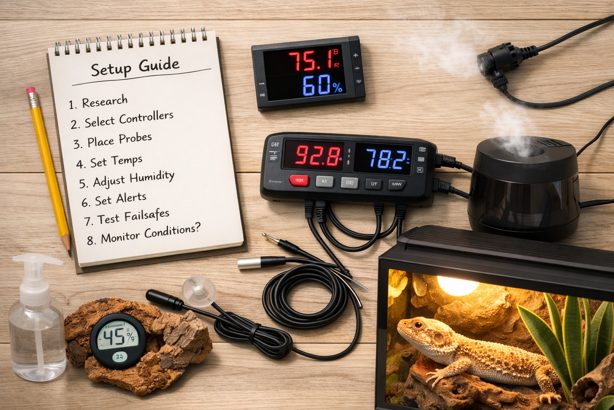
- Research species requirements: Document target temperature ranges (basking and cool end), humidity levels and day/night lighting schedule before selecting equipment. Cross-reference multiple care sheets to identify agreed-upon ranges.
- Select appropriate controllers: See our guide to the best reptile thermostats for detailed comparisons of control types and accuracy levels suited to different species and budgets.
- Position temperature probes strategically: Place basking zone probes directly under heat lamps at reptile height. Cool zone probes go at the opposite end, away from heat sources. Secure probes so your reptile can’t move or damage them.
- Configure day and night temperatures: Program daytime basking and ambient temperatures along with nighttime drops. Many species benefit from a modest nighttime temperature decrease (often by around 5-15°F), but confirm what’s appropriate for your species.
- Set humidity controls: If using automated misting, program session frequency and duration based on bedding type and enclosure ventilation. Start conservative and adjust based on hygrometer readings.
- Establish alert thresholds: Configure notifications for critical deviations (for example, temperatures well outside your normal basking or cool zone targets, or humidity levels that pose health risks). Avoid setting alerts too sensitive or you’ll likely end up ignoring important warnings.
- Test failsafe mechanisms: Verify alerts trigger correctly by temporarily unplugging heat sources. Confirm the app notifies you and that manual overrides function as expected.
- Monitor baseline conditions: Run the system for 48 hours before introducing animals, being sure to log temperature and humidity patterns. This will identify problems with equipment placement or programming before your reptile depends on it.
Choosing Smart Terrarium Equipment
Thermostat Selection Criteria
Accuracy requirements: Budget on/off thermostats (±3-5°F) work for hardy species like corn snakes or leopard geckos. Sensitive species like panther chameleons or rare morphs justify pulse proportional models (±0.5-1°F) costing around $150-400.
Control method: On/off control suffices for heat mats and ceramic emitters. Dimming models are often preferred for visible basking bulbs to provide smoother light output. Pulse proportional works with many heating elements and delivers the tightest temperature control.
Number of zones: Single-zone controllers will often be enough for small enclosures with one heat source. Larger setups or complex gradients, on the other hand, may need multi-zone controllers managing basking lamps, ambient heat and nighttime heating independently.
Connectivity: Wi-Fi enables remote monitoring and alerts while you’re out. Bluetooth works fine if you’re home daily but won’t notify you of emergencies when away. Hub based systems using Zigbee or Z-Wave integrate with broader smart home ecosystems.
Power capacity: Match controller wattage to your heating devices. Small heat mats draw 15-45W, ceramic emitters 60-150W, and basking combinations might total 200-300W. Under-powered controllers can create safety hazards.
Humidity Control Considerations
Not all species need automated humidity. Desert reptiles like bearded dragons, uromastyx and leopard geckos thrive at 30-40% humidity, achievable with water bowls alone. Tropical species like green tree pythons, red-eyed tree frogs and day geckos require 60-80% humidity, maintained through active misting.
Automated misting systems pair with hygrostat controllers to maintain precise levels. Entry level options with timer functions cost $50-100. Premium systems with Wi-Fi monitoring and programmable multi-session misting run $150-300.
App and Integration Quality
The app determines whether your smart system will delight or frustrate. Before buying, check recent reviews for connectivity issues, abandoned development or forced subscription fees. Look for:
- Intuitive interface with clear status displays
- Reliable push notifications (not excessive or missed)
- Historical data graphing (day/week/month views)
- Offline functionality (local control if Wi-Fi drops)
- Regular updates and active development
Smart home integration through Alexa, Google Home or Apple HomeKit offers voice control and automation. While not essential, integration allows routines like “vacation mode” that adjusts multiple enclosures simultaneously or triggers alerts through your home security system.
What You Can Automate (and What You Shouldn’t)
Ideal for Automation
- Temperature regulation: The primary benefit of smart systems. Consistent, precise heating improves health outcomes dramatically.
- Humidity maintenance: Scheduled misting with hygrostat control keeps tropical species in optimal ranges without manual spraying.
- Lighting schedules: Day/night cycles, UVB timing and seasonal adjustments all benefit from automation.
- Environmental monitoring: Continuous data collection identifies problems and tracks long term trends.
Don’t Automate These
- Feeding: Automated feeders exist but most reptiles eat irregularly and need observation during feeding for health assessment.
- Water changes: Bowls need daily cleaning. Automation risks bacterial growth in stagnant systems.
- Health monitoring: No sensor replaces visual inspection for weight loss, injuries, parasites or behavioral changes.
- Spot cleaning: Waste removal and bedding maintenance remain manual tasks requiring judgment.
Smart systems reduce environmental management workload by roughly 70-80% but don’t eliminate the need for regular care and observation. Think of them as precision tools that free your time for aspects of keeping that genuinely require human attention.
Common Challenges and Solutions
Wi-Fi Connectivity Issues
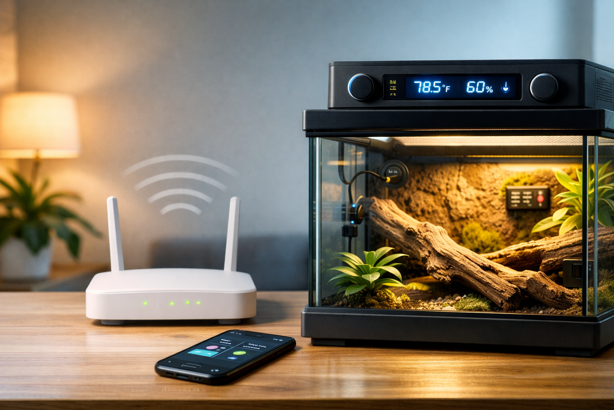
Most Wi-Fi enabled smart terrarium controllers use 2.4GHz exclusively. They won’t connect to 5GHz-only networks or automatically switch between dual-band routers. Ensure your router broadcasts a 2.4GHz network with WPA2 security (WPA3-only networks may cause compatibility issues).
Enclosures in basements or far from routers may need Wi-Fi extenders. Mesh network systems like Eero or Google Wifi work well, providing consistent 2.4GHz coverage throughout homes. Some controllers also support local control even when Internet access drops, maintaining basic functionality during outages.
Sensor Probe Failures
Temperature and humidity probes eventually degrade through exposure to moisture and bedding. Most systems detect probe failures and alert you, but periodic testing helps confirm the readings are still accurate.
Keep spare probes on hand. When controllers display “Err” or erratic readings, probe replacement usually costs $10-30 and takes minutes to swap. Premium systems use higher quality probes, which can last years with proper care.
False Alarms and Notification Fatigue
Overly sensitive alerts create notification fatigue, training you to ignore warnings. Configure thresholds thoughtfully. If your leopard gecko’s cool side occasionally drops to 73°F instead of 75°F, that’s not necessarily an emergency requiring immediate alerts.
Reserve critical notifications for genuine problems like basking zones exceeding safe limits, cool sides dropping dangerously low or humidity staying above 90% for extended periods (which can increase respiratory risk for some species). Set warning levels for minor deviations that need attention within hours rather than minutes.
Power Outages and Backup Systems
Extended power loss disables all heating and monitoring. Uninterruptible power supplies (UPS) offer a backup solution for critical systems. A 600VA UPS like the APC BE600M1 can run a thermostat and heating equipment, though runtime varies significantly with total wattage – from under an hour for high wattage ceramic emitters to several hours for low power heat mats.
For extended outages during travel, consider chemical heat packs, portable generators or arrangements with friends who can provide emergency care. Wi-Fi controllers alert you to power failures, but you need contingency plans to act on those warnings.
Cost Analysis: Smart vs. Traditional Setups
Traditional analog thermostats cost $15-30 each. A basic two-zone setup with separate day/night heat sources runs $30-60 for temperature control alone, plus $15-25 for manual timers and basic thermometers. Smart equivalents cost $35-100 for entry level single or dual-zone Wi-Fi thermostats, $150-300 for mid-range dual-zone systems with humidity control, and $300-500 for premium multi-zone controllers with comprehensive environmental management.
The upfront premium looks smaller when you factor in the benefits:
- Reduced veterinary costs from preventing temperature related illness
- Lower mortality rates among sensitive or expensive specimens
- Energy savings through efficient heating (precision control prevents waste)
- Time savings (~5-10 hours monthly of manual monitoring eliminated)
For keepers with a single pet store leopard gecko, basic analog equipment should do the job. Breeders managing collections, owners of rare morphs, or keepers of demanding species like chameleons or monitors generally find smart systems pay for themselves over time through improved stability and fewer equipment failures.
Smart Terrariums for Different Species
Desert Reptiles (Bearded Dragons, Leopard Geckos, Uromastyx)
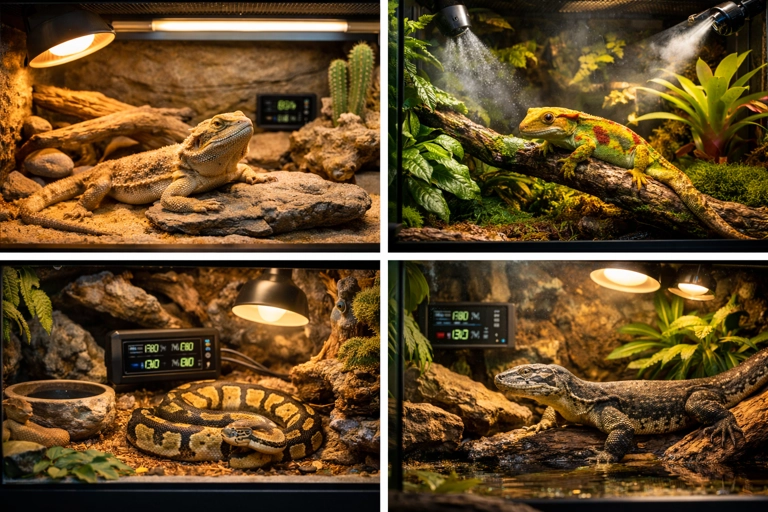
These species tolerate wider temperature ranges and lower humidity, making them easier to manage for beginners. A single-zone Wi-Fi thermostat managing basking temperatures covers essential needs. Automation value comes primarily from remote monitoring and day/night cycles rather than precision humidity control.
Tropical Species (Chameleons, Tree Frogs, Crested Geckos)
High humidity requirements and narrow temperature tolerances make tropical species ideal candidates for smart systems. Automated misting maintains 60-80% humidity without daily manual spraying, while precise temperature control supports stable conditions.
Snakes (Ball Pythons, Boas, Corn Snakes)
Most snakes need stable temperatures but moderate humidity. Two-zone controllers managing under-tank heating and ambient temperatures provide the gradient snakes use to thermoregulate. Humidity automation benefits tropical species like ball pythons and green tree pythons during shedding cycles.
Monitors and Large Lizards
Large enclosures for savannah monitors, tegus or iguanas present heating challenges. Multiple basking zones, ambient heat sources and nighttime temperature maintenance require sophisticated control that smart systems handle efficiently. The high replacement cost of these species also justifies premium equipment investments.
Smart Terrarium Technology for Bioactive Setups
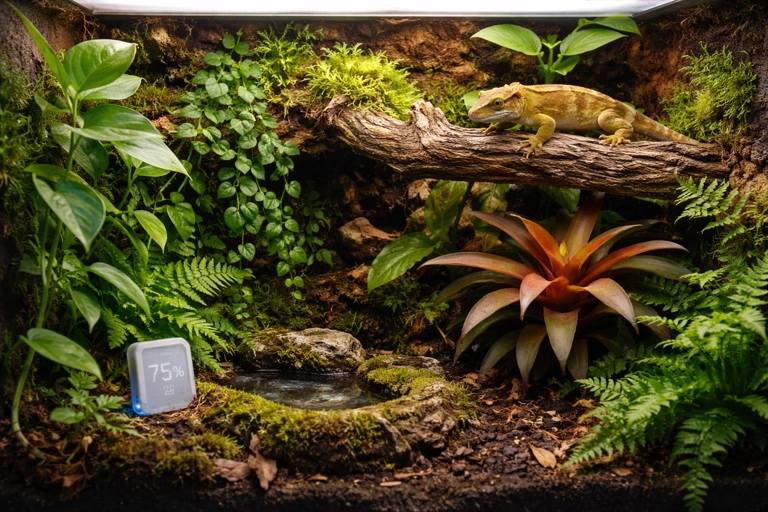
Bioactive terrariums combine reptile keeping with live plants, creating self-sustaining ecosystems. These setups require balancing animal needs with plant requirements.
Smart systems excel here by managing competing demands:
- Plant growth benefits from stable humidity (60-70%), while some reptiles prefer drier periods
- Lighting schedules must provide enough daylight hours for photosynthesis while respecting reptile day/night cycles
- Temperature gradients for reptiles must coexist with relatively uniform temps plants prefer
Advanced controllers solve these conflicts through independent zone management. Basking areas reach temperatures suitable for reptiles while planted sections maintain moderate ranges. Misting systems hydrate plants without over-saturating reptile hiding spots.
Some hobbyists integrate smart plant sensors into bioactive terrariums to monitor soil moisture separately from ambient humidity. This prevents overwatering plants while maintaining proper enclosure humidity for tropical reptiles.
Keeping Your Cool Without Losing The Heat
Stable environments are what reptiles rely on most, yet they’re often the hardest thing for keepers to maintain consistently. Small fluctuations caused by room temperature, seasonal changes or aging equipment can slowly push enclosure conditions outside the ideal range without anyone noticing.
Smart terrarium systems make those changes visible and easier to control. Continuous monitoring, alerts and automated adjustments help prevent minor issues from becoming serious problems, especially when you’re away from home or managing multiple enclosures.
That extra awareness makes a real difference over time. When temperature and humidity stay predictable, reptiles can thermoregulate properly, feeding responses improve, and stress stays lower.
Smart terrarium systems make that stability easier to maintain – helping you keep your cool without losing the heat.
Smart terrariums are one category within the broader smart pet technology ecosystem, applying IoT automation to reptile and amphibian care. Ready to upgrade your setup? Our guide to the best reptile thermostats compares controllers from budget to premium, including Wi-Fi enabled options for remote monitoring, helping you choose the right automation level for your collection. For plant focused growers, smart gardens offer similar environmental automation for year-round herb and vegetable production.