
You’re comparing ceiling fans and keep seeing “AC motor” versus “DC motor” in the specs. One costs $150, the other $300. The marketing claims DC saves energy and runs quieter, but is the premium actually worth it or just another upsell? Does motor type affect how long the fan lasts? And if you’re replacing an old fan, does switching to DC require different wiring?
This guide breaks down how AC and DC motors work in ceiling fans, what the real world differences are in energy use and noise, and when the higher upfront cost makes financial sense versus when a traditional AC motor does the job just fine.
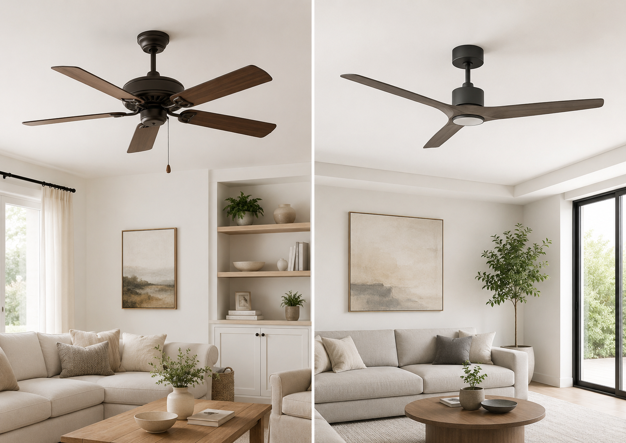
AC vs DC Motor Ceiling Fans: Quick Comparison
| Feature | AC Motor | DC Motor |
|---|---|---|
| Energy Use (52″ fan, medium) | 55-75W | 20-30W |
| Typical Price Range | $80-200 | $200-500 |
| Speed Settings | 3-4 speeds | 6-8 speeds |
| Noise Level | Often more audible hum | Usually quieter |
| Estimated Lifespan | 10+ years, quality dependent | 10+ years, may last longer |
| Annual Energy Cost* | $29-40 | $11-16 |
| Speed Control | Wall switch or basic remote | Remote, app or voice |
How AC and DC Motors Work
The difference between AC and DC ceiling fan motors starts with the type of electrical current each uses and how that current gets converted into mechanical motion.
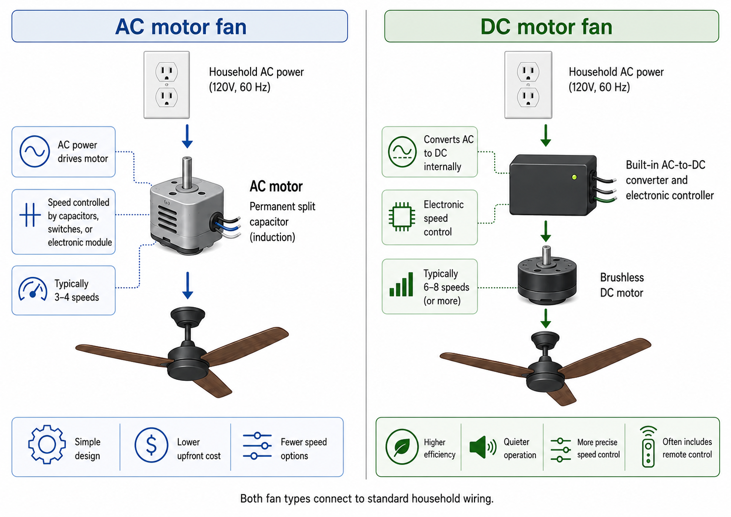
AC motors run on alternating current, the same type of power supplied by standard US home wiring. Many traditional ceiling fans use permanent split capacitor (PSC) induction-style motors. The household supply remains fixed at 60 Hz. The motor includes windings and a capacitor that work together to create the magnetic fields needed for operation.
Fan speed is controlled through capacitors, winding taps or electronic controls that alter how power is delivered to the motor. This is why traditional AC fans typically offer a few fixed speed settings, usually low, medium and high.
The simplicity is an advantage here. AC motors use household AC power directly, with relatively simple control hardware, which is why they’ve been the standard in ceiling fans for decades and remain less expensive to manufacture.
DC motors still plug into normal household AC wiring, but the fan includes built-in electronics that convert incoming AC power into DC power and control how that power is delivered to the motor. Most modern DC ceiling fans use brushless DC motors, where an electronic controller energizes the motor windings in sequence and permanent magnets help turn the rotor efficiently.
This design allows the controller to adjust motor output electronically, enabling smoother incremental changes rather than relying only on a few fixed speed steps. That’s why DC fans typically offer 6-8 speeds, and some models offer continuously variable control through remotes or apps.
The additional conversion and control electronics add to manufacturing cost and complexity, but they contribute to the efficiency gains and control features that differentiate DC fans from AC models.
Do DC Ceiling Fans Really Use Less Energy?
Marketing materials for DC ceiling fans frequently cite 50-70% energy savings compared to AC motors. The claim is directionally accurate, but understanding what you’re actually saving is important here.
A typical 52-inch AC motor ceiling fan consumes 55-75 watts on medium speed. The same size DC motor fan uses 20-30 watts at comparable airflow. That’s roughly 60-70% less power, matching the advertised efficiency gap.
But let’s put this into context. Running that AC fan 8 hours daily costs about $29-40 annually at the 2026 average US residential electricity rate of $0.18/kWh. The equivalent DC fan costs $11-16 per year. You’re saving around $15-25 annually per fan, which is real money but not a huge figure in isolation.
The energy efficiency comes from several factors. Brushless DC motors use permanent magnets and electronic control to produce rotation efficiently, while reducing some of the heat and electrical losses found in traditional AC motor designs. Electronic speed control in DC motors can also be more efficient than the capacitor-based speed control used in many AC fans.
For one fan, the annual savings feel modest. But if you’re running four ceiling fans in a home during cooling season, that’s $60-100 saved per year with DC motors. Over a 10 year lifespan, you’re looking at $600-1,000 in cumulative electricity savings across all fans.
The catch is upfront cost. DC fans usually cost around $100-200 more than comparable AC fans. With $15-25 annual savings per fan, the payback period runs 4-8 years on the DC motor premium alone. If you’re replacing existing fans that still work mechanically, the payback period extends even further since you’re also eating the cost of working AC fans you’re discarding.
Energy savings aren’t the only factor, but if cost recovery is your primary concern, DC motors eventually pay for themselves through a decrease in electricity usage. Just don’t expect massive year-one savings on your utility bill from swapping a single bedroom fan.
Noise Levels: Why DC Fans Run Quieter
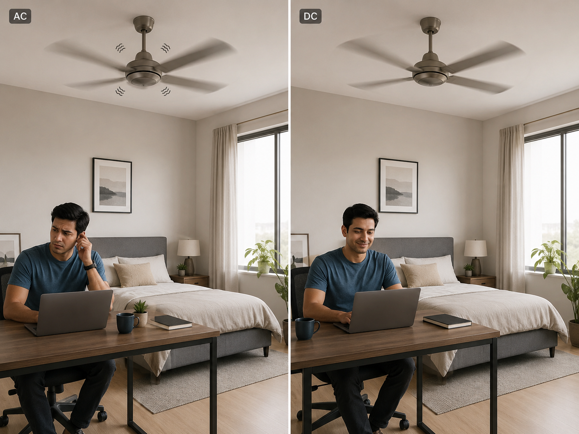
AC ceiling fans produce a characteristic low hum that becomes noticeable in quiet rooms. DC fans operate much more quietly. The difference is measurable and audible, though exact decibel ratings vary by model.
AC motors can generate noise through electromagnetic vibration. In the US, alternating current cycles at 60 Hz and changes polarity 120 times per second, creating rapid changes in the motor’s magnetic field. Those changing magnetic forces can cause small vibrations in the motor assembly, which contribute to the low hum you may hear from some AC ceiling fans.
Brushless DC motors avoid the same 60 Hz AC motor behavior that can contribute to hum in traditional AC fans. Instead, an electronic controller manages the motor windings more precisely, which helps reduce vibration and allows smoother, low speed operation. Some premium DC models at their lowest settings operate nearly silently.
As a rough rule of thumb, every 10 dB increase is often perceived as about twice as loud, so even moderate decibel differences can feel dramatic in a quiet room. At higher speeds, much of what you hear from either motor type is air movement noise from the blades rather than motor noise alone.
For bedrooms, nurseries or home offices where ambient noise matters, the difference is tangible. An AC fan running at low speed can produce enough hum to disturb noise-sensitive sleepers. A DC fan at the same airflow often disappears into background silence.
In living rooms, kitchens, or spaces with higher ambient noise, the AC motor hum becomes less noticeable simply because other sounds mask it. If you’re running a TV, cooking or having conversations, motor noise doesn’t stand out as much.
Speed Control and Precision
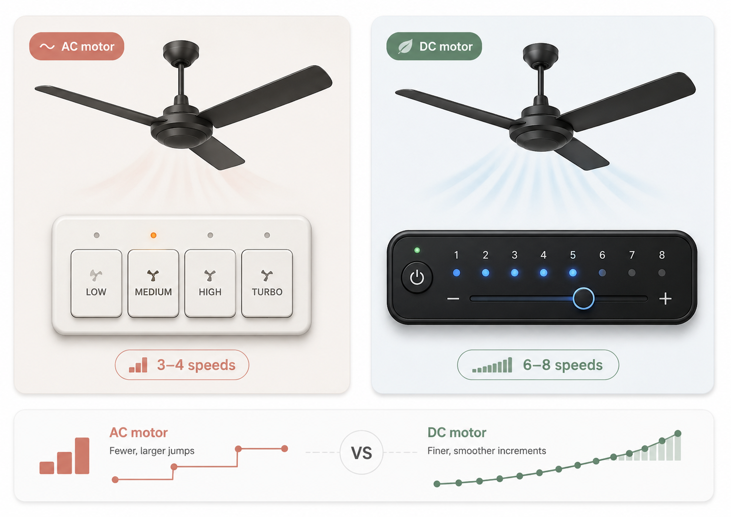
AC motors regulate speed by switching between different capacitors or using other methods that create distinct speed steps (low, medium, high), with noticeable gaps between each setting. You might find medium too gentle and high too aggressive, with no middle ground.
DC motors control speed through electronic controllers that precisely adjust motor output, allowing for much finer speed variation within the motor’s range. Manufacturers often preset 6-8 distinct speeds in the control interface, but the motor itself can usually operate at many points along that spectrum. This means the gap between speed settings is much smaller, giving you finer control over airflow intensity.
The practical benefit shows up in comfort dialing. With an AC fan, you’re stuck with whatever speeds the manufacturer programmed. With a DC fan, you can find a more precise airflow that feels right for the current temperature and humidity, instead of settling for “close enough” between two fixed settings.
Remote control is common on DC fans because the electronic speed controller makes wireless control relatively straightforward to add. AC fans can have remotes, and many do, but they usually control a simpler set of fixed speed steps.
Smart ceiling fans with app control and voice integration often use DC motor models, since the electronic controller that allows precise speed management also facilitates network connectivity more easily than traditional AC motor designs.
Durability and Lifespan
A quality ceiling fan of either type can last well over a decade, so motor type is only one part of durability. DC motors may have advantages because they often run cooler and use efficient brushless designs, but brand quality, bearings, installation, humidity, dust, runtime, and controller reliability all affect lifespan.
Brushless DC motors have fewer moving parts subject to wear. They eliminate the physical contact between brushes and commutator found in older motor designs, removing a wear point that eventually requires maintenance or replacement. This contributes to their potential longevity.
As DC motors tend to run cooler than AC motors, the lower operating temperatures reduce thermal stress on internal components, such as windings, bearings and electronic controllers. Heat accelerates component degradation, so cooler operation can contribute to longer functional life.
AC motor capacitors represent a potential wear point. Capacitors in AC fans help regulate speed and can degrade with repeated use over many years. When an AC fan starts losing its ability to switch speeds properly, capacitor degradation is sometimes the cause. DC motors use solid-state electronic controllers instead of capacitors for speed regulation.
That said, DC fans do contain more electronics. Those electronic controllers can fail even if the motor itself remains efficient.
The realistic expectation is that quality fans of either type should provide 10-15 years or more of service with proper maintenance.
Do DC Ceiling Fans Need Different Wiring?
From an installation standpoint, AC and DC ceiling fans are nearly identical. Both mount to standard ceiling fan-rated junction boxes. In a typical modern installation, both connect to the same basic supply wiring (hot, neutral and ground), with an additional switched conductor sometimes used for separate light control.
The built-in converter in DC fans handles AC-to-DC conversion internally, so you’re not running different wiring or installing external transformers. The conversion happens inside the fan’s canopy housing. From the installer’s perspective, you are usually connecting the fan to the same household supply wires, even if the fan’s internal control module handles the motor differently.
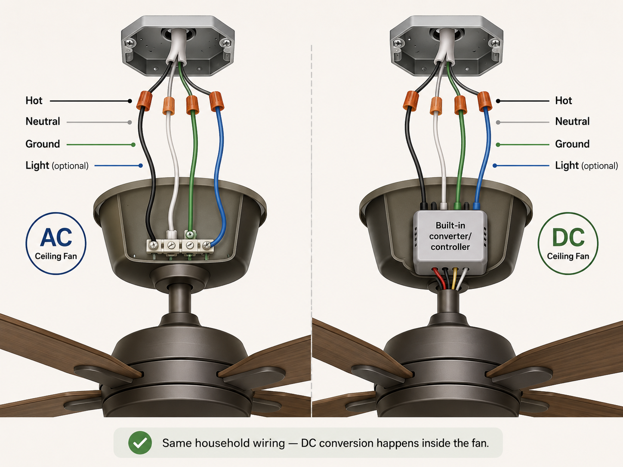
If you’re replacing an existing AC fan with a DC model, no major rewiring is usually needed. With power turned off at the breaker, remove the old fan, mount the new bracket following the manufacturer’s instructions, connect the required supply wires, and install the included receiver or control module if the fan uses one. The swap may take 30-60 minutes for a straightforward replacement, but longer if the ceiling box, wiring, receiver module or mounting hardware needs adjustment.
Important caveat: If your old fan was connected to a wall-mounted fan speed controller or dimmer-style switch, check the new fan’s instructions before reusing it. Many DC fans are designed to receive constant power and be controlled by their included remote, wall module or app. Using an incompatible wall speed control can cause humming, erratic behavior, or damage to the fan’s electronic controller. When in doubt, replace old speed controls with a simple on/off switch and use the fan’s built-in speed control system.
When AC Motors Make Sense
DC motors win on many performance specs, but several scenarios still favor AC ceiling fans.
Budget constraints: Many decent AC ceiling fans start around $80-150. DC fans more commonly start around $200 and often run $300-500 for stronger build quality and features. If you’re furnishing multiple rooms or replacing fans throughout a house, the cost difference compounds quickly. Four AC fans at $120 each costs $480. Four comparable DC fans at $300 each costs $1,200. Even accounting for long term energy savings, the upfront budget gap can make a meaningful difference for some.
Rental properties: If you’re renting and planning to move within a few years, the energy savings from DC motors won’t accumulate long enough to offset the higher purchase price. An AC fan with decent airflow performance and acceptable noise levels serves the purpose without the premium investment you won’t recoup.
High ambient noise environments: In workshops, garages, finished basements with HVAC equipment, or rooms with constant background noise, the quietness advantage of DC motors becomes less relevant. Motor hum is often masked by higher ambient noise, so you may be paying for a quietness benefit you barely notice in those spaces.
Limited usage patterns: Ceiling fans in guest rooms, seasonal spaces, or locations where they run only a few hours weekly accumulate minimal energy costs either way. If you’re running a fan 100 hours per year instead of 2,000 hours, the difference between $2 and $6 annual operating cost likely won’t justify the DC premium.
Straightforward operation preference: Some users prefer dead simple wall switch control without remotes, apps or multiple speed options. Pull chains and basic three-speed wall controls can work reliably with no batteries to replace or apps to troubleshoot. If operational simplicity is more of a priority than optimization, AC fans deliver uncomplicated functionality.
When DC Motors Are Worth the Premium
Bedrooms and nurseries: The noise reduction of DC motors makes a tangible difference in sleep quality for many people. If fan noise keeps you awake or wakes you during the night, the premium pays for itself in better rest regardless of energy savings.
Home offices and study spaces: A quiet environment matters when you’re on video calls, recording audio, or need to concentrate. AC motor hum can become an audible distraction in recordings and creates low frequency noise that may interfere with focus.
Multiple fans running long hours: If you run three or more ceiling fans 8+ hours daily throughout cooling season, the cumulative energy savings may justify the DC investment within 4-6 years.
Smart home integration: Many smart ceiling fans use DC motors because the electronic controller pairs naturally with remote, app and voice control features. If app control, voice commands or automation routines feature in your usage pattern, DC fans generally provide those features more seamlessly.
Precise airflow control: People with specific temperature sensitivities benefit from the 6-8 speed granularity many DC fans offer. The ability to dial in more precise airflow rather than choosing between only three fixed speeds improves comfort in a way you’ll notice every day.
Long term ownership: If you own your home and plan to stay for 10+ years, DC fans can end up paying for themselves through energy savings, and quality models may outlast comparable AC fans. The total cost of ownership can favor DC in permanent installations where you’ll capture the full lifespan benefits.
Best Motor Type by Room
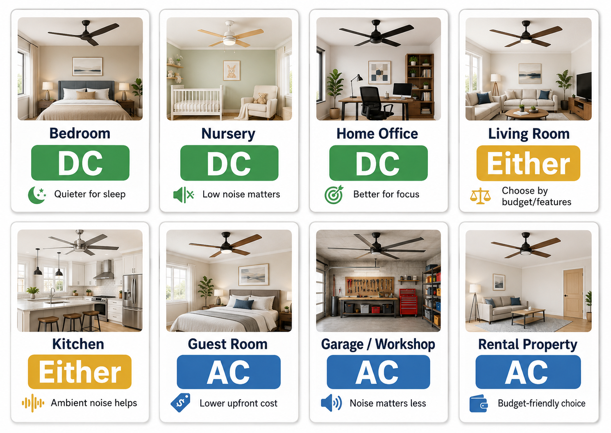
For bedrooms, nurseries and home offices, a DC motor fan is usually the better choice because quieter operation can be a crucial factor in those spaces. For guest rooms, garages, workshops and rental properties, an AC motor fan often makes more sense because of the lower upfront cost. In living rooms and kitchens where ambient noise is already present, either motor type works well. Choose based on your budget and whether you want smart features that typically come with DC motors.
The Right Fan For The Job
The best motor choice comes down to what you need the fan to do most often. In bedrooms, nurseries, offices and other daily use rooms, a DC fan earns its keep through quieter operation, lower energy use and finer speed control. In guest rooms, garages, rentals and occasional use spaces, a good AC fan can still be the more sensible buy.
Think of DC as the comfort-first option and AC as the value-first option. Once you match the motor to the room, the runtime and the level of quiet you need, the decision becomes much easier, and your ceiling fan can get back to doing its real job – moving air without drawing attention to itself.
Ready to choose a fan? My best smart ceiling fans guide compares specific models across both motor types.