Smart bird feeders have quietly become one of the fastest growing categories in connected home technology. They sit at the intersection of backyard wildlife and IoT – Wi-Fi connected, app-controlled, AI-powered devices that identify visiting species in real-time. Bird Buddy and Birdfy (by Netvue) consistently rise to the top of this market. They represent genuinely different approaches to the same problem.
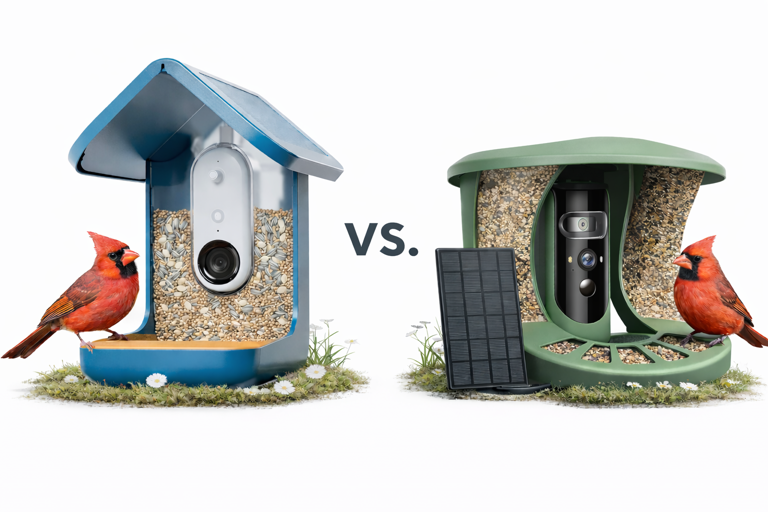
This comparison focuses on the current flagship models from each brand – the Bird Buddy Pro Solar and the Birdfy Feeder 2 Pro. It cuts through the marketing claims to show you where each one wins, where each falls short, and which fits what you actually want from a smart feeder.
How Smart Bird Feeders Work
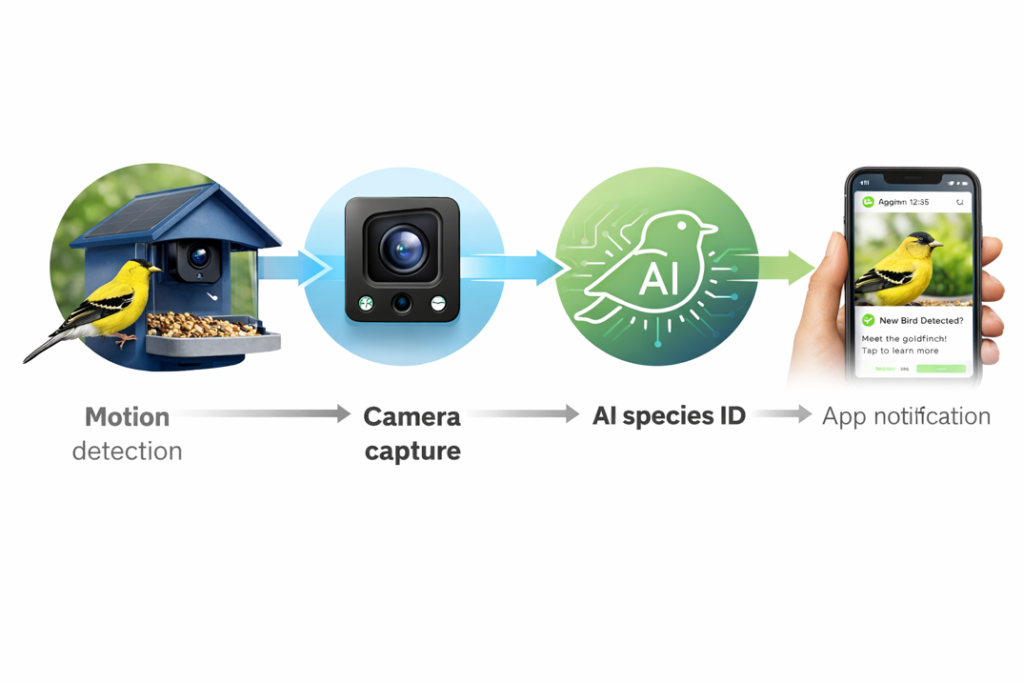
Before diving into the comparison, it helps to understand what these devices do. Both feeders house a removable camera module inside the seed compartment. When a bird lands, motion detection triggers the camera. It records a short video clip and captures still photos. The companion app receives those images via your home Wi-Fi network, where built-in AI analyzes the footage and identifies the species.
Birdfy’s database covers more than 6,000 bird species globally. Bird Buddy identifies over 1,000 species, with its strongest accuracy in North America and Europe, and prioritizes precision over breadth. Both send push notifications when birds arrive and build a logged collection of every visitor over time. Neither requires any technical setup beyond connecting to a standard 2.4GHz Wi-Fi network.
The Products: What You’re Comparing
Bird Buddy Pro Solar retails at around $299. It includes the feeder body, a 5MP camera module with 2K HDR video, and an integrated solar roof that keeps the 3,800mAh battery charged without manual intervention. A Bird Buddy 2 launched in early 2026 at $199 with upgraded specs including birdsong identification and dual solar panels. Availability has been limited since pre-orders sold out. For this comparison, the Pro Solar remains the current in-stock flagship model.
Birdfy Feeder 2 Pro retails at $299.99 on Amazon. It includes a dual-lens camera system (a 3MP (2K) close-up portrait lens paired with a 2MP (1080p) wide-angle lens), along with a detachable solar panel. Birdfy also offers the standard Feeder 2 and the Feeder 2 Duo, which adds a third side-angle camera for a triple-perspective setup.
Camera Quality: Bird Buddy Wins on Sharpness, Birdfy Wins on Coverage
Camera performance is where the two brands diverge most clearly, and it comes down to a deliberate design trade-off.
Bird Buddy’s 5MP sensor with HDR processing consistently produces sharper, better exposed images. The camera handles high contrast lighting well (bright morning sun, backlit birds, dappled shade), without the color fringing and artifacting that can appear in Birdfy footage. If the quality of individual bird photographs matters to you, Bird Buddy is the better camera. The 120fps slow motion capability also captures wing detail and quick movements that standard video misses.
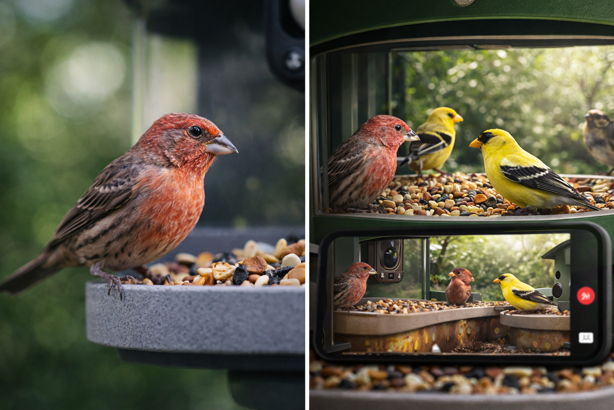
Birdfy’s dual-lens approach trades some per-image sharpness for context. The wide-angle lens records the whole feeder area while the portrait lens simultaneously tracks individual birds. You get two perspectives on every visit, something genuinely useful when multiple birds are present or when you want to see feeder dynamics. The Feeder 2 Duo extends this further with a third side-mounted camera, though that’s a separate product at a higher price point.
The practical implication: if you want gallery worthy photos of individual species, Bird Buddy wins. If you want comprehensive coverage of everything happening at your feeder, the Feeder 2 Pro’s dual-lens system is more capable.
AI Species Identification: Bird Buddy for Accuracy, Birdfy for Scale
Both feeders use machine learning to identify visiting species from camera footage, but they handle accuracy differently.
Bird Buddy’s AI tends to be cautious when its confidence is low. Rather than forcing a precise species match, it will sometimes classify birds at a broader level such as “finch” or “sparrow.” This approach reduces obvious misidentifications, although closely related species can still be difficult to separate. Accuracy can also drop when multiple birds appear in the frame, since the system is primarily designed to analyze a single subject at a time. When mistakes do occur, users can manually correct the identification within the app.
Birdfy’s AI supports recognition of more than 6,000 bird species globally, giving it broader coverage for international users or anyone hoping to identify uncommon visitors. The trade-off is that the system can sometimes be overly confident, occasionally presenting low confidence matches or alternate suggestions for a bird. Community feedback on forums such as Reddit often describes the system as inconsistent rather than outright incorrect.
At CES 2026, Birdfy also introduced OrniSense, an AI-driven identification system designed to reason through bird identifications and support natural language questions about species and behavior. As this technology rolls out, it may help narrow the accuracy gap between Birdfy and more conservative identification systems.
For US based backyard birders watching common North American species, Bird Buddy’s identification often feels like the more reliable day-to-day experience. Birdfy’s broader database and newer AI developments make it an interesting option for enthusiasts wanting more.
App Experience: Bird Buddy Leads on Polish, Birdfy on Flexibility
The app is where the actual birdwatching experience lives day-to-day, and this is one of the clearest differentiators between the two brands.
Bird Buddy’s app organizes visits as “postcards” – curated, well framed captures rather than every triggered recording. This means fewer notifications and a more pleasant browsing experience. The app includes species trivia, a personal bird catalog, access to a global network of shared feeders, and a strong community element. The interface draws comparisons to Pokémon Go for birders, as it gamifies the hobby in an engaging rather than annoying way. Premium features such as extended cloud storage, advanced AI features, and Frenzy Mode require a paid subscription. Check current in-app pricing before buying, as basic use without a subscription is possible but more limited.
Birdfy’s app is more functional than refined. Live streaming, real-time notifications and detailed recording controls give users more granular control over feeder behavior. The interface takes a little more familiarity before it becomes intuitive. A key advantage is that the Feeder 2 Pro and Feeder 2 Duo include lifetime AI bird identification without a required subscription. The base Feeder 2 uses a subscription model for AI recognition, so if avoiding recurring fees matters, the Pro is the better Birdfy to choose. Cloud storage typically includes a 30 day rolling retention window, while extended storage and additional features are available through a separate subscription.
Battery Life and Solar Power
Each brand handles battery management in its own way. This matters more than it might seem, as neither feeder is easy to bring indoors for charging.
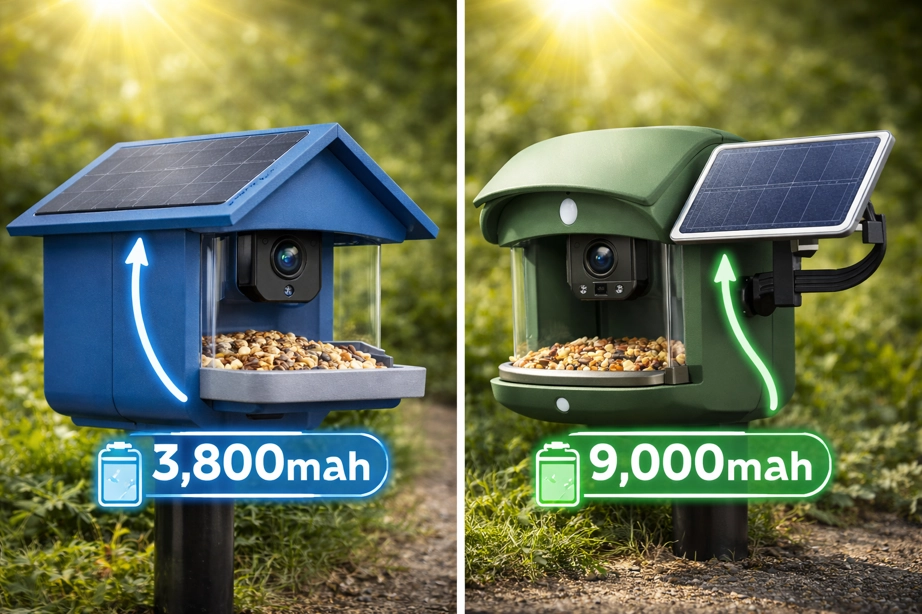
Bird Buddy Pro Solar uses a solar roof that replaces the standard feeder roof, sitting flush with the housing once installed. In adequate sunlight, it can sustain the 3,800mAh battery for extended periods without manual charging. In heavy shade or extended cloudy weather, occasional charging may still be necessary. Battery life typically runs around 5–15 days, depending on bird traffic and usage patterns. The roof mounted design is cleaner and simpler than external solar panels with separate cables.
Birdfy Feeder 2 Pro includes a detachable external solar panel connected by cable. Its 9,000 mAh battery (more than double the capacity of Bird Buddy’s) allows substantially longer runtimes between charges. Birdfy estimates around 29 days under heavy use and up to 85 days at lower activity levels, even without solar assistance (these are manufacturer figures, and real world results will vary). The detachable panel is less elegant and can be harder to position on pole mounted setups. Even so, the larger battery capacity is a meaningful advantage for anyone with limited sunlight or who wants minimal maintenance.
If your feeder location gets reliable direct sun, Bird Buddy’s integrated solar roof is the more convenient solution. If it’s in partial shade or you want maximum time between any manual intervention, Birdfy’s larger battery offers a clear advantage.
Hardware and Build
Both feeders are built for year-round outdoor use. Birdfy carries an IP66 weatherproof rating across the Feeder 2 series, suitable for rain, snow and temperatures from 14°F to 113°F. Bird Buddy describes the camera module itself as IP67 rated, but the feeder system as a whole is better described as weather resistant rather than fully IP rated.
Bird Buddy holds 0.9 liter of seed. That’s adequate, but it means more frequent refilling compared to Birdfy’s 1.25 liters on the Feeder 2 Pro. The filling hatch on Bird Buddy is notably small and tends to cause spills, which is a consistent complaint in user reviews. Birdfy’s flip-top roof design exposes a much larger opening, making refilling considerably easier.
Both feeders support pole, wall, and hanging mounting configurations, giving you flexibility to install them on a fence, pole, tree, or under an eave.
Bird Buddy vs Birdfy: Side-by-Side Comparison
| Bird Buddy Pro Solar | Birdfy Feeder 2 Pro | |
|---|---|---|
| Price | ~$299 | ~$299 |
| Camera | 5MP, 2K HDR, slow motion | 3MP (2K portrait) + 2MP wide-angle dual lens |
| AI species database | 1,000+ | 6,000+ |
| AI subscription | Advanced features require subscription | Lifetime AI recognition included |
| Battery | 3,800mAh + integrated solar | 9,000mAh + detachable solar |
| Weatherproofing | Weather resistant (camera module IP67) | IP66 rated |
| Seed capacity | ~0.9L | ~1.25L |
| Storage | Cloud storage (subscription tiers) | Cloud storage (30 day retention) |
| App style | Curated postcards, community focused | Functional, more control options |
| Birdsong ID | Bird Buddy 2 only (limited 2026) | Not available |
Who Should Choose Bird Buddy
Bird Buddy is the better choice if photo quality and app experience are your priorities. Its 5MP camera often produces sharper images of individual birds, and the curated postcard format makes the app enjoyable to browse rather than turning it into a stream of notifications. The community features add a social dimension that Birdfy’s app doesn’t emphasize as strongly. If you’re introducing someone to birdwatching (for a family friend or as a gift for a parent), the Bird Buddy experience is more immediately engaging and accessible.
The ongoing subscription is worth factoring in. Several advanced features require Bird Buddy Premium, so while the feeder works without it, the experience is more limited than Birdfy’s free AI tier.
Who Should Choose Birdfy
Birdfy Feeder 2 Pro makes the stronger case if value, battery life and overall camera coverage are more important to you than individual photo sharpness. The dual-lens system captures more of what’s happening at your feeder simultaneously. The 9,000mAh battery requires significantly less attention than Bird Buddy’s. The lifetime free AI on the Pro model eliminates subscription costs entirely. For anyone wanting solid daily performance without ongoing fees, the Feeder 2 Pro delivers a compelling package.
The app needs more initial patience, and AI identification is less reliable on single-species accuracy. If those trade-offs are acceptable, Birdfy offers more hardware value for the price.
The Pecking Order
Both Bird Buddy and Birdfy prove how far smart feeders have evolved. What used to be a simple tray of seed has become a connected wildlife camera, species identifier, and daily window into the activity happening just outside your home.
The difference between them comes down to what kind of experience you want from that window.
Bird Buddy leans toward photography and storytelling. The sharper images, curated captures, and community features make it feel like a birdwatching journal that updates itself throughout the day.
Birdfy leans toward coverage and practicality. The larger battery, dual-lens setup and subscription-free AI make it the more hands-off device that silently records everything happening at the feeder.
Either way, the real result is the same – the kind of small daily discovery that keeps you checking the feeder long after the novelty should have worn off.
Both feeders sit within the broader world of smart pet technology, where IoT connectivity is transforming how we interact with and monitor the animals in our lives – from backyard visitors to indoor companions.