
Your chameleon needs misting six times a day to stay hydrated. The dart frog enclosure drops to 55% humidity every afternoon. Your crested gecko’s terrarium is fine until you go away for a weekend – and then it isn’t. Manual spraying works until life gets in the way, and even diligent keepers miss sessions. The difference between a misted enclosure and a missed one can matter more than most people realize.
Automated terrarium misters and reptile foggers (sometimes called reptile humidifiers or reptile misting systems) solve this by handling humidity on a schedule or in response to real-time sensor readings. This guide covers five systems across the full buyer spectrum, from entry level automatic foggers to the pressurized misting setup that serious keepers rely on. Before the reviews, there’s one distinction worth understanding – foggers and misters aren’t the same thing. Getting this wrong can affect the humidity results you see.
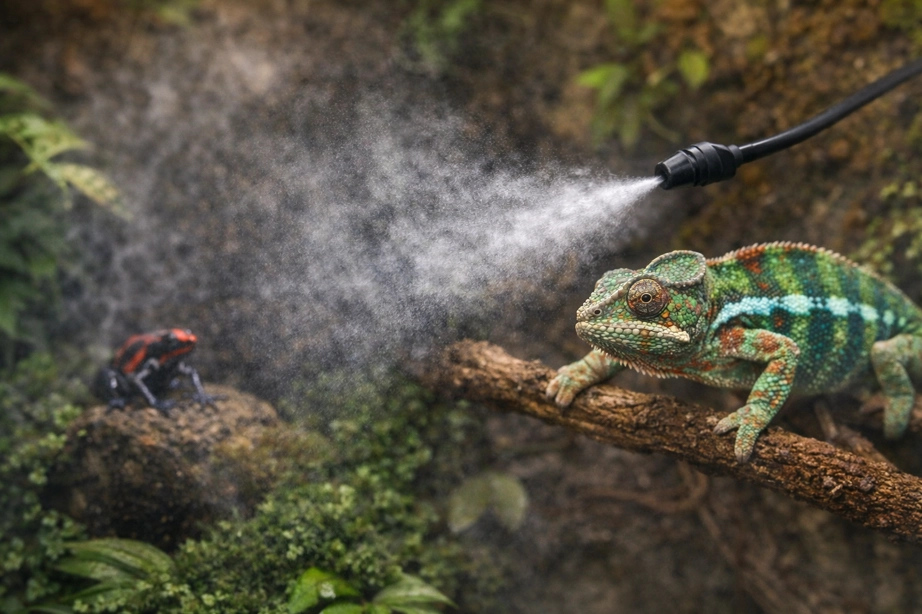
Quick Picks: Best Terrarium Misters and Reptile Foggers
🏆 Best Overall: Exo Terra Monsoon Solo II – $125-140
Pressurized pump, programmable cycles, expandable to 2 nozzles, trusted reptile brand
💧 Best Entry Automated Fogger: Evergreen Pet Supplies 4L – $70-80
Digital timer, 4L tank, dry-run protection
🌿 Best Mid-Range + Hygrostat Combo: REPTI ZOO 4L TF14 + Inkbird IHC-200 – $50-60 + $40-45
Timer-based fogger paired with a dedicated humidity controller for closed loop automation
📱 Best Smart Fogger: COOSPIDER 5L – $60-70
Built-in humidity control, digital display, remote control, 5L capacity
🔬 Best Pro Misting System: MistKing Starter V5.0 – $175-185
Pressurized pump, per-second timer precision, expandable to 10 nozzles, used by zoos, botanical gardens, universities and professional breeders worldwide
Fogger vs. Mister: The Difference That Matters
Most product listings blur the line between these two categories, but the distinction is real and affects which type best suits your setup.
Ultrasonic foggers use a vibrating membrane to create a cool vapour – essentially the same technology as a household humidifier. The output is a fine mist/fog that raises ambient humidity gradually. These are quieter, simpler and often less expensive. The trade-off is that ultrasonic units require distilled or RO (reverse osmosis) filtered water to prevent mineral build-up on the transducer, and the mist droplets are small enough that they’re primarily an ambient humidity solution, rather than a direct drinking water source for species like chameleons.
Pressurized misting systems use a pump to force water through fine nozzles at high pressure, producing a fine spray that coats leaves and surfaces more effectively than an ultrasonic fogger. This is the technology behind the Exo Terra Monsoon and MistKing systems. Because the spray settles on foliage and enclosure furniture rather than dispersing as vapour, these systems are better suited to species that drink from surface moisture. It is worth noting, however, that Exo Terra describes the Solo II’s own output as an “extremely fine” mist with a “fog-like effect”, so results may vary with nozzle positioning and enclosure size. Pressurized systems also tend to be more reliable in the long term because there’s no ultrasonic transducer, which tends to degrade with mineral exposure.
For most setups, either works for raising humidity. If you have chameleons, water dragons and other species that rely on surface moisture to drink, a pressurized system is the better choice. For snakes, tropical geckos and dart frogs where ambient RH is the goal, a quality ultrasonic fogger does the job well.
30-Second Selector: Which System Is Right for You?
1. What species are you keeping?
- Chameleon, water dragon or species that drink from droplets → Exo Terra Monsoon or MistKing Starter (pressurized systems only)
- Ball python, crested gecko, dart frog, tropical snake → any system below works
- Multiple enclosures or a large collection → MistKing Starter
2. What’s your budget?
- Under $80 → Evergreen 4L (timer, proven reliability)
- $90-110 total → REPTI ZOO + Inkbird (adds closed loop humidity control)
- $60-70 → COOSPIDER 5L (built-in humidity sensor, all-in-one)
- $125-140 → Exo Terra Monsoon (pressurized, programmable, Exo Terra brand)
- $175+ → MistKing Starter (professional grade, expandable, long term reliability)
3. What’s your situation?
- First automated fogger, single enclosure → Evergreen 4L
- Want humidity to maintain itself without manual checks → COOSPIDER 5L or REPTI ZOO + Inkbird
- Building a smart terrarium with full automation → REPTI ZOO + Inkbird or MistKing Starter
- Managing multiple enclosures or a breeding room → MistKing Starter
Who This Guide Is For (and Who Should Skip It)
This guide is a good fit if you: keep reptiles, amphibians or invertebrates that need consistent humidity, are currently misting by hand and want to automate, or are building or upgrading a smart terrarium with automated environmental control. It’s also relevant if you already have a fogger but are finding manual humidity management unreliable.
You can probably skip it if you: keep desert species like bearded dragons, uromastyx or leopard geckos that thrive at 30-40% humidity. A water bowl and decent ventilation typically maintain those levels without active equipment. This guide also doesn’t cover aquarium misters or greenhouse systems, which have different requirements.
Terrarium Mister and Reptile Fogger Comparison Table
| Model | Price Range | Type | Capacity | Humidity Control | Best For |
|---|---|---|---|---|---|
| Exo Terra Monsoon Solo II | $125-140 | Pressurized mister | 1.5L | Timer (programmable cycles) | Single enclosure / droplet drinkers |
| Evergreen 4L | $70-80 | Ultrasonic fogger | 4L | Digital timer | Entry automated / ambient humidity |
| REPTI ZOO TF14 + Inkbird IHC-200 | $90-105 (combined) | Ultrasonic fogger + hygrostat | 4L | Closed loop humidity sensor | Precision humidity targets |
| COOSPIDER 5L | $60-70 | Ultrasonic fogger | 5L | Built-in humidity controller + timer | All-in-one smart fogger |
| MistKing Starter V5.0 | $175-185 | Pressurized mister | External reservoir | Precision seconds timer | Multi-enclosure / serious keepers |
Best Terrarium Misters and Reptile Foggers for 2026
From pressurized misting systems to ultrasonic foggers with built-in humidity control, the five options below cover every keeper scenario – from a first automated setup to a professional grade system running an entire collection.
Exo Terra Monsoon Solo II
🏆 Best Overall | $125-140 | View on Amazon
Rating: 4.5/5
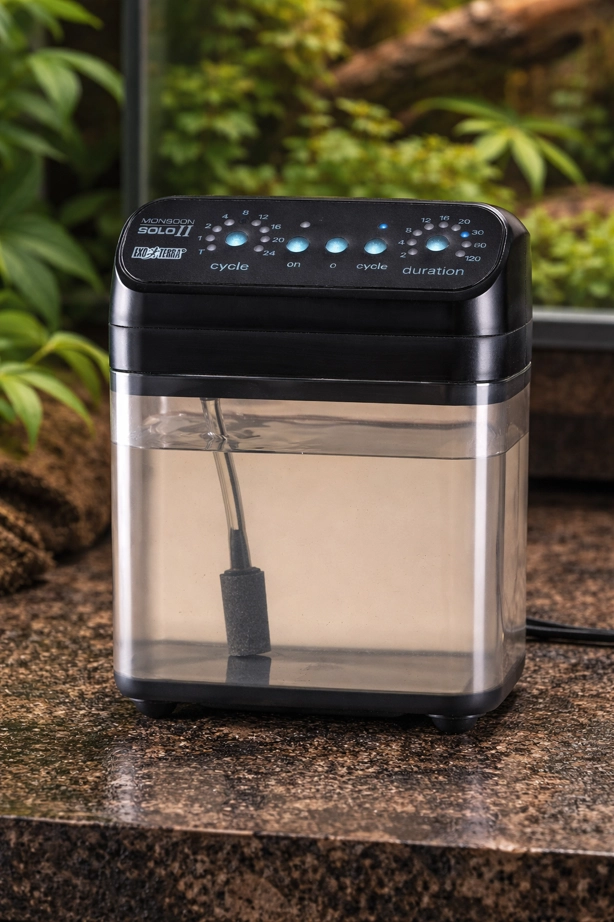
The Monsoon Solo II is the most complete out-of-the-box pressurized misting system at this price point, and the one most likely to satisfy keepers who’ve outgrown basic foggers. Its 2.5 BAR pump forces water through a flexible nozzle to produce a fine pressurized spray that coats leaves, glass and enclosure furniture more effectively than an ultrasonic fogger. Run the included nozzle solo, or expand to two nozzles for a second enclosure or better distribution across a larger tank.
Programming is handled entirely via the front panel (no app required). You can set misting frequency (up to 8 cycles per 24 hours) and duration (2 seconds to 2 minutes per cycle) independently – flexible enough for species needing brief, frequent misting as well as longer, less frequent sessions. The 1.5L reservoir refills without dismantling the unit, and the sloping lid design prevents leaks at the reservoir connection, which is a common failure point on cheaper units.
Key Specs
- Type: Pressurized misting system
- Pump pressure: 2.5 BAR (36.25 PSI)
- Reservoir: 1.5L (0.40 gallon)
- Nozzles: 1 included, expandable to 2
- Cycle frequency: Up to 8 cycles per 24 hours
- Cycle duration: 2 seconds to 2 minutes per session
- Water type: Distilled or demineralized water strongly recommended (Exo Terra’s manual warns that tap water will clog nozzles with mineral deposits)
- Connectivity: Standalone (no app)
Worth Knowing
The 1.5L reservoir is the main limitation. In a warm room with frequent misting, you may be refilling every 2-3 days rather than the “several days” Exo Terra suggests. The pump can be audible during operation, particularly at night. This unit controls misting by schedule only. There’s no humidity sensor, so it won’t adjust output based on actual enclosure conditions. If closed loop humidity control matters to you, the REPTI ZOO + Inkbird combo below is worth considering.
Best For
Chameleon and water dragon keepers who need real water droplets for drinking, dart frog and tropical gecko setups needing reliable scheduled misting, anyone upgrading from a basic ultrasonic fogger and wanting a purpose-built reptile brand solution.
Evergreen Pet Supplies 4L Reptile Fogger
💧 Best Entry Automated Fogger | $70-80 | View on Amazon
Rating: 4.3/5
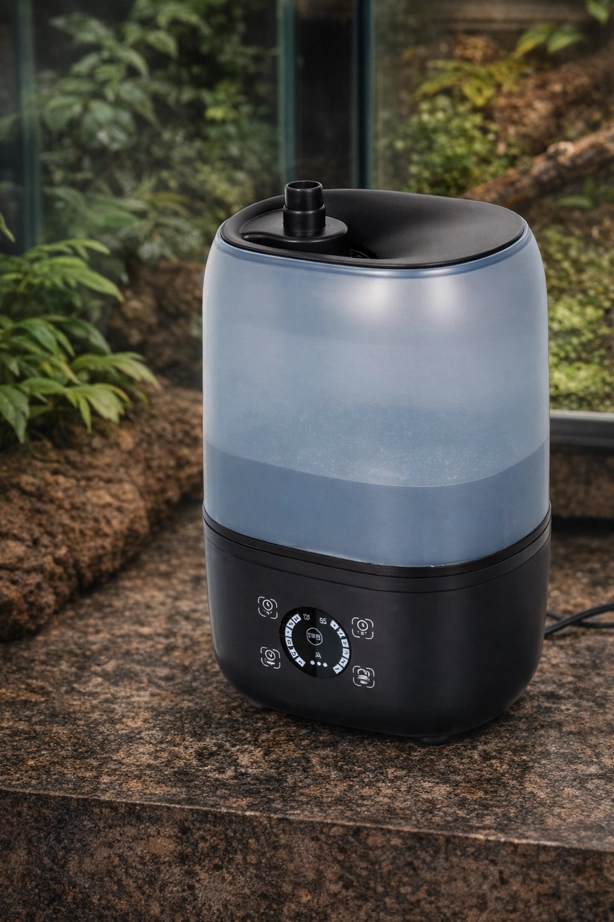
With thousands of Amazon reviews behind it, the Evergreen is the most field-tested entry level automated fogger in this category. Feedback spans ball pythons, crested geckos, dart frogs, box turtles and more. The digital timer handles scheduling automatically, the 4L tank delivers up to 13 hours of runtime at maximum output, and dry-run protection shuts the unit off safely when water runs low. A flexible hose adjusts from 1.5 to 5 feet. Output is adjustable up to 300ml per hour, adequate for most single terrariums up to medium size.
Key Specs
- Type: Ultrasonic fogger
- Reservoir: 4L
- Max output: 300ml per hour
- Runtime: Up to 13 hours at max output
- Automation: Digital timer
- Safety: Dry-run auto shut-off
- Hose: Flexible, adjustable 1.5-5 feet
- Water type: Distilled recommended (ultrasonic unit)
Worth Knowing
This is a timer-based fogger only. There’s no humidity sensor, so it runs on a schedule regardless of enclosure conditions. In a particularly dry environment, it may not keep up. In a well-sealed enclosure, it can over-humidify if left on too long. Distilled or RO filtered water is genuinely required for longevity (this is not just a suggestion). Not appropriate for species that need droplets to drink. For closed loop humidity control, the REPTI ZOO + Inkbird combo is the next step up.
Best For
Ball python, crested gecko and tropical snake keepers needing reliable ambient humidity automation, anyone making their first move from manual misting to an automated system, setups where a large, well validated review base matters more than advanced features.
REPTI ZOO 4L TF14 + Inkbird IHC-200
🌿 Best Mid-Range + Hygrostat Combo | ~$50-60 + ~$40-45 | REPTI ZOO on Amazon | Inkbird IHC-200 on Amazon
Rating: 4.4/5
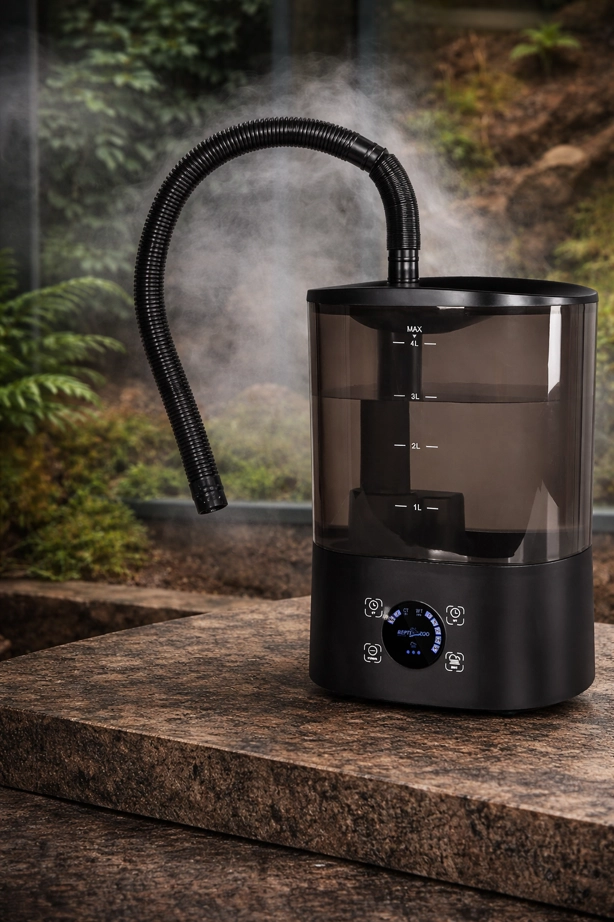
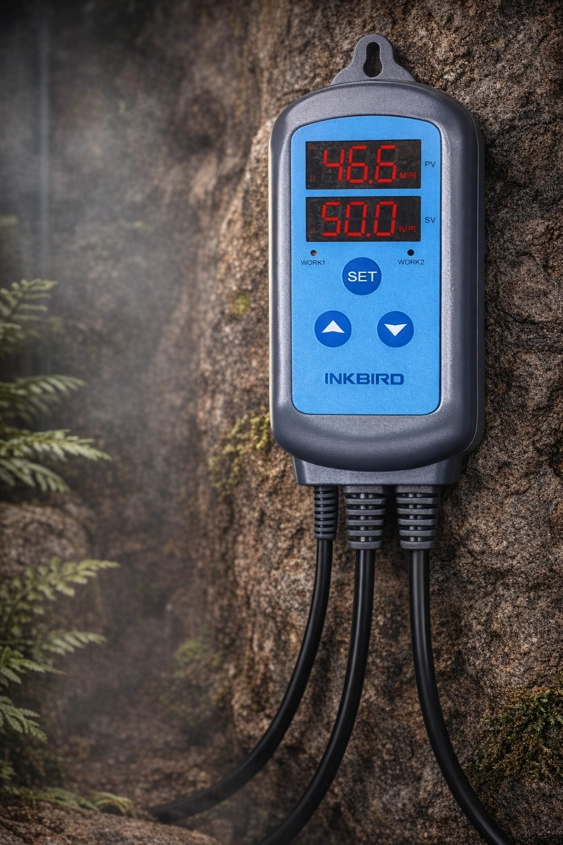
This is the only combination pick in the guide, and it earns its place because the pairing solves a genuine limitation of timer-only foggers. The REPTI ZOO TF14 is a capable 4L ultrasonic fogger with intermittent timing functionality and a quiet pump, but like most foggers at this price point, it runs on a schedule rather than responding to real-time humidity readings. Pair it with the Inkbird IHC-200 humidity controller and that limitation disappears. The Inkbird sits between the wall outlet and the fogger, monitors enclosure humidity continuously via its probe, and switches the fogger on and off to maintain your target RH (relative humidity) – similar to how a thermostat manages temperature.
The Inkbird IHC-200 is worth discussing on its own merits. It handles both humidification and dehumidification (two independent outlets), reads from 5-99.99% RH with ±3% accuracy, and includes audible alarms when humidity hits preset limits. Note that the standard IHC-200 is a standalone controller with no app connectivity. Remote monitoring is available on the IHC-200 Wi-Fi version only, which costs a little more. For anyone already using Inkbird thermostats from our reptile thermostat guide, the interface style will feel familiar regardless of which version you choose.
Key Specs – REPTI ZOO TF14
- Type: Ultrasonic fogger
- Reservoir: 4L, integrated leak-proof design
- Display: LED digital display with a touch-sensitive control panel
- Safety: Auto shut-off when water runs low
- Water type: Distilled recommended
Key Specs – Inkbird IHC-200
- Control type: Dual stage (humidification + dehumidification)
- RH range: 5-99.99%
- Accuracy: ±3% RH
- Outlets: 2 independent (humidifier + dehumidifier)
- Alarms: High/low RH audible and visual alerts
- Connectivity: Standalone (pairs with smart plug for remote monitoring)
Worth Knowing
This is a two device setup. You’re managing two units and two power connections rather than one. The Inkbird IHC-200 is a general purpose controller, not reptile-specific, though it’s widely adopted in the reptile keeping community. Combined cost approaches the Exo Terra Monsoon, so if your species needs a pressurized system for droplet drinking, the Monsoon may be the cleaner choice at a similar spend.
Best For
Keepers who want genuine humidity-triggered automation rather than simple timer control, tropical species setups where maintaining a specific RH range matters, those building a connected smart terrarium who want a dedicated humidity controller that complements a separate thermostat.
COOSPIDER 5L Reptile Fogger with Humidity Control
📱 Best Smart Fogger | $60-70 | View on Amazon
Rating: 4.2/5
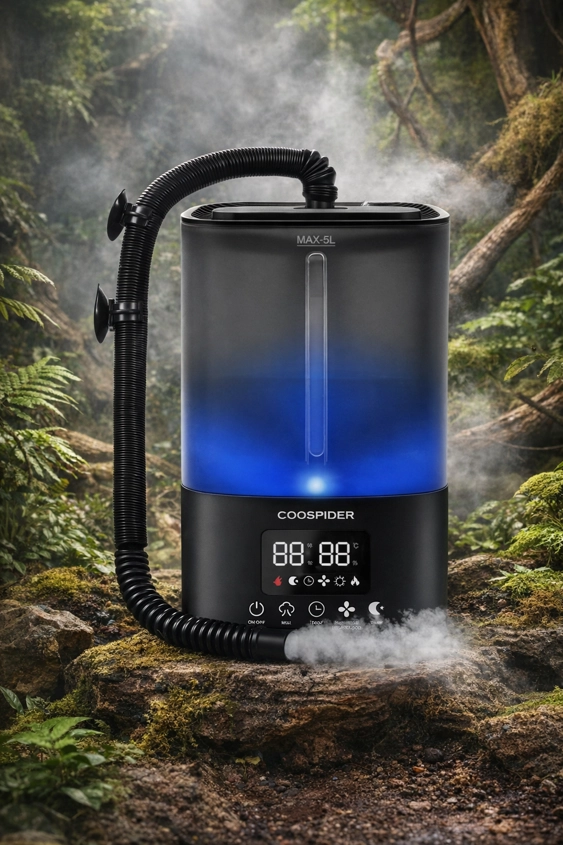
The COOSPIDER 5L stands apart from the other foggers in this guide by combining an ultrasonic humidifier, built-in timer and a humidity controller into a single unit. Set your target RH on the digital display and the unit handles the rest, activating when humidity drops and switching off when it hits your target. The 5L tank is the largest in this category, giving meaningful runtime between refills. A remote control is included for convenience.
Key Specs
- Type: Ultrasonic fogger with integrated humidity controller
- Reservoir: 5L
- Humidity control: Built-in sensor, automatic on/off to target RH
- Display: Digital readout (current RH and temperature)
- Controls: Front panel + included remote control
- Water type: Distilled recommended
Worth Knowing
As with all ultrasonic foggers, distilled or filtered water is required, as mineral deposits from tap water may degrade the transducer over time. Not suitable for species requiring pressurized misting and surface coating moisture. The built-in controller is convenient, but a dedicated external probe-based controller still gives you more flexibility over sensor placement.
Best For
Keepers who want humidity automation in a single device, tropical species setups where RH maintenance matters more than droplet production, anyone who values the simplicity of one unit over the flexibility of a separate fogger and humidity controller.
MistKing Starter Misting System V5.0
🔬 Best Pro System | $175-185 | View at Jungle Hobbies
Rating: 4.8/5
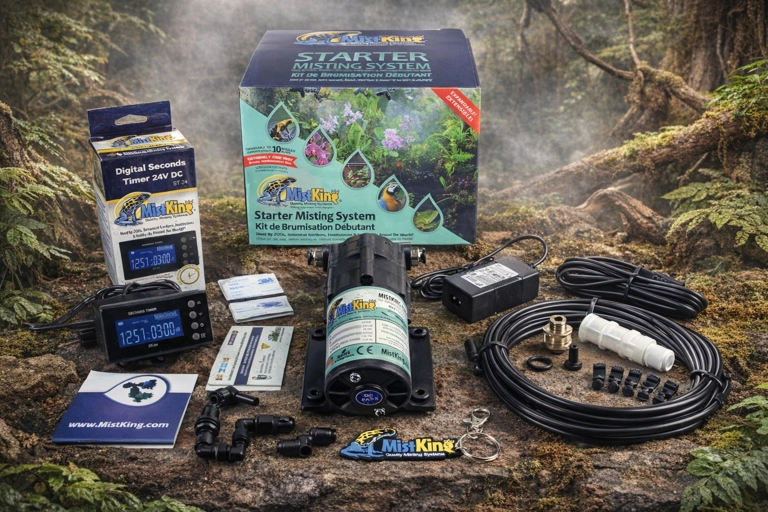
MistKing has been the reference standard for serious reptile and amphibian keepers for nearly two decades. The Starter V5.0 is not a consumer fogger with a pump added. It’s a proper pressurized misting system built around a custom 24V DC diaphragm pump that MistKing has engineered specifically for this application. The pump can run dry without damage, and operates virtually silently on vibration-dampening rubber feet. The fifth generation brings upgraded timer electronics with triple the electrical tolerance of previous versions, a change that should improve reliability around power fluctuations and recovery after electrical disturbances.
The Starter ships with one nozzle and expands to ten – enough for a small collection or a single large enclosure with multiple misting points. The per-second ST-24 timer allows sessions as short as one second, far more precise than most consumer foggers and entry level misting systems. This is valuable for dart frogs and species that need brief, targeted misting rather than extended humidity raising sessions. MistKing’s check-valved nozzles reduce post-mist drip, and the ZipDrip valve option (available as an add-on) releases line pressure instantly to minimize drip at cycle end. Zoos, botanical gardens and professional breeders use this system. That reputation has been built over years of use in demanding setups.
Key Specs
- Type: Pressurized misting system
- Pump: Custom 24V DC diaphragm
- Nozzles: 1 included (~50 micron droplet size), expandable to 10
- Timer: ST-24 seconds timer (per-second precision)
- Reservoir: External (any bucket or container – bulkhead fitting included)
- Water type: Distilled recommended to reduce nozzle mineral build-up, although pressurized systems are generally less sensitive to scaling than ultrasonic foggers
- Connectivity: Standalone – compatible with MistKing HT-24 humidity timer (sold separately)
Worth Knowing
The price premium is real. At $175-185, this is the most expensive option in the guide. It earns that cost for keepers with multiple enclosures, demanding species, or anyone who’s dealt with fogger failures at inconvenient times. No app or Wi-Fi connectivity is included. For humidity-triggered automation, pair with the optional MistKing HT-24 humidity timer or the Inkbird IHC-200. The reservoir is not included. You’ll need any standard bucket or container, which MistKing intentionally omits to reduce shipping costs.
Best For
Dart frog keepers and chameleon enthusiasts who demand pressurized, precisely timed misting, collections of multiple enclosures where one system covers the room, breeders and serious hobbyists for whom equipment failure is not an acceptable outcome.
Other Products Considered
Exo Terra Monsoon Multi II (~$185-200): The larger sibling to the Solo II. 8L reservoir, up to 6 nozzles, 4.5 BAR pump. Strong specs but its lower 3.8 Amazon rating kept it out of this guide.
MistKing Ultimate V5.0 (~$240-260): The step up from the Starter. Supports up to 20 nozzles and includes MistKing’s larger pump. The right choice for keepers running more than 10 enclosures or wanting the highest flow rate. For most hobbyists, the Starter V5.0 is the more sensible entry point.
REPTI ZOO 2.2L Solo Misting System (~$75-85): A pressurized starter mister with a built-in tank and timer. The 2.2L reservoir limits runtime and the price sits close to the Exo Terra Monsoon Solo II, which offers more programmability from an established brand.
Terrarium Mister and Reptile Fogger Buying Guide
Water Quality: The Maintenance Decision You Make Before You Buy
Ultrasonic foggers depend on a vibrating ceramic disc to create mist. Tap water contains dissolved minerals that deposit on that disc over time, decreasing output and eventually causing failure. Distilled water (widely available at grocery stores for under $1 per gallon) or RO filtered water eliminates this problem. Pressurized systems like the Exo Terra Monsoon have no ultrasonic components to degrade, but Exo Terra’s own manual still recommends distilled water to prevent mineral deposits from clogging nozzles. The MistKing’s nozzles are similarly susceptible to scale in hard water areas. The practical advice is the same regardless of system type. Use distilled or filtered water and your equipment will last considerably longer.
Timer vs. Hygrostat: Scheduled vs. Responsive Automation
Timer-based systems run on a fixed schedule. This is generally useful and reliable, but they don’t know what’s actually happening inside the enclosure. A hot summer day, a draft from an AC unit or a change in bedding moisture can all shift humidity independently of the schedule. Humidity controller managed systems respond to real conditions. When humidity drops below your target, the fogger activates. When humidity hits the ceiling, the fogger is stopped. For species with narrow humidity requirements or in environments with significant ambient variation, closed loop control via a dedicated humidity controller is meaningfully better than a timer alone.
Reservoir Size and Realistic Runtime
Manufacturer runtime claims are typically calculated at minimum output. At higher fog output levels, which you’ll likely need for larger enclosures or high humidity species, runtime drops proportionally. A 4L tank at 300ml/hr maximum output lasts roughly 13 hours. At 150ml/hr, it might manage 24+ hours. Realistically, daily or every other day refills are normal for active foggers in warm environments. A larger reservoir provides a buffer against dry-run shut-off if you’re away for a day or two.
Probe Placement for Humidity Sensors
Whether you’re using the COOSPIDER’s built-in sensor or a separate Inkbird humidity controller, probe placement affects the readings your controller acts on. Position the humidity probe at mid-height in the enclosure, away from the misting nozzle and away from the bedding surface. A probe too close to the nozzle reads artificially high during misting. One near the bedding can pick up evaporation from water bowls or damp bedding, rather than true ambient RH. If your controller consistently reads differently from a secondary hygrometer, probe position is usually the culprit before the equipment itself is at fault.
Integration with a Smart Terrarium Setup
Humidity control doesn’t exist in isolation. For keepers building a more complete automated setup, a dedicated fogger or misting system works alongside a temperature controller, each managing its own parameter independently. The Inkbird IHC-200 pairs naturally with Inkbird thermostats (see our reptile thermostat guide) in terms of interface familiarity. If you want both humidity and temperature controllable via app, opt for Inkbird’s Wi-Fi versions of each. For a deeper look at how these components fit together in a fully connected enclosure, our guide to smart terrariums covers the full picture.
Frequently Asked Questions
Can I use a reptile fogger for a chameleon?
It depends on what the fogger is doing in your setup. Chameleons typically don’t drink from standing water. They drink from moisture on leaves and surfaces. Ultrasonic foggers raise ambient humidity effectively, but the mist is too fine to coat surfaces as drinkable moisture the way a pressurized system can. If your chameleon relies on misting sessions for hydration, a pressurized misting system like the Exo Terra Monsoon Solo II or MistKing Starter is the more appropriate choice. An ultrasonic fogger can still play a supplementary role for maintaining background humidity between misting sessions, but shouldn’t be your chameleon’s only water source.
How often should I clean my reptile fogger?
Monthly cleaning is the standard recommendation for ultrasonic units, more frequently if you notice reduced output or visible mineral deposits. Drain the reservoir fully between uses rather than leaving stagnant water sitting in the tank. Warm, still water in a fogger reservoir is an ideal environment for bacterial and algal growth, which can introduce pathogens into your enclosure via the mist. A diluted white vinegar soak (around 1:1 with water) for 30 minutes effectively dissolves mineral deposits from the transducer and tank walls. Rinse thoroughly before refilling. Pressurized systems like the MistKing and Exo Terra Monsoon have fewer components in contact with water and generally require less frequent maintenance, though nozzle checks remain worthwhile monthly.
Will a fogger make my enclosure too wet?
It can, particularly in well-sealed enclosures with limited ventilation. Over-humidification creates conditions that promote respiratory infections in many reptile species and increases the risk of mold growth in bioactive setups. The answer is enclosure-specific. A screen-topped enclosure loses humidity quickly and may need frequent misting, whereas a glass-sided vivarium with a partial screen top holds humidity much longer. Starting with shorter, less frequent sessions and monitoring with a secondary hygrometer is better practice than running a full schedule from day one. Timer-only foggers carry more over-humidification risk than humidity controller managed systems, since they’ll run regardless of current conditions.
What’s the difference between a reptile fogger and a reptile humidifier?
In practice, these terms are used interchangeably across the industry, and most products described as one are functionally the other. Both usually refer to ultrasonic devices that raise enclosure humidity via a fine mist. “Misting system” tends to refer specifically to pressurized pump systems like the Exo Terra Monsoon or MistKing, which use a different mechanism and deliver a finer pressurized spray that coats surfaces more effectively than ultrasonic vapour. When in doubt, look at the mechanism. Ultrasonic disc = fogger/humidifier. Pressurized pump = misting system.
Do I need a separate humidity controller if my fogger has a built-in humidity sensor?
Not necessarily, but there are two things worth checking. First, sensor accuracy. Built-in sensors on foggers vary in precision, and a dedicated unit like the Inkbird IHC-200 (±3% RH) will generally outperform an integrated sensor on a budget fogger. Second is sensor placement. A built-in sensor positioned on the body of the fogger reads conditions near the fogger, which may differ from conditions at animal height inside the enclosure. For species with narrow humidity tolerances, a separate humidity controller with a probe positioned correctly inside the enclosure will give you more reliable control than a built-in sensor on the device body.
Making Your Decision
The right system comes down to three things – whether your species needs real water droplets or just raised ambient humidity, how much automation precision you want, and whether you’re managing one enclosure or several.
- Species drinks from surface moisture (chameleon, water dragon): The Exo Terra Monsoon Solo II – the strongest mainstream pressurized option in this guide for keepers who need surface coating spray without stepping up to MistKing pricing.
- First automated fogger, want proven reliability: The Evergreen 4L – a large, well-validated review base gives this pick more real world backing than most low cost foggers. Use distilled water, set the timer, done.
- Want humidity to maintain itself at a target RH: The COOSPIDER 5L for all-in-one simplicity, or the REPTI ZOO TF14 + Inkbird IHC-200 for better sensor accuracy and flexibility.
- Building a connected smart terrarium: The REPTI ZOO + Inkbird combo – the Inkbird IHC-200 pairs naturally with the Inkbird thermostat for unified humidity and temperature monitoring.
- Managing multiple enclosures or serious about reliability: The MistKing Starter V5.0 – buy it once, stop thinking about your misting system.
Mist Opportunities
Humidity problems rarely come from a single failure. They build from small gaps in routine – a missed misting session, an enclosure drying faster than expected, or equipment that runs longer than planned.
Automation closes those gaps. Timers keep schedules consistent, humidity controllers react to real conditions, and pressurized misting systems deliver the droplets some species genuinely rely on.
Stable conditions support better shedding, hydration and respiratory health. When humidity stays consistent, the enclosure simply maintains itself in the background, and the animals experience the environment they evolved for.
Because in the end, successful reptile keeping comes down to consistency. Remove the moments where humidity drifts unnoticed, and the enclosure stops depending on sheer luck.