
If your smart lights randomly stop responding or your Wi-Fi feels overloaded every time your security cameras are recording, the problem might not be your router. It might be the protocol your devices use.
Z-Wave is a sub-GHz, low power wireless protocol used for smart home devices like locks, switches, sensors and thermostats. It’s designed for reliability, security and interoperability rather than high speed data transfer.
Unlike Wi-Fi, which handles everything from streaming video to web browsing, Z-Wave focuses exclusively on connecting smart home devices with minimal power consumption and consistent performance.
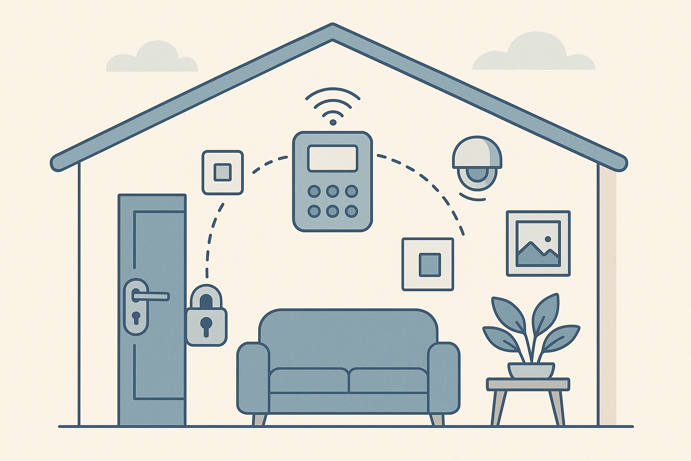
How Z-Wave Works
Z-Wave operates on low radio frequencies – 908.42 MHz in the United States and 868.42 MHz in Europe. This differs from most smart home protocols that crowd the 2.4 GHz band, giving Z-Wave a considerable advantage in avoiding interference from Wi-Fi routers, Bluetooth devices and microwaves.
The protocol uses mesh networking, where each powered device acts as a signal repeater. When you send a command from your hub to a distant smart lock, the signal can hop through light switches and outlets along the way, extending your network’s range and reliability. In a typical US two story home, a Z-Wave mesh can often cover the entire house with just a handful of switches and outlets acting as repeaters. Battery powered devices like sensors don’t repeat signals to preserve battery life.
Z-Wave networks support up to 232 devices per hub and can route signals through up to four hops. In practice, this creates a robust network that self-heals when devices go offline and automatically finds the most efficient communication paths.
Key Advantages of Z-Wave
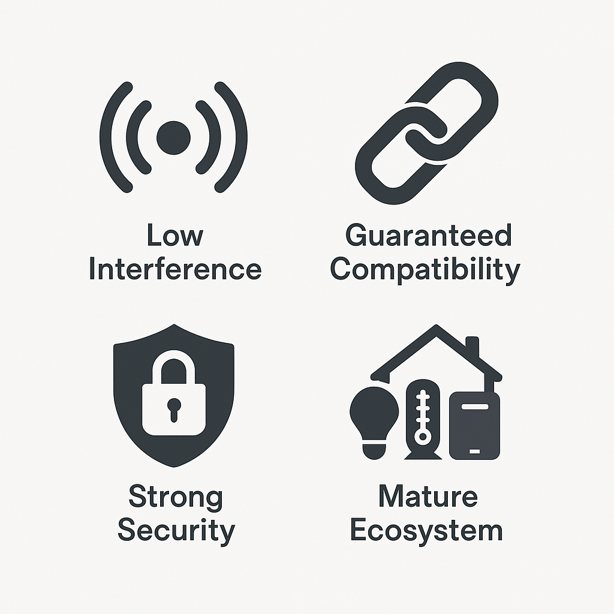
Minimal interference: Operating below the congested 2.4 GHz band means Z-Wave rarely experiences the connectivity hiccups that plague some Zigbee and Wi-Fi devices. This makes it particularly reliable in apartment buildings or dense neighborhoods.
Near guaranteed interoperability: The Z-Wave Alliance maintains strict certification standards. Any device bearing the Z-Wave logo should work with any Z-Wave hub, regardless of manufacturer. While some advanced features may vary by hub, this level of compatibility is far more reliable than Zigbee, where device pairing can be unpredictable despite using the same protocol.
Strong security: Z-Wave uses AES-128 encryption and requires the S2 security framework for all newly certified devices. While no protocol is perfectly secure, Z-Wave’s security implementation is generally solid for residential applications.
Mature ecosystem: Z-Wave has been around since 1999, which means extensive device selection, particularly for locks, thermostats and switches where reliability matters most.
Limitations to Consider
Higher device costs: Z-Wave devices typically cost 20-40% more than comparable Zigbee or Wi-Fi alternatives. The protocol’s licensing fees and stricter certification requirements contribute to these price premiums.
Regional frequency restrictions: Because Z-Wave uses different frequencies in different regions, a hub purchased in the US won’t work with devices bought in Europe or Australia. This makes a difference if you import devices or move internationally.
Slower development pace: While protocols like Matter are evolving rapidly with features like multi-admin and enhanced IoT security, Z-Wave development moves more conservatively. The recently introduced Z-Wave Long Range extends transmission distance, but innovation generally lags behind newer standards.
Hub dependency: Unlike Matter, which works across ecosystems, Z-Wave requires a dedicated hub. You can’t control Z-Wave devices directly from your phone without that central controller.

Z-Wave vs. Other Protocols
Compared to Zigbee: Both are low power mesh protocols, but Z-Wave offers more consistent compatibility between devices. Zigbee has a larger device ecosystem and doesn’t require regional frequency matching, but you’ll encounter more compatibility headaches, especially with older devices or when mixing hubs and endpoints from different manufacturers.
Compared to Matter: Matter is the newer standard focused on interoperability across Apple, Google and Amazon ecosystems. It’s where much of the industry is investing, though device availability and real world stability are still maturing. Z-Wave offers broader device choice and proven reliability today, particularly for locks and sensors where Matter adoption is still ramping up.
Compared to Wi-Fi: Wi-Fi devices don’t need a hub and offer faster data transmission, but they consume significantly more power and can congest your network. Z-Wave is purpose built for low power, always-on smart home devices.
When Z-Wave Makes Sense
Z-Wave works best when paired with a hub that supports local control, creating a reliable smart home network that doesn’t depend on cloud services. It’s particularly strong for:
- Security focused applications where you want locks, sensors and alarms operating on a dedicated network separate from your Internet connected devices
- Retrofit installations in homes where Wi-Fi coverage is poor or interference is high
- Long term reliability in scenarios where you’re less concerned about cutting edge features and more focused on devices that simply work
Ride the Wave
If you’re starting from scratch, Matter-over-Thread is hard to ignore, with its modern design and ambition to unify smart home platforms over time. It’s clearly aimed at the future.
But when reliability, breadth of devices and interoperability that’s already been proven in the real world matter most, Z-Wave continues to earn its place. It’s a mature, stable foundation that does exactly what it promises.
Z-Wave may not be the most exciting option, but for locks, alarms and security-critical automation, boring, predictable and dependable is often the smartest choice.