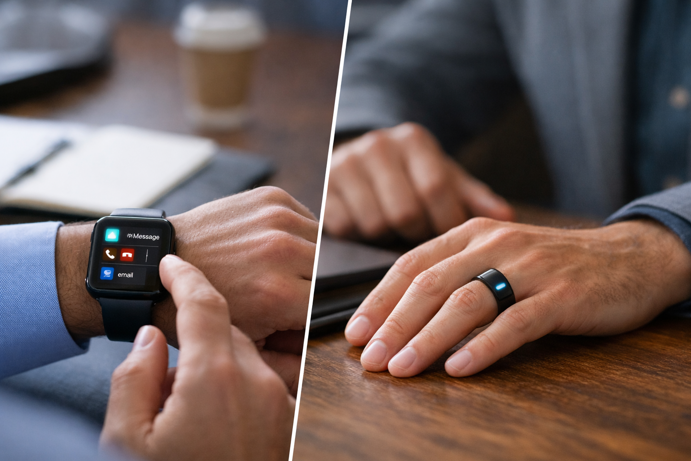
You’re at a work meeting when your wrist buzzes for the fifth time this hour. Another notification you can’t check without obviously glancing at a glowing screen. Meanwhile, your colleague subtly taps their finger twice on the table, already knowing their spouse just texted without anyone else noticing. The device on their hand? A smart ring that fits their work style better than a watch often does.
Smart rings and smartwatches both track health metrics and deliver notifications, but they approach wearable technology from fundamentally different philosophies. The smart ring vs smartwatch decision comes down to whether you want active engagement or passive monitoring. Watches prioritize screens, real-time feedback and constant interaction. Rings emphasize background tracking, discretion and multi-day battery life. Understanding which trade-offs matter for your situation determines whether you’ll wear the device consistently or leave it in a drawer after three months.
This guide cuts through the marketing claims to examine how these devices really differ in daily use, what each does well, and which limitations matter most.
The Core Difference: Active vs Passive Tracking
Smartwatches are essentially miniature computers strapped to your wrist. They run apps, display information on demand, respond to touch and voice commands, and require daily interaction. The screen serves as the primary interface, where you can check the time, read messages, control music and view workout metrics. This active engagement defines the smartwatch experience.
Smart rings take the opposite approach. They collect data continuously but present almost nothing in real-time. No screen means no immediate feedback during workouts, no message previews, no visible clock. You wear the ring throughout the day and night, then review accumulated data through a smartphone app. The ring works in the background, staying out of your way until you choose to examine what it recorded.
This fundamental design split creates cascading differences in battery life, form factor, use cases and most importantly, user experience. A smartwatch can show you your current heart rate mid-run because it has a screen and enough battery capacity to power constant display updates. A ring can’t show you anything, but it can track that same heart rate for a week on a single charge because it’s not lighting up a display dozens of times per day.
Display and Interaction
The presence or absence of a screen shapes everything about how you use these devices. Smartwatch displays range from always-on AMOLED screens that remain visible at a glance to raise-to-wake displays that illuminate when you rotate your wrist. Either way, the screen delivers information on demand, such as notifications, workout stats, navigation and app interfaces.
This immediate access creates convenience but demands interaction. Smartwatches require you to swipe, tap, scroll and navigate menus. In return, you gain the ability to respond to messages, control smart home devices, pay for coffee and track real-time pace during runs without pulling out your phone. The screen becomes both the device’s greatest strength and its most obvious presence.
Smart rings eliminate screens entirely, relying on subtle alternatives for immediate feedback. Some models include small LED lights visible only to you or gentle vibrations for notifications. You can configure different vibration patterns for specific contacts or notification types, providing basic context without checking your phone. However, you can’t read message content, see who’s calling or interact with notifications directly. The ring alerts you that something needs attention, but you still need your phone to respond.
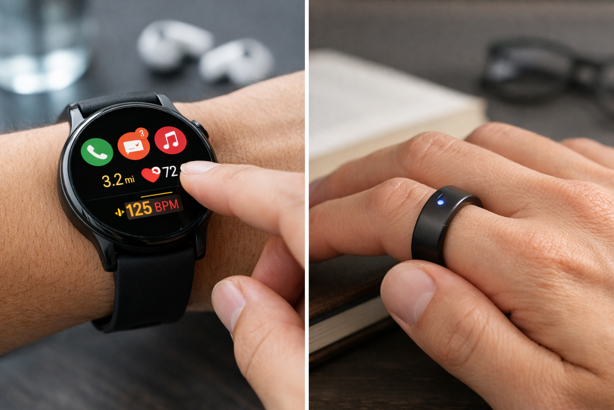
This constraint becomes either liberating or limiting depending on your priorities. For someone wanting to reduce screen time and constant checking, a ring’s inability to display information prevents the reflexive glance that turns into five minutes of distracted scrolling. For someone who relies on wrist based message reading or navigation during workouts, the lack of display makes rings impractical.
Health and Fitness Tracking
Both devices track similar health metrics, including heart rate, steps, sleep stages, calories burned and activity levels. The sensors work on the same principles, using photoplethysmography (PPG) to detect blood flow changes and accelerometers to measure movement. However, sensor placement and intended use cases create meaningful differences in accuracy and functionality.
Sensor Accuracy by Location
Smartwatches position optical sensors against your wrist, where blood flow is adequate during rest but can become less reliable during intense exercise or in cold conditions. Wrist placement also allows more movement between sensor and skin. During high intensity workouts or activities with significant arm motion, wrist based heart rate tracking sometimes shows lag or inaccuracy compared to chest strap monitors.
Smart rings place sensors on your finger, where capillary networks are denser and signals often remain cleaner during rest and sleep. This positioning advantage particularly benefits overnight tracking. Heart rate variability (HRV), resting heart rate and skin temperature trends from finger sensors tend to be more consistent than wrist measurements when you’re stationary. However, during exercise, blood flow shifts away from extremities toward major muscle groups. Rings can struggle with active workout tracking, showing delayed or inaccurate readings during intense activity when blood flow to fingers decreases.
For sleep optimization and recovery monitoring, rings often excel. For real-time workout guidance and training zones, watches generally perform better. A recovery focused ring like the Oura prioritizes overnight HRV and sleep staging, while a training focused watch like a Garmin emphasizes workout metrics and performance analytics.
GPS and Location Tracking
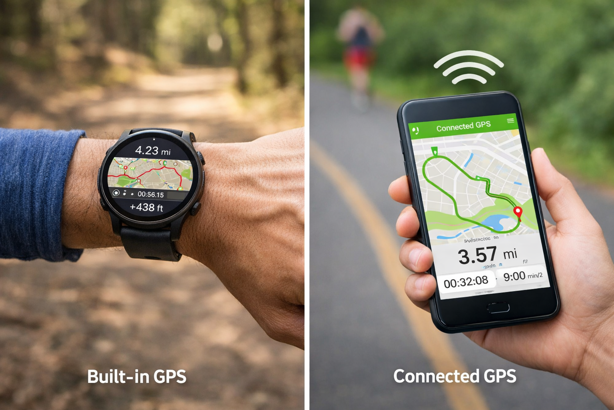
Smartwatches frequently include built-in GPS, allowing you to track outdoor runs, rides and hikes without carrying your phone. Multi-band GPS in premium models improves accuracy in challenging environments like urban areas with tall buildings or dense forests. The watch records your route, distance, elevation and pace, syncing this data to companion apps after your workout.
Smart rings currently lack built-in GPS due to size and power constraints. They can use your smartphone’s GPS when you carry it during outdoor activities, a compromise called connected GPS. This works for many people who already bring phones on runs for music or safety, but eliminates the phone-free workout option that many runners and cyclists value. If leaving your phone behind during exercise is important to you, a ring won’t support that use case.
Real-Time Workout Feedback
The screen advantage becomes most apparent during active exercise. Smartwatches display current heart rate, pace, distance, time elapsed and training zone directly on your wrist mid-workout. You can glance down during a run to check if you’re maintaining target pace or drifting too fast. Interval workouts show remaining time, current set and recovery periods. This immediate feedback allows you to adjust intensity in real-time rather than discovering after the fact that you went too hard or too easy.
Smart rings provide zero workout feedback while you’re exercising. They record heart rate and movement patterns, but you can’t see any of this data until you finish and check your phone. Some users find this liberating – no constant checking or performance anxiety during workouts. Others may find it frustrating, especially when training for goals that require maintaining certain heart rate zones or paces. The ring essentially asks you to trust your perceived exertion rather than relying on quantified feedback.
Sleep Tracking
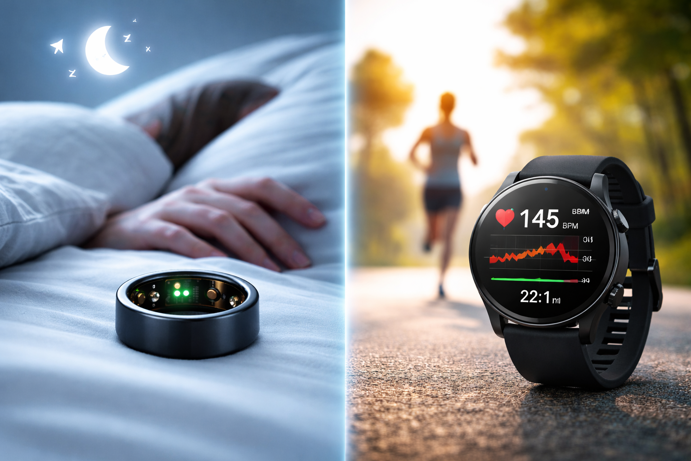
Sleep tracking represents a use case where smart rings often outperform watches. The smaller form factor makes rings more comfortable for overnight wear. Many people who tolerate wearing a watch during the day find it intrusive while sleeping. Rings practically disappear on your finger after the first few nights of adjustment.
The finger based sensor placement also delivers cleaner signals during sleep when you’re still and blood flow is stable. This makes for better HRV and skin temperature trend tracking, two metrics that deliver valuable recovery insights. Many rings make sleep and recovery monitoring their primary focus, with training metrics treated as secondary features.
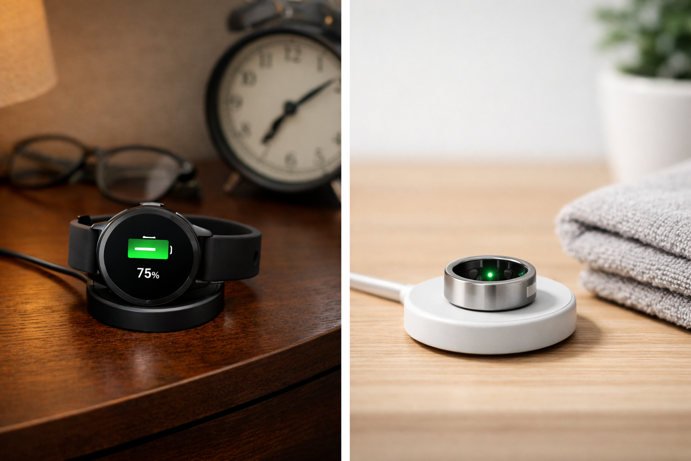
Smartwatches track sleep effectively too, especially newer models designed with overnight wear in mind. However, the larger size and weight make them less comfortable for some people. Battery life also becomes a consideration. If your watch needs nightly charging, you have to choose between tracking sleep or ensuring a full charge for tomorrow’s activities. Rings typically last 4-7 days between charges, easily covering multiple nights of sleep tracking without interruption.
Battery Life
Battery endurance varies dramatically between these devices, largely due to display power consumption. Smartwatches with always-on displays, frequent screen wake-ups, GPS tracking and app usage typically require daily charging. Some fitness focused watches stretch to 5-10 days by using more efficient processors and limiting smartwatch features, but these remain exceptions rather than the norm. Even multi-day watches usually need charging twice weekly.
Smart rings routinely last 4-7 days on a single charge despite continuous health monitoring. The absence of a power-hungry display helps. You charge the ring once or twice per week, perhaps during showers or while getting ready in the morning. This reduced charging frequency means fewer gaps in your data and less daily maintenance.
The practical difference becomes most noticeable during travel or busy periods. Forgetting to charge your smartwatch overnight means starting the next day with partial battery or a dead device. Forgetting to charge your ring for two days likely still leaves you with enough battery to get through tomorrow.
Form Factor and Wearability
Smartwatches occupy significant wrist real estate (in particular, larger models designed for men or athletes). Case sizes range from 40-49mm, with thickness adding noticeable bulk. This size houses the display, battery, processor and sensors, creating a device that clearly signals “wearable technology” rather than subtle accessory.
Smart rings measure 7-8mm wide and weigh 4-6 grams depending on size and material. They resemble wedding bands or fashion rings in appearance, though usually chunkier than purely decorative jewelry. Most people wear them on their index or middle finger for optimal sensor contact and comfort. After an adjustment period, rings become barely noticeable. You forget you’re wearing one until you actively think about it.
This discretion matters in contexts where watches feel inappropriate or impractical. Healthcare workers, chefs, mechanics and others who work with their hands often find watches interfere with gloves, get caught on equipment or violate workplace dress codes. Rings can be easier to manage in some of these roles, though many workplaces restrict all jewelry for safety or hygiene reasons. Similarly, formal events or professional settings where smartwatch notifications might seem disrespectful become easier to navigate with a ring’s subtle vibration versus a watch’s glowing screen.
Conversely, smartwatches offer more versatility in how you wear them. Interchangeable bands let you switch between sport, casual and formal styles in seconds. Rings require precise sizing that can’t be adjusted. Weight fluctuations, temperature changes and even time of day affect how rings fit. A ring that feels perfect in the morning might feel tight by evening. Sizing mistakes are expensive since most manufacturers don’t accept returns on opened rings due to hygiene concerns.
Smart Features Beyond Health Tracking
Smartwatches function as wrist mounted smartphones with extensive app ecosystems, payment capabilities, music storage and voice assistant integration. You can respond to messages, make calls, control smart home devices, navigate with maps, listen to music and run third-party apps. This functionality makes smartwatches genuinely useful for reducing how often you pull out your phone during the day.
Smart rings offer minimal smart features beyond health tracking. Some models include NFC for contactless payments, though support varies and many popular rings prioritize health monitoring over payment functionality. A few rings can store credentials for smart locks or trigger smart home routines, but these capabilities remain limited compared to watches.
At-a-Glance Comparison
| Feature | Smart Ring | Smartwatch |
|---|---|---|
| Display | None (LED indicators on some models) | Touchscreen AMOLED/LCD |
| Battery Life | 4-7 days typical | 1-2 days typical (up to 10 for fitness focused models) |
| Health Tracking | Excellent for sleep, HRV, resting metrics | Excellent for active workouts, real-time feedback |
| GPS | Connected (requires phone) | Built-in (phone-free tracking) |
| Workout Feedback | None during exercise | Real-time metrics on screen |
| Notifications | Vibration/LED alerts only | Full message preview and interaction |
| Smart Features | Minimal (payments on some models) | Extensive (apps, music, voice control) |
| Form Factor | 7-8mm ring band, 4-6g | 40-49mm watch case, 25-50g |
| Comfort | Often unnoticeable after adjustment | Noticeable presence, especially during sleep |
| Price Range | $200-500 (often + subscription) | $200-800+ |
| Best For | Sleep optimization, recovery tracking, discreet monitoring | Active training, daily productivity, phone replacement |
Cost Considerations
Pricing overlaps considerably between these device categories, though the value proposition differs. Entry level smartwatches start around $200-250, mid-range models cost $300-450, and premium devices reach $500-800 or more. These prices usually include all features without ongoing costs, though some manufacturers offer optional subscription services for advanced health insights or cellular connectivity.
Smart rings generally range from $200-350 for basic models to $300-500 for premium options. However, many popular rings require monthly or annual subscriptions (e.g. $5.99/month or $69.99/year) to access detailed health insights, trend analysis and personalized recommendations. Without the subscription, you often get only basic data viewing – seeing raw numbers but losing the interpretation and actionable insights that make tracking worthwhile.
This subscription model means total cost of ownership can add up over time. For example, a $350 ring with a $6/month membership costs $422 in year one (device plus first year of subscription), then $72 per year for the ongoing subscription. Over three years, that’s $566 total if you maintain the membership. A $400 smartwatch with no subscription costs $400 regardless of how many years you use it.
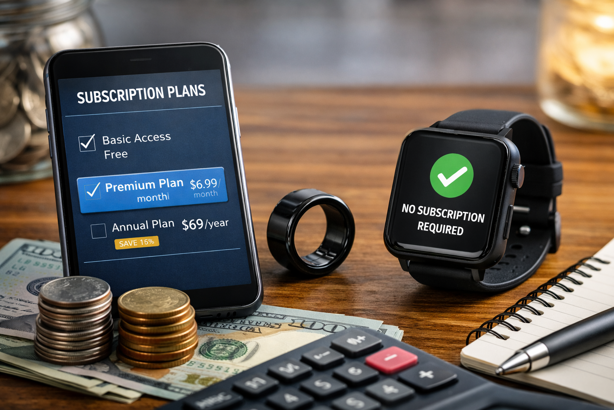
Factor in potential replacement costs if your finger size changes and you need a new ring, and the long term economics often favor watches despite seemingly comparable starting prices.
Some newer rings eliminate subscription requirements, offering full feature access for the upfront price. These models make the cost comparison more straightforward, though you sacrifice some of the sophisticated analysis and insights that subscription based platforms deliver.
For detailed pricing and feature comparisons of the top smart rings, see our comprehensive smart ring buying guide.
Who Should Choose a Smart Ring?
Smart rings work best for use cases where their strengths align with your priorities. If you prioritize sleep optimization and recovery tracking over active workout guidance, rings are a good choice. Their comfort during overnight wear and finger based sensor accuracy make them particularly effective for sleep stage analysis, HRV trends and skin temperature trend tracking – metrics that inform how ready your body is for intense training or stressful days.
Professionals in occupations where watches are impractical benefit. Healthcare workers who frequently wash hands and wear gloves, mechanics who work with machinery, chefs handling food and others with hands-on work often can’t wear watches for practical reasons. Rings can be easier than watches in some of these roles, though you should always verify your workplace’s jewelry policy, as many environments restrict all jewelry for safety or hygiene reasons.
Minimalists and those with sensory sensitivities often prefer rings over watches. The small form factor disappears on your hand after an initial adjustment period, while watches maintain a persistent presence on your wrist. Some people find watch bands irritating or confining, particularly during sleep or in warm weather. Rings eliminate these comfort concerns for many users.
Conversely, rings don’t work well if you want real-time workout feedback, rely on wrist based message reading, need built-in GPS for phone-free outdoor activities or value the convenience of wrist based smart features like payments, music control or voice assistants.
Who Should Choose a Smartwatch?
Athletes training for certain performance goals benefit from real-time feedback during workouts. Runners maintaining target times, cyclists tracking power zones or anyone following structured training plans need immediate data to adjust intensity mid-session. Watches display current metrics and provide guidance that helps you stay on track rather than discovering after finishing that you went too hard or too easy.
People who want phone-free outdoor activities require built-in GPS. If you run, hike or cycle without carrying your phone, watches enable accurate route tracking and distance measurement. Premium watches with multi-band GPS improve accuracy in challenging environments like urban areas or dense forests.
Those already comfortable with daily charging routines won’t find smartwatch battery life burdensome. If you charge your phone nightly anyway, adding a watch to the charging station is a minor task. Modern fast charging often restores watches to full battery in 1-2 hours, allowing morning charging during your routine if you forget overnight.
Smartwatches don’t work as well if you’re primarily interested in sleep tracking and find wrist devices uncomfortable overnight, want to minimize screen time and digital distractions, work in environments where watches are impractical or unsafe, prioritize maximum battery life between charges, or simply prefer minimal jewelry that doesn’t announce itself as technology.
Can You Use Both?
Some people wear both a smartwatch and a smart ring, taking advantage of each device’s strengths. A common approach uses a smartwatch during the day for active features and workout tracking, then switches to a ring overnight for comfortable sleep monitoring.
The main challenge is cost. Owning both devices plus potentially multiple subscriptions gets expensive fast. Data fragmentation also becomes an issue, as your health metrics split across two different apps and platforms. Some companion apps integrate with each other or with centralized health platforms like Apple Health or Google Fit, but this creates additional complexity in tracking trends and interpreting combined data.
For most people, choosing one device that best matches their primary use case makes more practical and financial sense than maintaining two separate wearables. The exception is serious athletes who want comprehensive recovery monitoring from a ring overnight while still needing real-time training guidance from a watch during workouts.
The Middle Ground: Fitness Trackers
Fitness trackers occupy the space between minimalist rings and full featured smartwatches. These slim wrist bands include small displays showing basic information like time, steps and heart rate, but lack the extensive app ecosystems and smart features of true smartwatches. They normally offer better battery life than smartwatches (5-14 days common), while maintaining the ability to view data on-device, unlike rings.
For people wanting some immediate feedback without the bulk or complexity of smartwatches, fitness trackers provide a workable compromise. However, they inherit wrist based sensor limitations and generally lack the sleep tracking comfort of rings or the comprehensive features of smartwatches. They could serve budget conscious buyers well, but often leave users wanting either the minimalism of rings or the capability of watches.
The Only Metric That Matters
Health data doesn’t change lives. Habits do.
Whether that habit is checking your wrist mid-run or reviewing sleep scores over coffee, the right device fits the way you already operate. Rings reward patience. Watches reward engagement. Both lose their edge the moment they demand more effort than you’re willing to give.
That’s why the decision matters less than it first appears. Not because the choice is trivial, but because the outcome depends on what happens after the purchase. The device that blends into your routine quietly compounds value over time. The one that fights your schedule, your comfort or your attention eventually gets left behind.
Choose the wearable that feels sustainable on ordinary days. That’s where consistency takes root – and where progress actually begins.