If you’ve ever wondered how IoT sensors make everyday processes smoother, you’re not alone. From production lines to smart homes, these components are central to modern life. Experts estimate there are already tens of billions of connected devices worldwide, all generating streams of valuable data that can optimize everything from home energy use to predicting equipment failures. In this guide, you’ll learn what IoT sensors are, the most common types and how to pick the right ones for your needs.
What Are IoT Sensors?
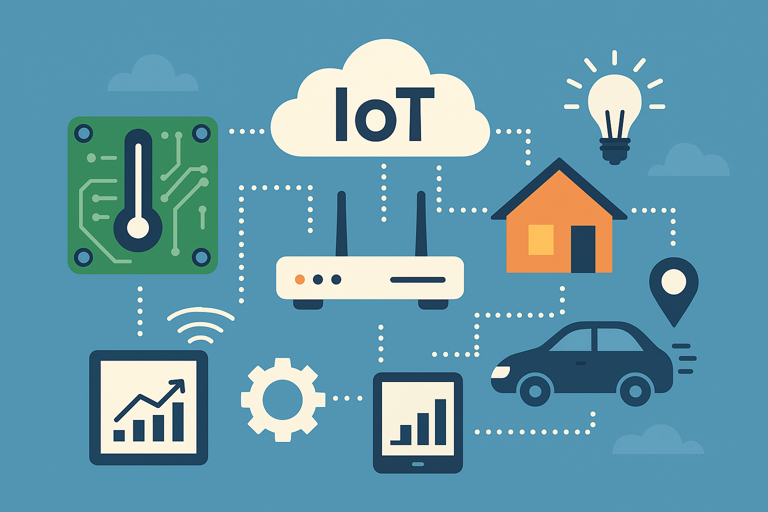
IoT sensors act like digital bridges between the physical world and the Internet. They detect changes in the environment (temperature, pressure, motion, light) and transmit that information to a central system for analysis. Thanks to the Internet of Things (IoT), nearly any object can become “smart” once fitted with a sensor and connectivity.
Today’s IoT applications span countless industries, including:
- Agriculture: Soil moisture and temperature sensors help farmers water efficiently and boost crop yields.
- Healthcare: Wearables track vital signs like heart rate or oxygen levels, enabling remote patient monitoring.
- Manufacturing: Machine sensors monitor status in real time, predicting maintenance needs before breakdowns occur.
Sensors perform three core functions – capturing environmental data, transmitting readings to a device or gateway over Wi-Fi, Bluetooth, cellular or specialized networks like LoRaWAN, and enabling analysis that produces insights, automates actions or triggers alerts. Together, these steps form real-time feedback loops. A smart thermostat sensor measures room temperature, sends data to the cloud and quickly adjusts heating for comfort and efficiency.
Why Use IoT Sensors?
If you’re looking for improved efficiency, cost savings or deeper insights, incorporating sensors into your processes delivers measurable benefits, like:
- Automation: Tasks run on autopilot, from turning off lights in empty rooms to adjusting manufacturing lines without manual intervention.
- Predictive maintenance: Constantly tracking performance data spots small problems before they become big breakdowns, reducing downtime and expensive surprises.
- Cost reduction: Automating routine checks and reducing energy usage lowers bills in offices and industrial facilities alike.
- Real-time insights: Data streaming enables quicker, evidence-based decisions and faster pattern recognition.
- Regulatory compliance: Many industries require constant monitoring to meet safety or environmental standards.
- Remote monitoring: Manage systems across different locations from a single dashboard.
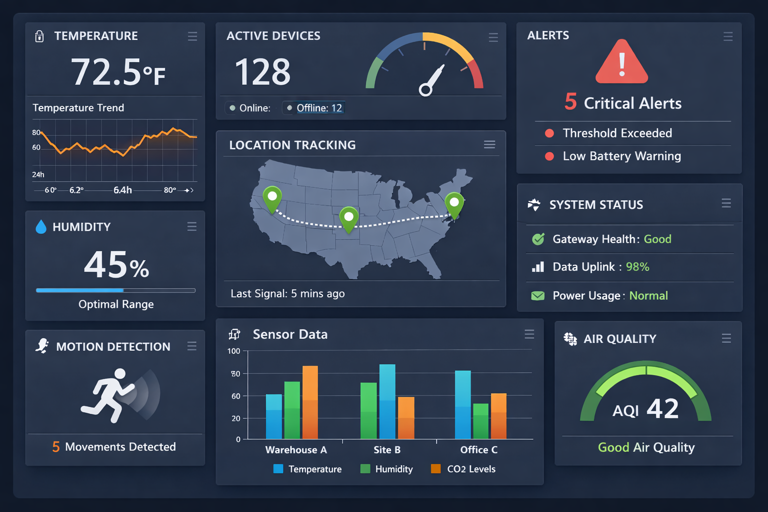
In a factory, sensors optimize production speed and worker safety. In a smart home, they alert you to windows left open or basement water leaks.
Core IoT Sensor Types
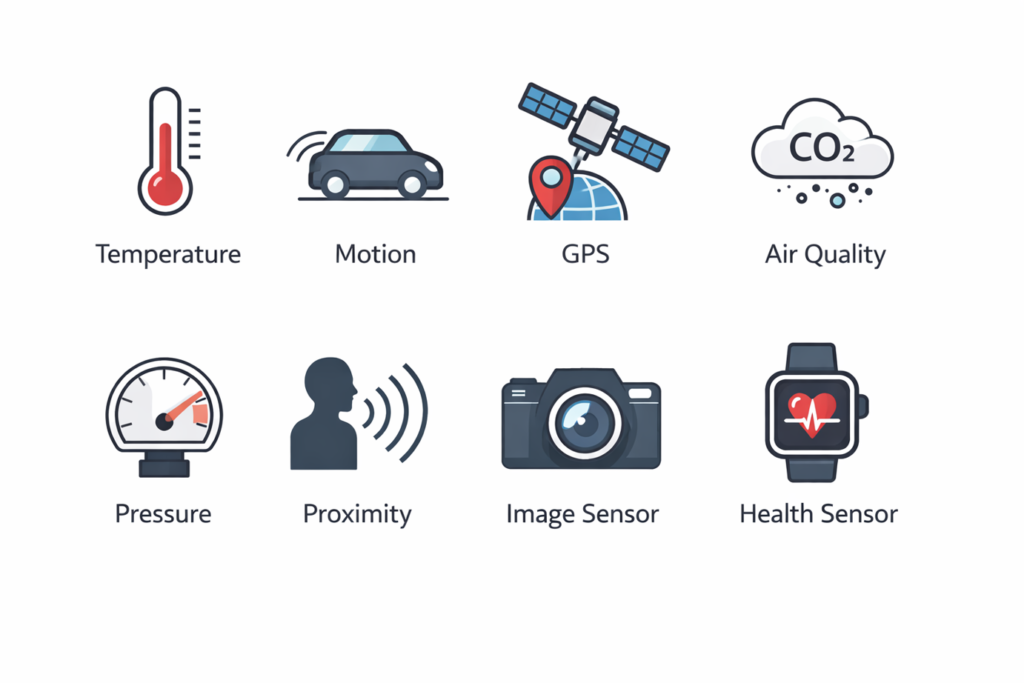
Not all sensors are created equal. Some measure temperature, others detect motion and many do much more. Below is a quick reference table, followed by details of the most common IoT sensor types and their applications.
| Sensor Type | What It Measures | Typical Uses | Example Technologies |
|---|---|---|---|
| Temperature | Heat/cold | Smart buildings, healthcare, food transport | Thermistors, RTDs, thermocouples |
| Proximity | Presence of nearby objects | Retail, parking, automation | Ultrasonic, infrared, capacitive |
| Pressure | Force per unit area | Vehicles, aircraft, leak detection | MEMS pressure sensors, TPMS |
| Motion | Movement in an area | Security, energy management | PIR, ultrasonic, microwave |
| Image | Visual data | Security, machine vision, vehicles | CMOS/CCD cameras |
| Accelerometer | Linear acceleration | Wearables, smartphones, vehicles | MEMS accelerometers |
| Air Quality | Gas/particulate levels | Smart cities, offices | CO₂, VOC, PM sensors |
| Biomedical | Vital signs | Healthcare, fitness wearables | Heart rate, SpO₂, glucose monitors |
| Level | Quantity of liquids/solids | Tanks, silos, fluid management | Ultrasonic, capacitive level sensors |
| Humidity | Moisture in air | Agriculture, HVAC | Resistive/capacitive humidity sensors |
| Gyroscope | Orientation/rotation | Drones, robotics, smartphones | MEMS gyroscopes |
| Optical | Light intensity | Smart lighting, phone displays | Photodiodes, phototransistors |
| Chemical/Gas | Specific gases/compounds | Industrial safety, homes | CO, ammonia, VOC sensors |
| Vibration | Oscillations or mechanical movement | Industrial machines, predictive maintenance, structural monitoring | Piezoelectric sensors, MEMS accelerometers |
| Sound / Acoustic | Noise levels, sound waves, ultrasonic signals | Noise monitoring, leak detection, voice assistants | Microphones, ultrasonic sensors |
| GPS / GNSS | Global positioning, location tracking | Fleet management, agriculture, asset tracking | GPS, GLONASS, Galileo, BeiDou receivers |
| Current / Voltage | Electrical parameters: current, voltage, power | Smart meters, energy monitoring, equipment maintenance | Hall effect sensors, current transformers |
Temperature Sensors
Temperature sensors measure heat or cold and appear in everything from home thermostats to complex industrial systems requiring precise heat management. Common types include thermistors, thermocouples and RTDs (resistor temperature detectors). They’re crucial in smart buildings (adjusting heating or cooling automatically), healthcare settings (monitoring patient temperature or keeping medical supplies at safe thresholds) and food transport (tracking temperature in reefer trucks or warehouses).
Proximity Sensors
Proximity sensors detect whether an object is near without physical contact by sending out a signal (infrared, ultrasonic or electromagnetic) and reading reflections or interruptions. Automatic store doors and cashier-less retail systems that detect products taken off shelves both rely on proximity sensors.
Pressure Sensors
Pressure sensors monitor force per unit area and are essential in automotive, aircraft and industrial manufacturing systems. A tire pressure monitoring system (TPMS) notifies you when a tire needs air, while aircraft sensors ensure cabin pressure remains at safe levels. They’re also used for leak detection in water pipelines or gas lines.
Motion Sensors
Motion sensors detect movement in defined zones for security or energy saving solutions. When you walk into a public restroom and lights switch on automatically, that’s likely a passive infrared (PIR) sensor. Ultrasonic and microwave sensors are alternatives, working by bouncing pulses off nearby objects and detecting environmental changes.
Image Sensors
Cameras are image sensors that capture and convert visuals into digital signals. Beyond security cameras, they power machine vision in industrial sorting, smart refrigerators that scan groceries and autonomous vehicles that detect traffic conditions.
Accelerometer Sensors
Accelerometers measure acceleration, which can be used to infer movement, orientation and changes in velocity. They’re in smartphones (helping the screen orient correctly), fitness trackers (measuring your steps) and car airbags (detecting sudden deceleration to deploy safety systems).
Air Quality Sensors
Air quality sensors measure gases and particulates like CO₂ or PM2.5. Smart cities install these sensors to track pollution and send alerts when levels get too high. They’re also common in offices ensuring optimal indoor air quality for employees.
Biomedical Sensors
Biomedical sensors measure vital signs like heart rate, blood pressure or oxygen saturation. Fitness watches that track your heart rate and hospital systems providing continuous patient monitoring with real-time alerts both use these sensors.
Level Sensors
Level sensors detect the amount of material in containers, from water tanks to grain silos. They’re crucial in industrial process control, ensuring machines run properly and resources don’t overflow or run low. Ultrasonic or capacitive sensors often measure liquid or solid levels without direct contact.
Humidity Sensors
Humidity sensors gauge water vapor in the air. In agriculture, they help adjust irrigation based on current moisture levels. In HVAC systems, they maintain comfortable indoor humidity and prevent mold growth.
Gyroscope Sensors
Gyroscope sensors measure orientation and rotation. When you tip your smartphone to rotate a racing game, that’s a gyroscope at work. Drones and robotics also depend on gyroscopes to maintain stability and orientation in flight.
Optical Sensors
Optical sensors measure light intensity and convert it into electronic signals. They enable auto-brightness in phone screens and street lights that turn on when it gets dark.
Chemical and Gas Sensors
These sensors detect hazardous substances like carbon monoxide, ammonia or volatile organic compounds (VOCs). Industries use them to maintain safe working conditions, while homeowners rely on carbon monoxide detectors to warn of dangerous leaks.
Vibration Sensors
Vibration sensors detect oscillations or irregular movements in machines, structures or vehicles. In industrial IoT, they’re critical for predictive maintenance, as changes in vibration patterns often reveal early signs of wear, imbalance or faults in motors and equipment. They also appear in structural monitoring for bridges or buildings.
Sound / Acoustic Sensors
Acoustic sensors measure sound waves or vibrations in the air. They’re increasingly important in smart cities tracking environmental noise levels and in industrial settings where ultrasonic microphones detect gas or water leaks. Microphones in IoT devices also enable voice assistants and smart speakers to respond to spoken commands.
GPS / GNSS Sensors
GPS and other global navigation satellite system (GNSS) sensors provide location data for IoT devices. They’re central to fleet tracking, smart agriculture (precision planting and harvesting) and asset management in logistics. Unlike accelerometers or gyroscopes that measure motion and orientation, GNSS sensors deliver absolute location for mapping and geofencing applications.
Current / Voltage Sensors
Electrical sensors measure current, voltage or power consumption in circuits. They play a critical role in smart meters, energy efficient buildings and predictive maintenance for electrical systems. By monitoring real-time power usage, these sensors help reduce waste, improve safety and identify failing components before they cause costly downtime.
Smart Data Collection with IoT Sensors
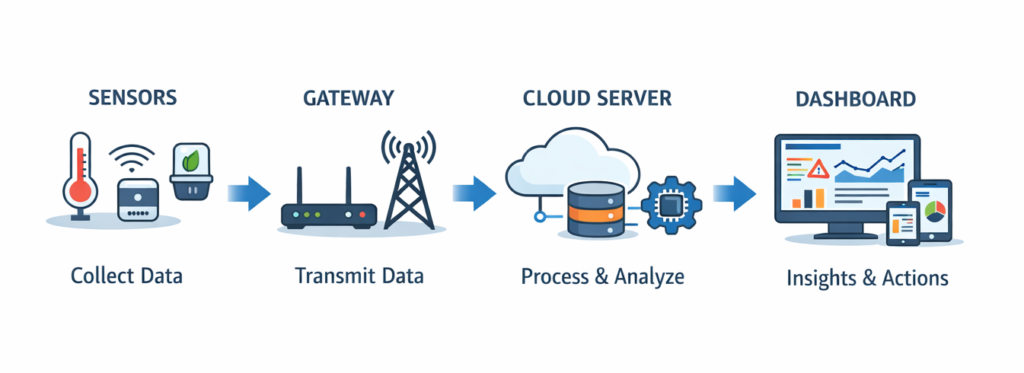
Sensors alone won’t transform your processes without solid data handling. Here’s how IoT data flows from collection to action:
- Collection: A sensor picks up environmental data like temperature or motion.
- Transmission: Wireless protocols (Wi-Fi, Bluetooth, LoRaWAN, cellular) transmit readings to a gateway.
- Processing: Analysis happens at the edge for real-time decisions or in the cloud for sophisticated analytics and long term storage.
- Action: Results appear in dashboards, mobile apps or automated triggers that put data to practical use.
Best Practices for Efficient Data Handling
- Prioritize security: Encrypt data both at rest and in transit to protect against unauthorized access.
- Clean and validate sensor data: Remove duplicates, correct errors and standardize formats. Messy data skews results and leads to poor decisions.
- Use gateways: An IoT gateway manages different protocols and can do initial data processing, handling large traffic volumes securely.
- Balance edge and cloud processing: Not all data needs to travel to the cloud. Processing information closer to where it’s generated reduces latency and saves bandwidth. A factory vibration sensor can flag anomalies locally to trigger an instant machine shutdown while sending summarized data to the cloud for long term trend analysis.
Scaling IoT Sensor Networks
Even if your sensor network starts small, it might expand quickly once you see the benefits. Projections suggest there could be over 30 billion IoT devices by 2030. A scalable approach helps you stay nimble as you add new sensors.
Embrace Modular Design
Choosing modular components and flexible gateways upfront makes it easier to swap sensors, integrate new protocols or update firmware without replacing your entire system.
Leverage Analytics and AI
Sensor data is valuable for machine learning models that spot anomalies and predict future outcomes. In manufacturing, advanced analytics catch slight irregularities in production lines, prompting early intervention that saves hours and money. For city planners, AI optimizes traffic lights based on real-time vehicle counts to reduce congestion.
Cost Control
When you scale, connectivity and storage costs can skyrocket. If you’re deploying thousands of sensors, consider usage based billing models. Zipit, for example, helps customers structure plans so end consumers cover increased utilization as more sensors come online, preventing unexpected expense surges.
Factor in Maintenance
Sensors still need occasional calibration and firmware updates. Plan a maintenance schedule based on vendor recommendations and watch for signs of wear or inaccurate readings, whether that means testing pressure sensors in vehicles every few months or recalibrating temperature sensors in refrigerated warehouses.
Measuring What Matters Most
At the heart of every connected device lies a simple idea – measure something important and act on it. IoT sensors make this possible, capturing everything from temperature and air quality to movement and orientation. Together, these readings create the insights that power smarter homes, safer workplaces, more efficient factories and healthier cities.
As IoT adoption accelerates, choosing the right mix of sensor types will determine how well systems deliver value, whether that’s saving energy, reducing downtime or keeping people safe. With the right sensors and a strong data strategy, businesses and individuals can turn ordinary environments into intelligent, responsive systems that measure what matters most and use that knowledge to make better decisions every day.