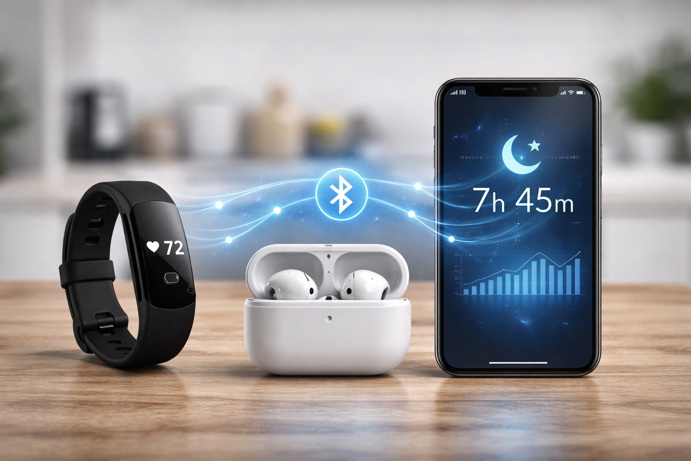
Your smart watch tracks your morning run. Your wireless earbuds connect the moment you open the case. And your fitness tracker syncs data while you sleep. None of this feels like “technology” anymore. It just works. That’s Bluetooth doing what it does best. Quietly connecting devices without you thinking about it.
But here’s what most people don’t realize. The Bluetooth in your phone isn’t the same as the Bluetooth in your IoT sensors. Bluetooth Low Energy (BLE) fundamentally changed what’s possible for connected devices. While classic Bluetooth powered your wireless speakers and car hands-free systems, BLE made years long battery life practical for sensors, trackers and wearables. This guide explains how Bluetooth fits into the IoT landscape, when it makes sense, and when you should probably look elsewhere.
What is Bluetooth for IoT?
Bluetooth for IoT refers primarily to Bluetooth Low Energy (BLE), a low power wireless protocol designed for short range communication between sensors, wearables and smartphones. It allows devices like fitness trackers and smart locks to run for months or years on small batteries, while maintaining reliable connectivity.
Bluetooth is a wireless protocol operating in the 2.4 GHz ISM band. Originally developed by Ericsson in 1994 for wireless headsets, it’s evolved into a family of standards serving various needs. The Bluetooth Special Interest Group (SIG) maintains the specification and oversees development.
Two distinct versions matter for IoT applications – Classic Bluetooth and Bluetooth Low Energy. They share the same frequency band and brand name but serve fundamentally different purposes.
Classic Bluetooth vs Bluetooth Low Energy
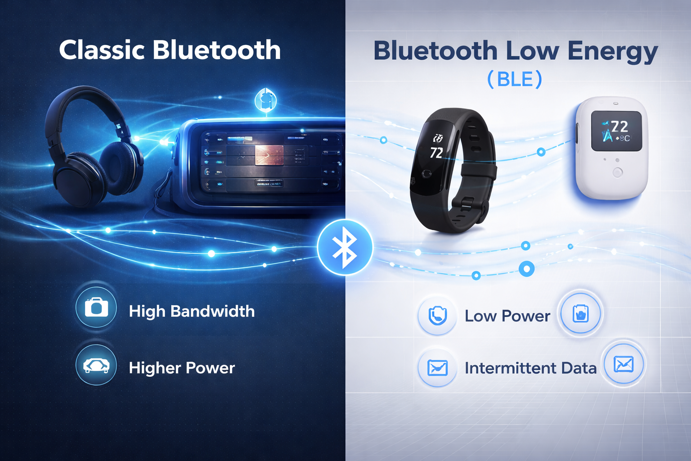
Classic Bluetooth was designed for continuous streaming applications like audio. It establishes persistent connections and maintains constant data flow. Your wireless headphones use classic Bluetooth because they need steady, reliable audio transmission without dropouts.
Bluetooth Low Energy takes a completely different approach. Introduced with Bluetooth 4.0 in 2010, BLE was built from the ground up for intermittent data transmission. Instead of maintaining constant connections, BLE devices wake up, transmit small packets of data and return to sleep mode in milliseconds. A heart rate sensor doesn’t need continuous streaming, as it sends a reading every second or two then goes dormant. This fundamental difference makes BLE devices last months or years on coin cell batteries.
The trade-off is throughput. Classic Bluetooth can push 2-3 Mbps while BLE typically operates at 125 kbps to 2 Mbps depending on the version and configuration, though real world application throughput is often lower. For sensors transmitting temperature readings or step counts, this is more than sufficient. For streaming video or audio files, classic Bluetooth or Wi-Fi makes more sense.
How Bluetooth Low Energy Works
BLE uses a star topology where a central device (usually your smartphone or hub) connects to multiple peripheral devices (sensors, trackers, locks). The central device initiates connections and coordinates communication. Peripherals advertise their presence by broadcasting packets at regular intervals. When a central device detects an advertisement, it can establish a connection.
This advertising mechanism is what makes BLE so power efficient. A fitness tracker doesn’t maintain an active connection to your phone the whole time. It advertises its presence every second or so using minimal power. When you open the companion app, your phone scans for advertisements, finds the tracker and establishes a connection only when needed. Data syncs in seconds, then both devices disconnect and the tracker returns to low power advertising mode.
GATT Profiles and Services
BLE organizes data using the Generic Attribute Profile (GATT). Think of GATT as a standardized menu system. Every BLE device exposes services (like “Heart Rate Service” or “Battery Service”), and each service contains characteristics (actual data points like “Heart Rate Measurement” or “Battery Level”).
The Bluetooth SIG maintains standard profiles for common device types. If you’re building a heart rate monitor, you implement the Heart Rate Profile. Any app supporting that profile can then read your device’s data without custom integration. This standardization is why your fitness watch works with multiple health apps without special driver software or configuration.
Custom profiles are equally straightforward. If you’re building a smart plant sensor with no standard profile, you define your own services and characteristics. The BLE specification provides the framework while giving you flexibility for specialized applications.
Bluetooth 5.0 and Beyond
Bluetooth 5.0, released in 2016, brought notable improvements for IoT applications. The introduction of LE Coded PHY enabled extended range modes that can reach several hundred meters in ideal conditions at lower data rates, while many Bluetooth 5 devices show improved range over previous versions in practice. Data throughput doubled to 2 Mbps in high speed mode. Perhaps most importantly, advertising packet capacity increased 8x, meaning devices could broadcast more information without establishing connections.
Bluetooth 5.1 added direction finding, enabling sub-meter indoor positioning and, in controlled setups, centimeter level accuracy. Bluetooth 5.2 introduced LE Audio with support for broadcast audio and hearing aid compatibility. Versions 5.3 and 5.4 continued refinements with improved connection reliability and reduced power consumption.
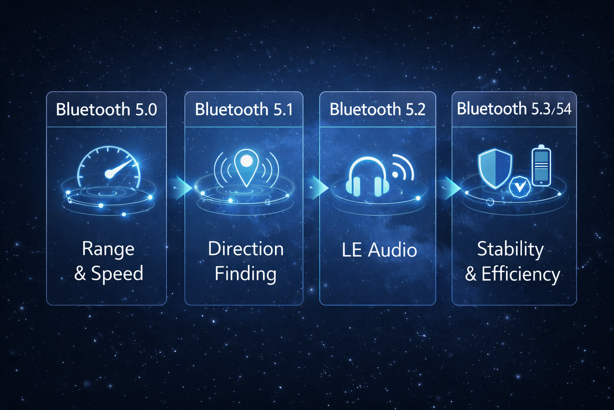
The practical impact here? Modern BLE devices last longer on batteries, communicate over greater distances and offer richer functionality than early implementations. If you’re deploying BLE sensors today, ensure they support at least Bluetooth 5.0 to take advantage of these improvements.
Bluetooth in Smart Homes and IoT
Walk through a modern home and you’ll encounter Bluetooth everywhere, even if you don’t notice it. The protocol excels in scenarios requiring proximity, simplicity and low power consumption.
Common Bluetooth IoT Applications
Wearables and Fitness Trackers: This is BLE’s sweet spot. Your fitness band needs to track steps all day and sync data occasionally. It doesn’t need constant connectivity. BLE enables month-long battery life while maintaining responsive smartphone pairing. Wearable devices from major manufacturers like Fitbit, Garmin and Apple rely on BLE for this exact reason.
Smart Locks: Bluetooth smart locks avoid the complexity of Wi-Fi setup while providing smartphone control. When properly configured, your phone authenticates via BLE as you approach your door and the lock opens automatically. No keys, no codes. Battery life typically spans 6-12 months on standard batteries because the lock only activates when it detects your phone nearby.
Proximity Sensors and Beacons: Retail stores use BLE beacons to detect when customers enter specific areas, enabling location based promotions and analytics. Museums deploy beacons near exhibits to trigger audio guides on visitor smartphones. Asset tracking systems use BLE tags to monitor equipment location within buildings.
Healthcare Monitors: Blood glucose meters, pulse oximeters and blood pressure monitors commonly use BLE to sync readings with smartphone apps. Medical grade accuracy matters more than bandwidth here, and BLE’s low power consumption means these devices last months between battery changes.
Bluetooth Mesh for Larger Deployments
Standard BLE uses a star topology, which limits scalability. Bluetooth Mesh, standardized in 2017, addresses this by enabling many-to-many device communication. Instead of every device connecting directly to a central hub, mesh nodes relay messages for each other.
Commercial building automation is where Bluetooth Mesh shines. A lighting control system might include hundreds of fixtures, switches and sensors. Mesh topology means you don’t need every light bulb within range of a central controller. Messages hop through intermediate devices, extending coverage throughout the building.

The mesh specification includes provisioning (adding devices to the network), security (AES-128 encryption with separate network and application keys), and features like friend nodes (powered devices that cache messages for low power sensors). It’s more complex than point-to-point BLE but solves scalability challenges for larger installations.
Adoption has been slower than anticipated. Zigbee and Thread established mesh networking earlier and gained stronger ecosystems. Bluetooth Mesh works well for specific applications like commercial lighting but hasn’t displaced existing mesh standards in smart home deployments.
Bluetooth vs Other IoT Protocols
No protocol wins at everything. Bluetooth excels in certain scenarios while other protocols prove superior for different requirements. Understanding these trade-offs can help prevent expensive mistakes.
| Attribute | Bluetooth LE | Zigbee | Thread | Wi-Fi |
|---|---|---|---|---|
| Range | 10-100m (version dependent) | 10-100m | 10-100m | 50-100m |
| Power | Very low | Very low | Very low | High |
| Data Rate | 125kbps-2Mbps | 250kbps | 250kbps | 1-1300Mbps |
| Topology | Star (Mesh available) | Mesh | Mesh | Star |
| Setup | Simple pairing | Requires hub | Requires border router | Network credentials |
| Phone Support | Universal | Requires hub | Requires hub | Universal |
| Best For | Wearables Phone connected devices | Home automation Mesh networks | Matter devices IP connectivity | High bandwidth Always-powered devices |
When Bluetooth Makes Sense
Direct smartphone control is required: If your primary interface is a smartphone app without a separate hub, Bluetooth eliminates infrastructure complexity. Users pair directly with the device. No gateway purchase, no network configuration.
Proximity matters for security: Bluetooth’s limited range becomes a feature for access control. Your smart lock only opens when your phone is physically present. Remote attackers can’t access it from across the Internet.
Battery life is critical with simple data needs: Temperature sensors, door contact sensors and motion detectors transmit tiny amounts of data infrequently. BLE’s aggressive power management can mean multi-year battery life.
Device portability is required: Fitness trackers and portable medical devices move with users. Bluetooth works anywhere your smartphone goes without requiring fixed infrastructure.
When to Choose Something Else
You need whole home automation: While Bluetooth Mesh exists, Zigbee, Z-Wave and Thread offer more mature ecosystems for comprehensive home automation. These protocols were designed from the start for mesh networking across dozens or hundreds of devices.
Remote access is essential: Bluetooth requires physical proximity. If you need to check sensor readings from across town or receive alerts while traveling, you need Internet connectivity. This requires either a BLE-to-Internet gateway or a different protocol like Wi-Fi, cellular or MQTT over Wi-Fi.
High bandwidth applications: Streaming video, large file transfers or frequent high resolution sensor readings exceed BLE’s capabilities. Wi-Fi becomes necessary, despite higher power consumption.
Extreme range requirements: BLE works within rooms or adjacent spaces. For agricultural monitoring, outdoor asset tracking or wide area sensing, LoRaWAN or cellular IoT deliver kilometer scale coverage BLE simply cannot match.
Security Considerations
Bluetooth security has improved substantially since early implementations. Modern BLE includes robust encryption and authentication, but implementation quality varies widely between manufacturers.
BLE uses AES-128 encryption with secure pairing methods. Bluetooth 4.2 and later support LE Secure Connections using ECDH (Elliptic Curve Diffie-Hellman) key exchange. This provides protection against passive eavesdropping and man-in-the-middle attacks during pairing.
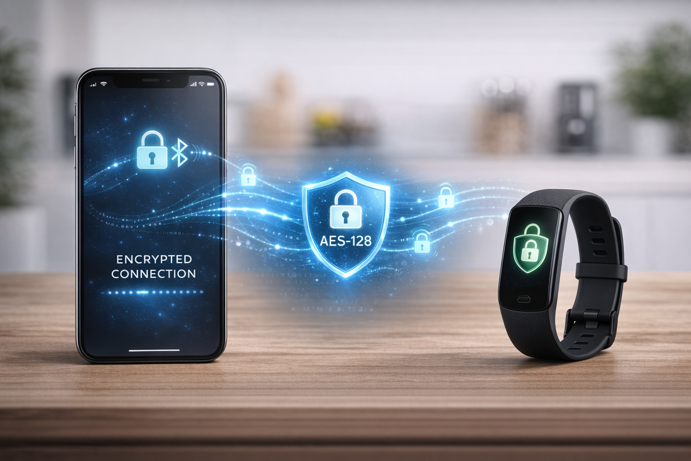
The pairing process matters enormously. “Just Works” pairing offers convenience but no man-in-the-middle protection. Anyone nearby during pairing could potentially intercept the connection. Numeric Comparison or Passkey Entry methods require user confirmation, ensuring that the correct device is being paired.
Once paired, communication uses the established encryption keys. Well designed BLE devices properly validate pairing, regularly rotate keys and implement secure firmware update mechanisms. Poorly designed devices might use default PINs, skip encryption entirely or contain exploitable vulnerabilities.
For IoT security in Bluetooth deployments:
- Verify devices support LE Secure Connections (Bluetooth 4.2+)
- Use authenticated pairing methods when security matters
- Keep firmware updated (many Bluetooth vulnerabilities get patched)
- Understand that proximity limits risk compared to Internet exposed devices
- Recognize that BLE security is only as strong as the weakest implementation in your system
Practical Limitations
Bluetooth isn’t perfect. Understanding its limitations can help avoid deployment headaches.
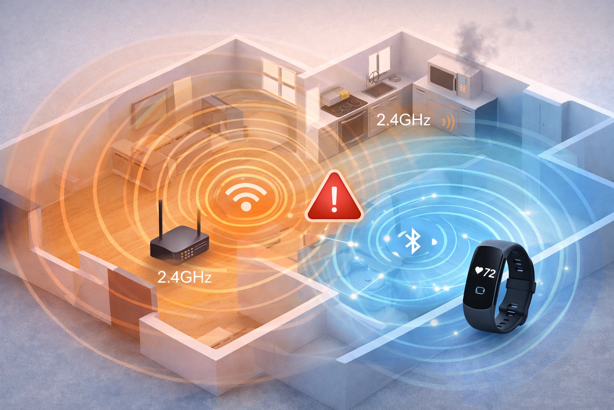
2.4 GHz interference: Bluetooth shares spectrum with Wi-Fi, microwave ovens and other devices. In congested environments, interference causes connection drops and decreased range. Bluetooth uses frequency hopping to mitigate this, rapidly switching between 40 channels, but heavy Wi-Fi traffic still impacts performance.
Connection limits: A single BLE central device (your phone) can theoretically maintain dozens of simultaneous connections, but practical limits depend on implementation. Most smartphones reliably handle 5-10 concurrent BLE connections before performance degrades. This rarely matters for consumer use but will likely impact scenarios requiring many simultaneous sensors.
Range variability: Advertised range of 100 meters assumes line-of-sight with no obstacles. Real world range through walls and furniture might be 10-30 meters. Concrete, metal and water considerably weaken signals. That fitness tracker works great until you leave your phone in the living room and walk to the bedroom.
Platform fragmentation: While the Bluetooth specification is standardized, implementation quality varies. Some Android devices handle BLE poorly with frequent disconnections or incomplete profile support. iOS generally delivers more consistent BLE performance but imposes restrictions on background scanning to preserve battery life.
No Internet without a gateway: BLE devices can’t access the Internet directly. Remote monitoring requires a smartphone or dedicated gateway that remains within range, receiving BLE data and forwarding it to cloud services. This adds complexity and potential points of failure.
Keeping It Short Range and Sweet
The beauty of Bluetooth for IoT is its simplicity. No hub purchases, no complicated network setup, no monthly fees. Users already have Bluetooth enabled smartphones. For many applications, particularly those involving personal devices and proximity based interactions, this simplicity outweighs any protocol limitations.
Start with your requirements, not the technology. If those requirements align with Bluetooth’s strengths (proximity, smartphone connectivity, low power and simplicity), you’re onto a winner. If they don’t, you can always explore the alternatives we’ve covered.
For a broader view of how Bluetooth fits into the IoT ecosystem alongside other protocols, check our complete IoT communication protocols guide.