A bearded dragon kept under the wrong UVB bulb can develop metabolic bone disease before any visible symptoms appear. A ball python kept without a proper heat gradient and day/night light cycle may survive, but it won’t be in conditions that support normal behavior and digestion. Chameleons are equally vulnerable. One kept under a compact fluorescent coil instead of a T5 tube may be getting a fraction of the UVB its body needs. Neither you nor the animal will know until the damage is done.
Reptile UVB lighting is more consequential than most keepers realize, and more confusing than it needs to be. UVB percentages, T5 versus T8 tubes, mercury vapor versus fluorescent, basking wattages, day/night timers – the options seem endless. This guide cuts through the confusion with eleven picks matched to specific species, enclosure types and budgets, plus a buying guide covering everything you need to get the lighting right the first time.
Not sure where to start? If your reptile basks in daylight (bearded dragon, monitor, uromastyx) → you need both UVB and a dedicated basking bulb. If it’s nocturnal or low UVB (ball python, crested gecko, leopard gecko) → requirements are usually more modest. Getting this wrong is one of the most common reptile lighting mistakes – and it’s entirely avoidable.
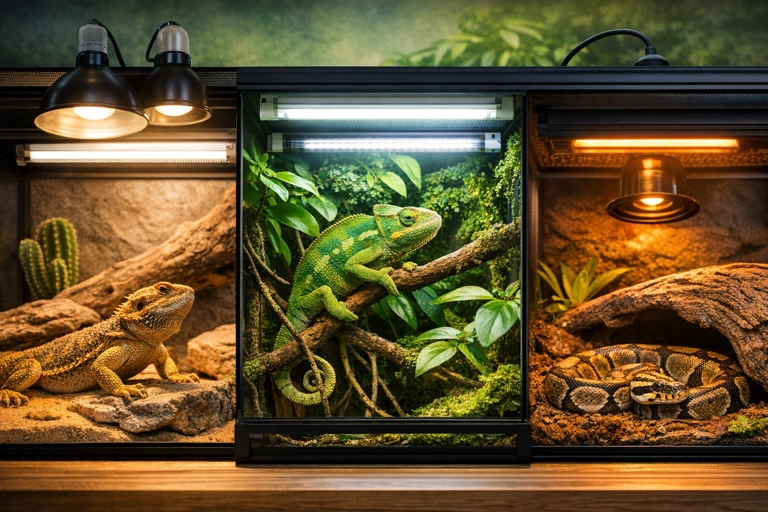
Quick Picks: Best Reptile UVB Lighting at a Glance
🏆 Best Premium UVB Kit: Arcadia ProT5 14% UVB Kit — $120-135
T5 HO fixture and tube, 14% UVB output, best-in-class for desert species that need strong, penetrating UVB in medium to large enclosures
🥇 Best Beginner Kit: Zoo Med Desert UVB & Heat Dual Kit — $60-70
Fixture, UVB bulb and basking bulb in one box, ideal first setup
💰 Best Value T5 Kit: REPTI ZOO T5 HO UVB Combo Kit — $45-55
Competitive price for fixture and 10.0 tube, strong real world sales record
💵 Best Budget Compact UVB: LUCKY HERP UVB Compact Fluorescent — $13-18
Available in 5.0 and 10.0, lowest entry point for UVB coverage
🔥 Best Basking Bulb: Fluker’s Basking Spotlight — $5-8
Available in 60W, 75W and 150W, widely used across the US reptile keeping community
🔆 Best Basking Fixture: Fluker’s Repta-Clamp Lamp — $15-20
UL/CUL approved, 75W max, on/off switch included
⚡ Best Mercury Vapor Bulb: Zoo Med PowerSun 80W — $55-65
UVB, UVA, visible light and basking heat in a single self-ballasted bulb
⏱️ Best Lighting Timer: Zilla Power Center Digital — $40-55
8 outlets, 24/7 digital programming, purpose-built for reptile habitats
🕐 Best Simple Timer: Zoo Med ReptiCare Controller — $25-32
Analog day/night timer, plug-and-play simplicity from a trusted brand
🌿 Best Bioactive LED: Arcadia Jungle Dawn LED Bar — $110-125
Full spectrum plant growth LED bar, community standard for bioactive vivarium setups
🌱 Best Mid-Range Bioactive LED: Exo Terra Forest Canopy LED — $50-60
Tropical plant growth LED, screw-in format, accessible price point
UVB, Basking and Full Spectrum: The Differences That Matter
Reptile lighting serves three distinct functions that are easy to conflate but important to keep separate.
UVB lighting enables reptiles to synthesize vitamin D3, which regulates calcium metabolism. Without adequate UVB, diurnal reptiles (species active during the day such as bearded dragons, uromastyx and monitors) can develop metabolic bone disease over time. UVB output is expressed as a percentage (5.0, 10.0, 14.0) and degrades invisibly over time. A bulb that still produces visible light may no longer produce meaningful UVB after 6-12 months. T5 HO tubes deliver stronger, deeper penetrating UVB than T8 tubes or compact fluorescent coils at equivalent percentages, making them the preferred format for enclosures where the basking area sits more than ~12-15 inches below the lamp.
Basking lights offer the radiant heat reptiles need for thermoregulation. An incandescent or halogen basking bulb creates a hot spot your reptile moves in and out of to regulate its body temperature. Most basking setups run separately from UVB tubes, though mercury vapor bulbs combine both functions in one unit for keepers who prefer a simpler setup.
Full spectrum and LED lights provide visible light quality – the wavelengths that affect color rendering, plant photosynthesis and natural behavior cycles. They are not a substitute for dedicated UVB sources. In bioactive terrariums combining live plants with reptiles, a quality full spectrum LED ensures plants receive appropriate light while the UVB tube handles the animal’s physiological needs separately.
Many diurnal reptile setups benefit from all three – a UVB tube for D3 synthesis, a basking bulb for thermoregulation, and a timer to cycle both on a schedule that matches the animal’s natural day/night cycles. Nocturnal species have more modest requirements. Often a low output UVB source or none at all, alongside a heat source that operates independently of light cycles, will suffice.
30-Second Selector: Which Reptile Lighting Is Right for You?
1. What species are you keeping?
- Bearded dragon, uromastyx, monitor or other high UVB desert species → Arcadia ProT5 14% or Zoo Med Dual Kit
- Chameleon or other arboreal daytime reptile → a linear T5 HO UVB setup with a lower output tube matched to the species (compact bulbs are not the preferred format for these enclosures)
- Crested gecko or other low UVB tropical species → LUCKY HERP 5.0 compact for smaller enclosures
- Ball python, corn snake or other low UVB snake → LUCKY HERP 5.0
- Monitor, iguana or large lizard needing basking heat and UVB together → Zoo Med PowerSun 80W
- Bioactive vivarium with live plants → Arcadia Jungle Dawn LED alongside a dedicated UVB tube
2. What’s your budget?
- Under $20 → LUCKY HERP (UVB coverage at the lowest entry point)
- $45-55 → REPTI ZOO T5 Kit (fixture and tube, good value)
- $60-70 → Zoo Med Dual Kit (UVB and basking in one box)
- $120-135 → Arcadia ProT5 14% (premium T5 HO for demanding species)
3. What’s your situation?
- First reptile setup, want everything in one box → Zoo Med Dual Kit
- Upgrading an existing setup with better UVB → Arcadia ProT5 14%
- Want to automate day/night lighting cycles → Zilla Power Center or Zoo Med ReptiCare
- Building a bioactive terrarium → Arcadia Jungle Dawn LED plus a separate UVB tube
- Managing multiple enclosures → Zilla Power Center for centralized scheduling
Who This Guide Is For (and Who Should Skip It)
This guide is a good fit if you: keep diurnal reptiles that need UVB, or are setting up a first enclosure and need to understand what lighting to buy. It’s also relevant if you’re upgrading from basic or incorrect lighting, or building a bioactive terrarium that needs to balance plant and reptile lighting requirements. Keepers who want to automate lighting schedules as part of a broader smart terrarium setup will also find it useful.
You can probably skip it if you: keep exclusively nocturnal invertebrates or species with no meaningful UVB requirement. It’s also not the right fit if you’re looking for aquarium lighting (a different category with different photosynthesis and color temperature requirements), or need greenhouse grow lighting rather than terrarium-specific products.
Reptile Lighting Comparison Table
| Model | Price Range | Type | UVB Output | Best For |
|---|---|---|---|---|
| Arcadia ProT5 14% Kit | $120-135 | T5 HO fixture + tube | 14% | High UVB desert species |
| Zoo Med Desert Dual Kit | $60-70 | Fixture + UVB + basking bulb | 10.0 (compact) | First setup / beginners |
| REPTI ZOO T5 HO Combo | $45-55 | T5 HO fixture + tube | 10.0 | Best value T5 kit |
| LUCKY HERP Compact UVB | $13-18 | Compact fluorescent | 5.0 or 10.0 | Budget / low UVB species |
| Fluker’s Basking Spotlight | $5-8 | Incandescent basking | None | Budget basking bulb |
| Fluker’s Repta-Clamp Lamp | $15-20 | Clamp lamp fixture | N/A | Basking lamp fixture |
| Zoo Med PowerSun 80W | $55-65 | Mercury vapor | Combined UVB+heat | Large enclosures / monitors |
| Zilla Power Center Digital | $40-55 | Digital timer strip | N/A | Multi-outlet scheduling |
| Zoo Med ReptiCare | $25-32 | Analog timer | N/A | Simple day/night cycling |
| Arcadia Jungle Dawn LED Bar | $110-125 | Full spectrum LED bar | None | Bioactive vivarium plants |
| Exo Terra Forest Canopy LED | $50-60 | Plant growth LED | None | Tropical bioactive setups |
Best Reptile UVB Lighting for 2026
The eleven picks below cover every keeper scenario, from a first desert lizard setup to a professional grade bioactive vivarium. UVB lighting leads, followed by basking, timers and full spectrum LEDs.
Arcadia ProT5 14% UVB Kit
🏆 Best Premium UVB Kit | $120-135 | View on Amazon
Rating: 4.5/5
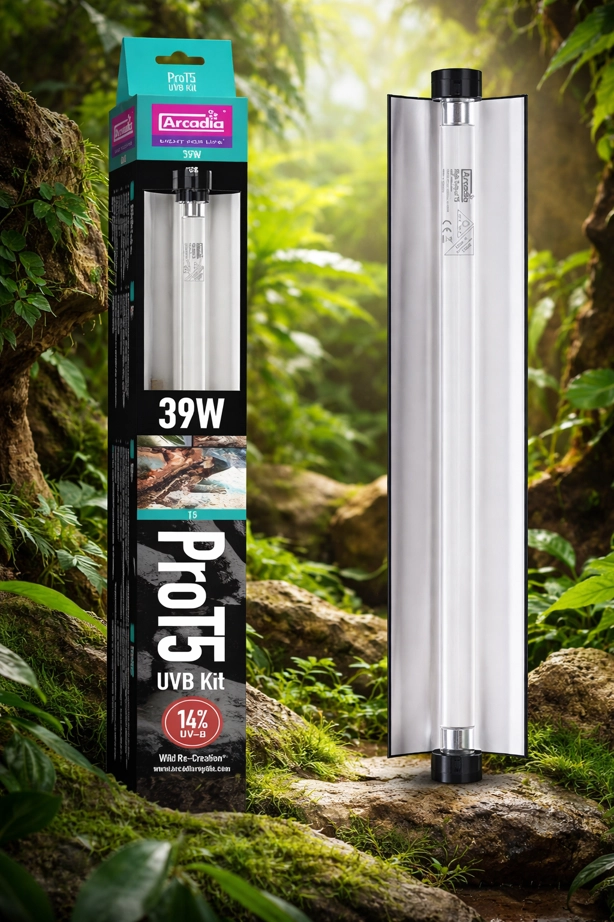
Arcadia’s ProT5 is the benchmark UVB kit for keepers who want the best available performance for demanding desert species. The T5 HO format delivers higher output and deeper UVB penetration than T8 tubes or compact fluorescent coils, which is critical for larger enclosures where the basking area sits more than 12-15 inches below the lamp. The 14% UVB rating is designed to simulate the higher UV exposure levels typical of open desert habitats, which makes this kit best suited to high UVB species. This includes bearded dragons, uromastyx, sand dwelling (psammophilic) lizards and monitors that need intense UV exposure to match their natural environment. At 34 inches and 39W, the fixture is a good fit for many medium-sized enclosures and ships as a complete kit with the tube included, so there’s no compatibility guesswork.
Key Specs
- Type: T5 HO fixture and tube kit
- UVB output: 14%
- Wattage: 39W
- Fixture length: 34 inches
- Kit includes: Fixture and UVB tube
Worth Knowing
The price premium is only justified for species that genuinely need high UVB output. A leopard gecko, ball python or crested gecko does not need a 14% T5 HO. Higher UVB percentage is not automatically better. Correct distance, reflector setup and target UVI matter just as much as the bulb rating. Like all UVB tubes, the bulb should be replaced every 6-12 months regardless of whether it still produces visible light, as UVB output degrades before the visible spectrum does.
Best For
Bearded dragons, uromastyx, monitors and other high UVB desert species, keepers upgrading from compact fluorescent UVB who want meaningful improvement in output and penetration depth, larger enclosures where UVB needs to reach the basking area from distance.
Zoo Med Desert UVB & Heat Dual Kit
🥇 Best Beginner Kit | $60-70 | View on Amazon
Rating: 4.5/5
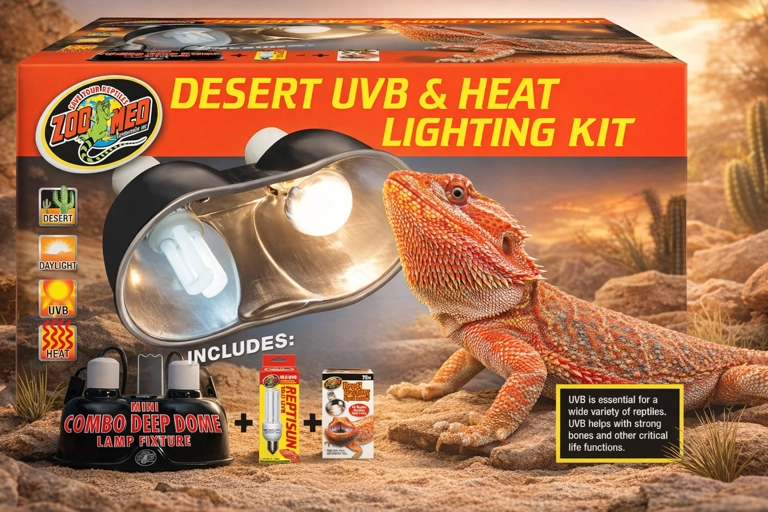
The strongest argument for this kit is simplicity. One box contains everything a first desert reptile setup needs to get lighting right from day one. Zoo Med includes a Mini Combo Deep Dome lamp fixture, a ReptiSun 10.0 compact UVB bulb and a 75W Repti Basking Spot lamp. That covers the two light sources most beginner desert setups need, with a single fixture that houses both. Zoo Med is one of the most widely recognized names in US reptile retail, and the ReptiSun 10.0 compact fluorescent has a long track record as a reliable entry-level UVB source for desert lizards.
Key Specs
- Kit includes: Mini Combo Deep Dome fixture, ReptiSun 10.0 UVB bulb, Repti Basking Spot lamp
- UVB output: 10.0 (13W, compact fluorescent)
- Basking wattage: 75W
- Fixture type: Dual dome, accommodates two bulbs independently
Worth Knowing
The UVB component is a compact fluorescent bulb, not a T5 HO tube. For smaller enclosures and beginner setups this is adequate, but keepers with larger tanks or species with very high UVB needs will eventually want to upgrade to a T5 HO setup. Ideally position the basking area within 6-8 inches of the UVB bulb for best results.
Best For
First reptile setups where simplicity matters, bearded dragons and similar diurnal desert species, anyone who wants a proven bundle from a recognized brand without researching compatible bulb and fixture combinations separately.
REPTI ZOO T5 HO UVB Lighting Combo Kit
💰 Best Value T5 Kit | $45-55 | View on Amazon
Rating: 4.1/5
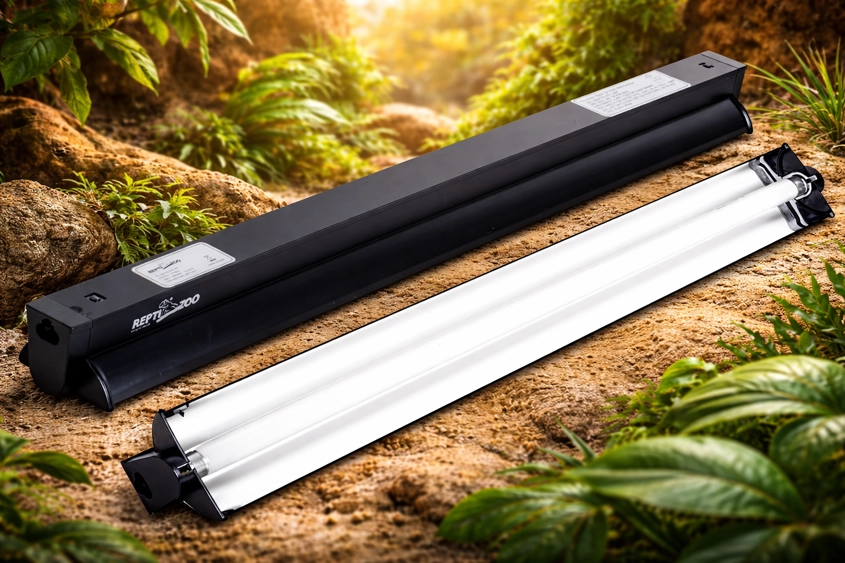
The REPTI ZOO T5 HO kit is a well established T5 combo with a strong US sales record. For keepers who want the penetration advantages of T5 HO technology without the Arcadia price tag, this is the natural starting point. The kit ships with a Desert 10.0 UVB tube and a compatible T5 HO fixture, available in 22.6-inch and 34-inch sizes to suit different enclosure lengths. The 10.0 UVB output suits desert and semi-arid species well.
Key Specs
- Type: T5 HO fixture and tube kit
- UVB output: 10.0 (Desert)
- Wattage: 24W (22.6-inch) or 39W (34-inch)
- Kit includes: T5 HO fixture and Desert 10.0 UVB tube
Worth Knowing
The 10.0 rating suits desert species but is not the right choice for tropical species like chameleons or crested geckos, which usually need lower UVB output (5.0). A separate basking bulb and fixture are still needed (this kit covers UVB only).
Best For
Keepers wanting T5 HO performance without the Arcadia price premium, desert species setups in mid-size enclosures, anyone who has outgrown a compact fluorescent UVB setup and wants a meaningful upgrade at a reasonable cost.
LUCKY HERP UVB Compact Fluorescent Lamp
💵 Best Budget Compact UVB | $13-18 | View on Amazon
Rating: 4.2/5
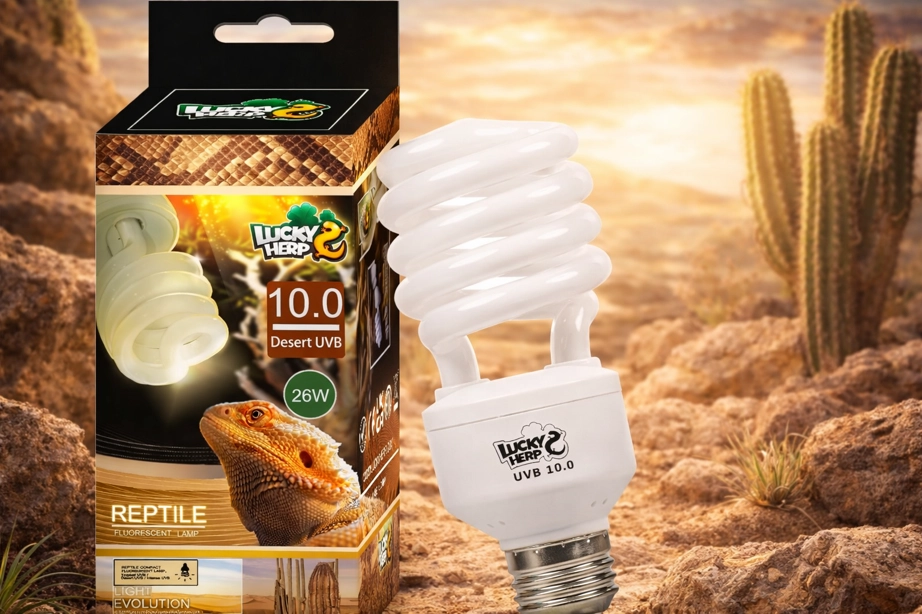
LUCKY HERP’s compact UVB lamp covers six variants under one product – 5.0, 10.0 and 15.0 output in both 13W and 26W. This gives keepers flexibility to choose the right UVB level for their species without paying separately for different products. The standard E26 screw base fits most clamp lamp fixtures already in use.
At $13-18, this is a practical option for species with modest UVB needs, such as crested geckos, many snakes and similar species. It’s also a useful secondary UVB source for keepers who want coverage in a smaller secondary enclosure without duplicating a full fixture investment.
Key Specs
- Type: Compact fluorescent UVB bulb
- UVB options: 5.0, 10.0 or 15.0 (13W or 26W)
- Bulb base: E26 standard screw
- Fixture required: Standard clamp lamp or dome fixture (not included)
Worth Knowing
Compact fluorescent UVB has real limitations compared with T5 HO, mainly its shallower penetration depth. Ideally, position the basking area within roughly 6-8 inches of the bulb for adequate UVB exposure. This bulb also requires a separate fixture. Plan for replacement every 6 months.
Best For
Low-to-moderate UVB species in smaller enclosures, secondary or supplemental UVB in setups with an existing fixture, keepers on a tight budget who want UVB coverage without committing to a full T5 HO investment.
Fluker’s Basking Spotlight Bulbs
🔥 Best Basking Bulb | $5-8 | View on Amazon
Rating: 4.4/5
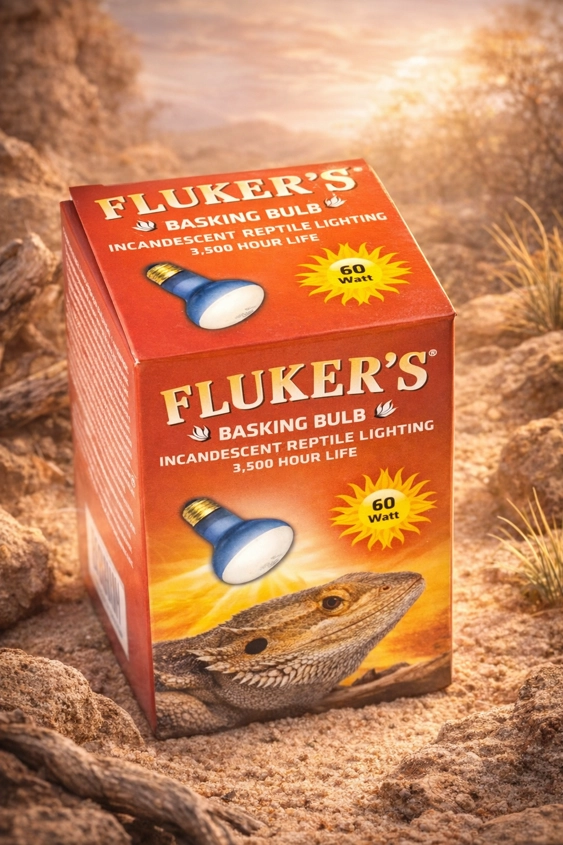
Fluker’s Basking Spotlight is a widely used basking bulb in the US reptile keeping community, available in 60W, 75W and 150W options at an accessible price point. Basking bulbs produce heat and visible light but no UVB. This is by design. Pairing a dedicated basking bulb with a separate UVB tube gives you independent control over each, which is generally preferred over combined solutions unless enclosure space is genuinely limited. The 3,500-hour rated life and incandescent construction mean these work well with a dimming thermostat for precise temperature control.
Key Specs
- Type: Incandescent basking spotlight
- Wattage options: 60W, 75W, 150W
- UVB output: None
- Rated life: 3,500 hours
- Bulb base: Standard screw (E26)
Worth Knowing
This is an incandescent bulb. It produces no UVB and should be paired with a dedicated UVB source for any species that requires it. If you’re using a thermostat to control this bulb (recommended for precise basking zone temperatures), use a dimming or pulse proportional controller rather than on/off, as described in our reptile thermostat guide. On/off cycling shortens incandescent bulb life considerably.
Best For
Any reptile requiring a dedicated basking spot where a separate UVB source is already in use. The 60W suits smaller enclosures and cooler ambient rooms, the 75W covers most standard setups, and the 150W suits large enclosures or species with high basking temperature requirements.
Fluker’s Repta-Clamp Lamp
🔆 Best Basking Fixture | $15-20 | View on Amazon
Rating: 4.6/5
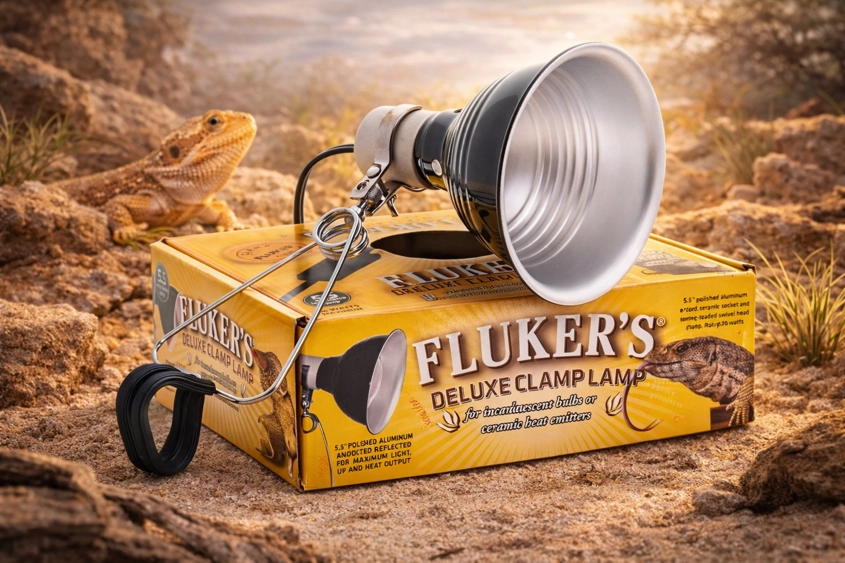
The Fluker’s Repta-Clamp Lamp is a long running fixture in the US reptile market. It comes with a polished aluminum reflector, spring loaded clamp, 75W maximum, UL/CUL safety approval, and an on/off switch on the cord.
The 5.5-inch dome size works well with bulbs up to 75W. The clamp attaches to enclosure frames, stands or mesh tops without tools. A Pack of 2 option is available for setups running dual basking zones or a separate basking and UVB fixture side by side.
Key Specs
- Dome diameter: 5.5 inches
- Max wattage: 75W
- Socket type: E26 (standard medium screw, compatible with reptile basking bulbs and ceramic heat emitters)
- Safety certification: UL/CUL approved
- Switch: On/off cord switch included
Worth Knowing
The 75W maximum ceiling rules out the 150W Fluker’s basking bulb. If you need higher wattage output, look for a deep dome fixture rated to 150W or higher. If connecting this to a thermostat, use a dimming or pulse proportional controller (not an on/off controller), and keep the cord switch in the on position for the thermostat to control the circuit.
Best For
Any single-enclosure basking setup using bulbs up to 75W, keepers who want a fixture with genuine safety certification at a modest price, setups running the Fluker’s Basking Spotlight or similar E26 incandescent bulbs.
Zoo Med PowerSun UV 80W
⚡ Best Mercury Vapor Bulb | $55-65 | View on Amazon
Rating: 4.1/5
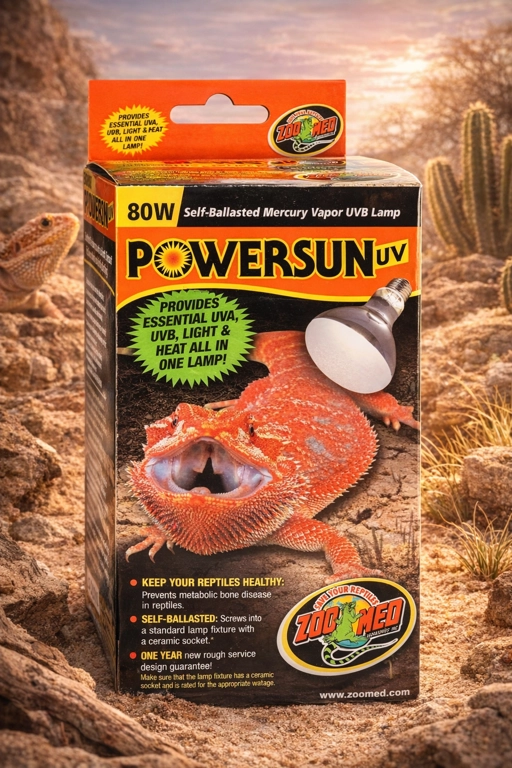
Mercury vapor bulbs occupy a distinct category – a single self-ballasted bulb that produces UVB, UVA, visible light and radiant basking heat simultaneously. For keepers of large lizards (iguanas, monitors, tegus, large agamids) or anyone managing an enclosure where running separate UVB and basking fixtures creates logistical problems, the PowerSun simplifies the setup considerably. The 80W output is appropriate for large enclosures where the basking area sits further from the lamp than compact fluorescent or T5 HO setups typically allow.
Key Specs
- Type: Self-ballasted mercury vapor
- Wattage: 80W
- Output: UVB, UVA, visible light and heat combined
- Bulb base: E26 standard screw
Worth Knowing
Mercury vapor bulbs require a ceramic socket fixture rated for the bulb’s wattage. Standard plastic socket clamp lamps are not appropriate and create a fire risk. Always follow Zoo Med’s instructions for the specific wattage you are using. The bulb must be used in a vertical orientation pointing downward. Mercury vapor also cannot be used with a dimming thermostat (on/off control only), which means basking temperature is managed through bulb wattage selection and distance from the basking surface rather than thermostat precision.
For the 80W specifically, Zoo Med’s official instructions recommend Zone 4 desert species at 4-6 inches, Zone 3 species at 6-16 inches, and Zone 2 species at 16-26 inches from the basking surface.
Best For
Large lizard enclosures where separate UVB and basking fixtures are impractical, monitors, iguanas and tegus needing strong combined output, keepers who prefer the simplicity of one lamp over managing two separate lighting systems.
Zilla Reptile Habitat Digital Power Center
⏱️ Best Lighting Timer | $40-55 | View on Amazon
Rating: 4.3/5
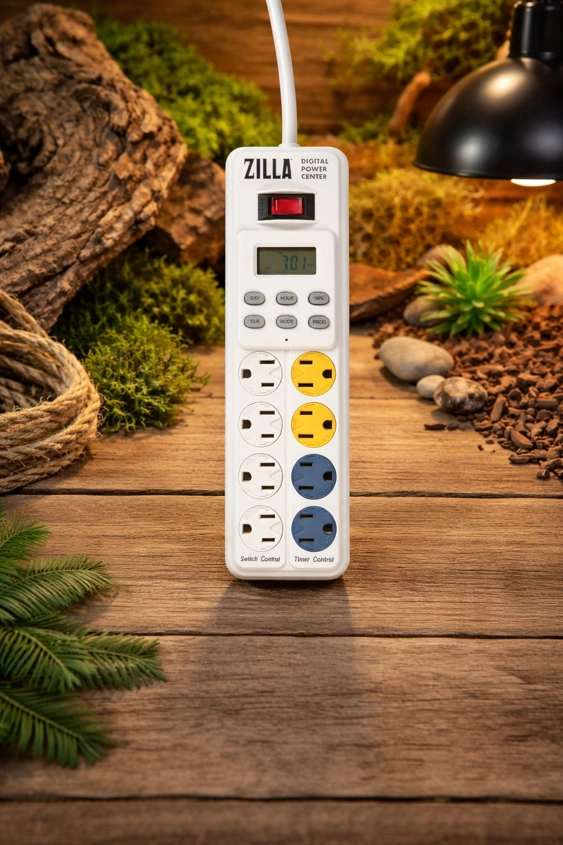
Automating reptile lighting is one of the most straightforward improvements any keeper can make, and the Zilla Power Center is the purpose-built way to do it. Eight outlets offer enough capacity for UVB tube, basking lamp, nighttime heat source and additional accessories, all controlled from a single programmable unit with a 24/7 digital timer and seven time cycle settings. The two yellow daytime outlets and two blue nighttime outlets alternate on your programmed schedule. The four white constant power outlets stay live for equipment that shouldn’t be interrupted.
For keepers building a connected reptile setup, the Zilla Power Center handles lighting automation while a dedicated thermostat manages temperature, the two working independently on the same enclosure. This pairs naturally with the Inkbird controllers covered in our reptile thermostat guide and slots into the broader smart terrarium approach without requiring app connectivity or hub integration.
Key Specs
- Outlets: 8 total – 4 constant power (white), 2 daytime timer (yellow), 2 nighttime timer (blue)
- Timer type: 24/7 digital with 7 time cycle settings
- Voltage: 120V
- Connectivity: Standalone (no app)
Worth Knowing
This is a lighting and device timer, not a thermostat. It controls when devices turn on and off by schedule, not in response to temperature readings. A separate thermostat is still required for temperature regulation. Not Wi-Fi enabled either. If remote schedule adjustment matters, a smart plug added to one of the outlets can extend basic connectivity.
Best For
Any keeper wanting automated day/night light cycling, multi-enclosure setups where centralized scheduling saves time, those building a more complete smart terrarium who want lighting automation sorted before adding temperature control.
Zoo Med ReptiCare Terrarium Controller
🕐 Best Simple Timer | $25-32 | View on Amazon
Rating: 4.5/5
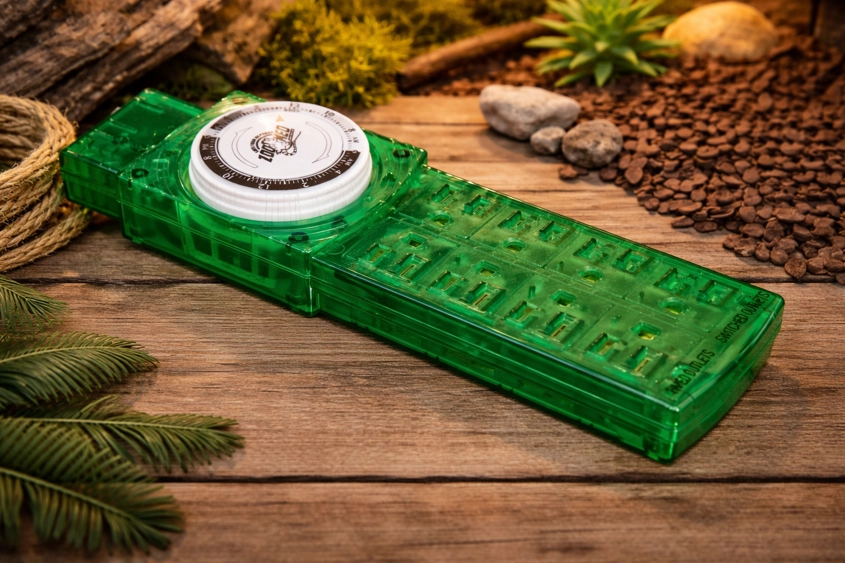
The ReptiCare is Zoo Med’s answer to basic day/night lighting automation – an analog dial timer integrated with a multi-outlet power strip, purpose-built for reptile enclosures. Set the dial to your desired on/off times and the timer handles the rest. No programming interface, no display to navigate, no digital settings to lose after a power cut. It’s a practical choice for keepers who want reliable simple cycling without the complexity or price of a full digital power center.
Key Specs
- Timer type: Analog 24-hour dial
- Outlets: 8 grounded (4 timer-controlled, 4 continuous power)
- Connectivity: Standalone
Worth Knowing
Analog timers set on/off times to roughly 15-30 minute intervals rather than exact minutes. For most day/night lighting cycles, this is perfectly adequate, but if precise timing matters for breeding conditioning, the Zilla Power Center’s digital precision is worth the additional cost.
Best For
Single-enclosure setups where basic day/night cycling is all that’s needed, keepers who prefer analog simplicity over digital programming, a cost effective starting point for lighting automation before expanding to a full power center.
Arcadia Jungle Dawn LED Bar
🌿 Best Bioactive LED | $110-125 | View on Amazon
Rating: 4.6/5
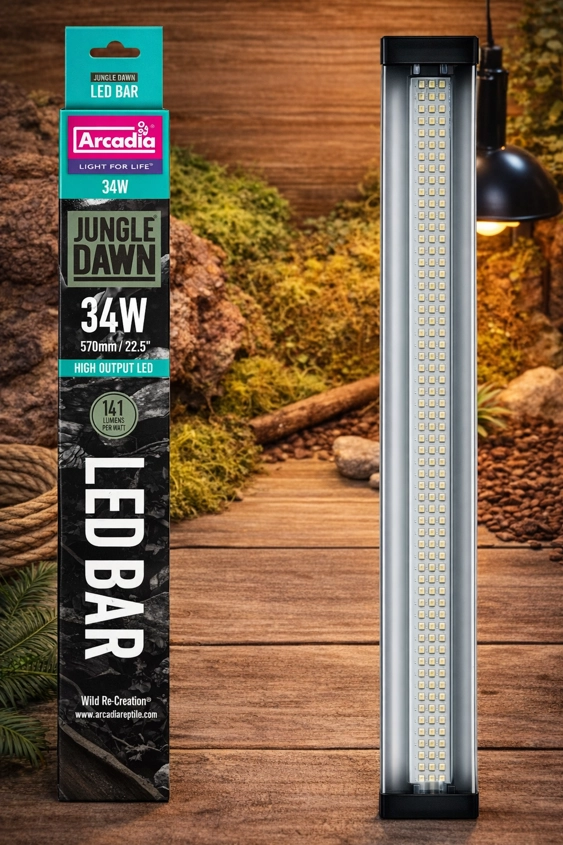
The Jungle Dawn LED Bar is widely adopted in bioactive vivarium setups for a straightforward reason. It produces high output, full spectrum white light engineered for plant growth. Unlike many grow lights, it does this without the purple hue that looks unnatural in a display enclosure. The bar-style design mounts on top of mesh enclosures or inside vivariums. It delivers 130+ lumens per watt at 6200K, a color temperature Arcadia describes as closely mimicking natural sunlight and falling within the typical daylight range. It produces no UVB, which is the correct approach for a dedicated plant light that works alongside a separate UVB tube rather than replacing one.
The 22.5-inch bar runs at approximately 34W. It can be linked with other Jungle Dawn units or connected to compatible Arcadia ProT5 UVB systems, allowing multiple lights to run from a single power outlet – a practical feature for keepers managing multiple units or complex setups. For keepers building bioactive terrariums with live substrate, live plants and clean-up crews, the Jungle Dawn addresses the core challenge of keeping plants healthy without overcomplicating the enclosure’s light environment.
Key Specs
- Type: Full spectrum LED bar (bar-style unit, not a screw-in bulb)
- Wattage: ~34W (22.5-inch bar)
- Color temperature: 6200K
- Output: 130+ lumens per watt
- UVB output: None
- Linkable: Yes, connects to other Jungle Dawn bars or compatible Arcadia ProT5 units
Worth Knowing
The Jungle Dawn produces no UVB and is not a substitute for a dedicated UVB tube. It must be used alongside a UVB source if the enclosure contains a UVB-dependent reptile. At $110-125, it’s a significant investment for a supplemental light. The Exo Terra Forest Canopy LED below covers similar ground at a lower price point if budget is a constraint. Some keepers also integrate smart plant sensors into bioactive setups to monitor soil moisture independently.
Best For
Bioactive vivariums with live plants where growth quality and natural light appearance both matter, display enclosures where purple grow light aesthetics are unwelcome, keepers who want the community-validated plant lighting solution and the option to link units across a larger setup.
Exo Terra Forest Canopy LED
🌱 Best Mid-Range Bioactive LED | $50-60 | View on Amazon
Rating: 4.2/5
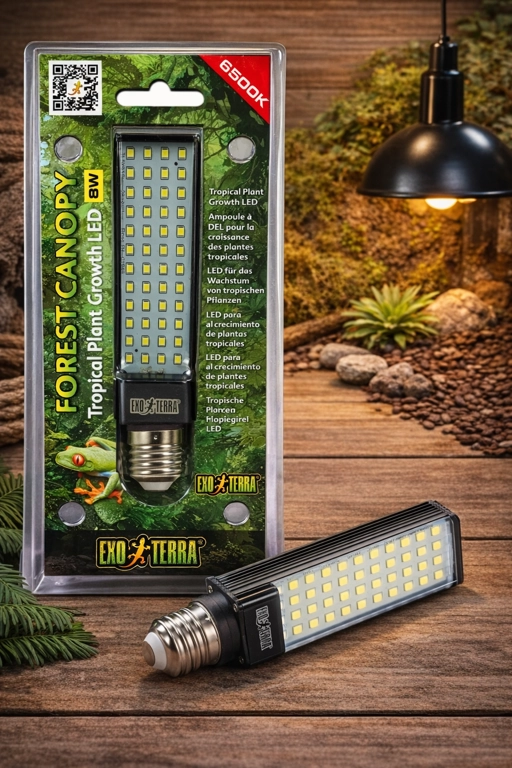
Where the Arcadia Jungle Dawn is a purpose-built LED bar, the Exo Terra Forest Canopy is a screw-in LED bulb, a more accessible format that fits any standard E26 socket including existing clamp lamp fixtures. The 6500K color temperature simulates unfiltered sunlight conditions in the upper layers of a tropical forest canopy and supports plant growth without the purple spectrum that makes dedicated grow bulbs look artificial. It’s the practical entry point for keepers building their first bioactive setup who don’t want to invest in the Jungle Dawn immediately.
Key Specs
- Type: Plant growth LED bulb
- Wattage: 8W
- Color temperature: 6500K
- Bulb base: E26 standard screw
- UVB output: None
Worth Knowing
At 8W, the output is more modest than the 34W Jungle Dawn, which is appropriate for smaller enclosures or as a supplemental plant light in larger builds rather than the primary growth light for a heavily planted vivarium. Produces no UVB, so requires a separate UVB source for any UVB-dependent species.
Best For
Smaller bioactive vivariums, keepers with existing E26 fixtures who want to add plant growth lighting without new hardware, a cost-accessible starting point before upgrading to the Arcadia Jungle Dawn.
Other Products Considered
Zoo Med ReptiSun T5 HO Hood 24″ (~$85): Strong brand with solid retail presence, but the review base was too thin to recommend confidently at time of writing. Worth revisiting as it accumulates real world feedback.
REPTI ZOO Switchable UVB Combo Kit (~$53-57): The switchable 10.0/5.0 functionality is a genuinely useful concept for keepers who might change species. The review base was marginal for a primary recommendation at time of writing. The standard T5 kit above is better validated at a similar price.
Zoo Med ReptiSun 10.0 Compact (~$19): Strong brand trust and a long track record, but LUCKY HERP undercuts it on price for comparable performance. Worth considering if brand familiarity is an important factor.
Exo Terra Solar Glo 80W (~$60): Mercury vapor equivalent to the Zoo Med PowerSun. The PowerSun has a stronger US reptile community reputation as a primary recommendation.
Reptile UVB Lighting Buying Guide
T5 HO vs T8 vs Compact Fluorescent: Which Format Is Right for Your Setup?
The tube format affects UVB output strength and penetration depth more than the percentage rating alone. T5 HO (High Output) tubes are the current standard for serious reptile keepers. They produce stronger UVB at greater distances than T8 tubes of equivalent percentage, which matters when your basking area sits more than 12-15 inches below the lamp. A T5 HO 10.0 tube delivers substantially more UVB at 18 inches than a T8 10.0 tube at the same distance.
T8 tubes are an older format increasingly displaced by T5 HO. They work but require closer positioning to the basking area and need replacing more frequently. Compact fluorescent UVB bulbs are the entry-level option – affordable, widely available and adequate for smaller enclosures and lower UVB species, but with limited penetration depth compared to either tube format.
Understanding UVB Percentages
UVB percentage ratings (5.0, 10.0, 14.0) indicate the proportion of UV output in the ultraviolet spectrum, not the total light output. Higher numbers suit species from more arid, high altitude or open canopy habitats where UV exposure in the wild is intense. Lower numbers suit forest dwelling or crepuscular (most active at dawn and dusk) species with more shaded natural environments.
As a general guide, desert species like bearded dragons and uromastyx typically need 10.0-14.0, semi-arid species like blue-tongued skinks and tortoises do well at 10.0, and tropical species like chameleons, day geckos and crested geckos typically need 5.0. Forest floor species like ball pythons and leopard geckos generally need low levels (5.0), though in some cases benefit from modest UVB exposure even if it wasn’t previously standard practice. Always cross-reference care resources for your particular species, as recommendations evolve as research develops.
UVB Tube Placement and the Ferguson Zone Framework
Where you position your UVB tube relative to the basking area affects how much UV your reptile actually receives. The Ferguson Zone system, developed from field measurements of UV exposure across different reptile species, provides a practical framework for matching tube output and placement to species requirements. Desert basking species (Ferguson Zone 3-4) need intense UV at close range, while forest species (Zone 1-2) need lower levels or filtered UV.
In practical terms, position the UVB tube so the basking spot sits within the manufacturer’s recommended distance for your tube type and output level. Most T5 HO tubes at 10.0 work well with the basking area positioned 10-18 inches below the lamp. Compact fluorescent at the same rating needs the basking area within 6-8 inches. These are starting points only. Final placement should account for lamp brand, reflector design, mesh obstruction and the target UVI for the species. Running UVB through glass or plastic decreases output significantly. Mesh screens cause some reduction but are generally acceptable.
When to Replace UVB Bulbs
UVB output degrades long before visible light does. A bulb that still appears bright may still produce little or no useful UVB. Most manufacturers recommend replacing UVB bulbs every 6-12 months. T5 HO tubes from quality manufacturers can hold output closer to 12 months, while compact fluorescent UVB should generally be replaced at 6 months. Keeping a bulb replacement date noted in your phone calendar is the simplest way to avoid inadvertently running a depleted UVB source.
Photoperiod: How Long Should Lights Run?
Most diurnal reptiles kept in temperate climates do well on a 12-hour on / 12-hour off light cycle year-round. Keepers managing breeding projects or conditioning animals for seasonal behavior often extend this to 14 hours in summer and shorten it to 10 hours in winter to simulate natural photoperiod (light cycle) changes. UVB and basking lights often run on the same schedule, switching off together at night. Nighttime heating, where required, should be provided by a non-light heat source like a ceramic heat emitter or deep heat projector, so the animal experiences genuine darkness. Using a timer like the Zilla Power Center above makes this automatic once configured.
Frequently Asked Questions
Can I use a regular LED bulb as a basking light?
Standard LED bulbs produce very little radiant heat. The efficiency that makes them useful for home lighting works against them as basking sources. A reptile basking spot requires enough infrared output to warm the animal’s body to the target temperature, which incandescent and halogen bulbs deliver much more effectively. Some specialist reptile LED basking products claim effective heat output, but none has yet displaced incandescent bulbs as the default recommendation in the keeping community.
Do nocturnal reptiles need UVB lighting?
This is more nuanced than the traditional answer of “no.” Nocturnal species like leopard geckos and ball pythons don’t bask under intense UV in the wild. Even so, emerging research suggests that low level UVB exposure may still provide physiological benefits, supporting D3 synthesis at modest levels. Current consensus in the keeping community has shifted toward providing low output UVB (~5.0) for many species previously considered to need none, while emphasizing that this is supplemental rather than critical. Check species-specific care resources for current guidance, as recommendations in this area have changed in recent years.
How do I know if my reptile is getting enough UVB?
Indirect indicators include normal appetite, active basking behavior, healthy shedding cycles and no signs of metabolic bone disease (soft jaw, limb deformity, tremors). However, UVB deficiency develops slowly and symptoms appear after damage has already occurred, which is why correct setup from the start matters more than monitoring for problems. Solarmeter devices can measure actual UV index at the basking spot. The Solarmeter 6.5 is the standard tool used by serious keepers, giving objective confirmation that your setup is delivering the right level. Veterinary examination including bloodwork can also confirm calcium metabolism status if you have concerns surrounding this.
Can I leave reptile lights on 24 hours a day?
No. Reptiles require a dark period as part of their circadian rhythm. Continuous light disrupts natural behavior and sleep cycles, and can cause chronic stress. This applies to UVB, basking and visible spectrum lighting equally. Nighttime heating requirements should be met with non-light heat sources so the animal experiences darkness. The only exception is very dim red or deep blue light, sometimes used for nocturnal observation, though even this is best kept to brief periods rather than running continuously.
What happens if UVB is too weak?
Weak UVB means your reptile can’t produce enough vitamin D3 to use calcium properly. Over time, this leads to weakened bones, poor growth, reduced activity, and eventually metabolic bone disease – damage that accumulates well before outward signs appear.
Can reptiles get too much UVB?
Yes. Excessively strong UVB at very close distances can cause eye irritation or skin damage in some species. This is why UVB percentage, lamp type and distance from the basking area all need to be matched to the species and enclosure size. A 14% T5 HO tube positioned too close to a species that naturally lives in forest understory creates a very different exposure than the same tube at the correct distance for a desert basker. Using a Solarmeter to verify UV index at the basking spot is the most reliable way to confirm your setup is delivering the right level rather than too little or too much.
Making Your Decision
The right reptile lighting setup comes down to three questions – what UVB output your species needs, whether you want a combined or separate approach to UVB and basking heat, and how much automation you want. Everything else follows from those decisions.
- First desert species setup, want everything in one box: The Zoo Med Desert UVB & Heat Dual Kit – fixture, UVB bulb and basking bulb included, from a brand available in most US pet retailers.
- Want the best available UVB for a demanding species: The Arcadia ProT5 14% – T5 HO penetration and output at the premium end, justified for bearded dragons, uromastyx and monitors.
- Want T5 HO performance without premium pricing: The REPTI ZOO T5 HO Kit – well established sales record, most validated mid-range T5 kit available.
- Need UVB on a tight budget: The LUCKY HERP – lowest entry price, multiple output options, fits any standard dome fixture.
- Large lizard needing combined UVB and heat: The Zoo Med PowerSun 80W – one bulb handles both, suited to monitors, tegus and iguanas in large enclosures.
- Want to automate lighting schedules: The Zilla Power Center for multi-outlet control or the Zoo Med ReptiCare for simple single-enclosure cycling.
- Building a bioactive vivarium: The Arcadia Jungle Dawn LED alongside a dedicated UVB tube, with the plant light and reptile light serving separate functions in the same enclosure.
Let There Be (The Right) Light
Reptile lighting is one of those areas where small setup decisions compound over time. Match the UVB output to the species, choose a format that delivers usable UV at the correct distance, and run it on a consistent day/night schedule. Get those three things right, and most of the complexity disappears.
When lighting is correct, the enclosure doesn’t need constant adjustment. The animal behaves as it should, feeding, basking and regulating itself within an environment that supports those behaviors by design.
That’s the standard to aim for. Not trial and error, not gradual correction, but a setup that works from day one.
Get the light right from the start. It’s one of the few mistakes reptile keeping doesn’t easily forgive.
Lighting is one component of a fully managed reptile environment. For temperature regulation, our guide to the best reptile thermostats covers everything from budget on/off controllers to professional grade proportional systems. Automated humidity is covered in the terrarium mister and reptile fogger guide, which compares pressurized misters and automated foggers across all budgets. To see how lighting, temperature and humidity control combine into a fully automated setup, visit our guide to smart terrariums.