
Your evening lavender routine feels like self-care. For your cat, it could be a genuine health risk. Essential oils are now a staple of smart home wellness routines. But the same compounds that help you unwind can seriously affect pets. Risks vary by species, oil type, and how you’re diffusing. The ASPCA Animal Poison Control Center regularly advises on essential oil exposures in pets, including incidents linked to diffusers.
This guide draws on veterinary toxicology resources, including the ASPCA and peer-reviewed discussions of feline metabolism. It covers which oils pose the greatest risk, how to configure your smart diffuser safely, and the warning signs that mean you need to act fast.
Important: You will find general guidance here only. Always consult your veterinarian before diffusing essential oils in a home with pets, particularly birds, cats or animals with existing health conditions.
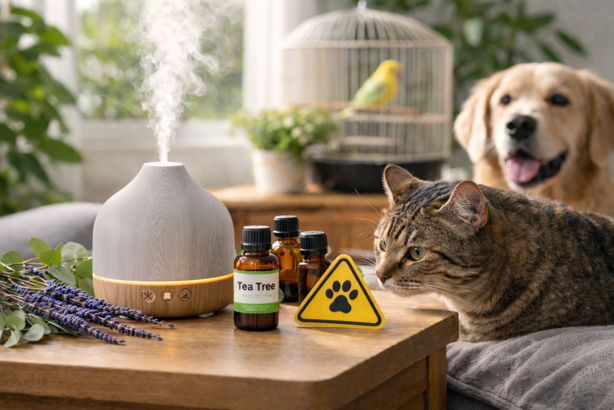
Why Pets React Differently to Essential Oils Than Humans
Essential oil molecules enter the body through inhalation and skin absorption. In humans, the liver processes these compounds efficiently. In many animals, that metabolic pathway works very differently, or barely at all.
The main issue is concentration. Essential oils are far more potent by volume than the herbs they come from. When diffused into a room, those molecules accumulate in enclosed spaces. Animals low to the ground, near surfaces where droplets settle, or in rooms without an easy exit face a much higher effective exposure than we might assume.
Pets can’t tell you something is wrong until symptoms are visible. By the time behavioral changes appear, exposure may have been ongoing for hours.
Are Essential Oil Diffusers Safe for Cats?
Not universally. Cats are among the most sensitive household pets to essential oil exposure, especially from diffusers. In general, essential oil diffusers are not considered reliably safe for cats, especially in small or poorly ventilated rooms.
Why Cats Are Especially Vulnerable
Cats have limited glucuronidation capacity, reducing their ability to metabolize phenols, ketones and terpenes found in common essential oils. What your body processes efficiently can accumulate in a cat’s system over time. This makes cats considerably more sensitive than dogs, and far more sensitive than humans, to essential oil exposure.
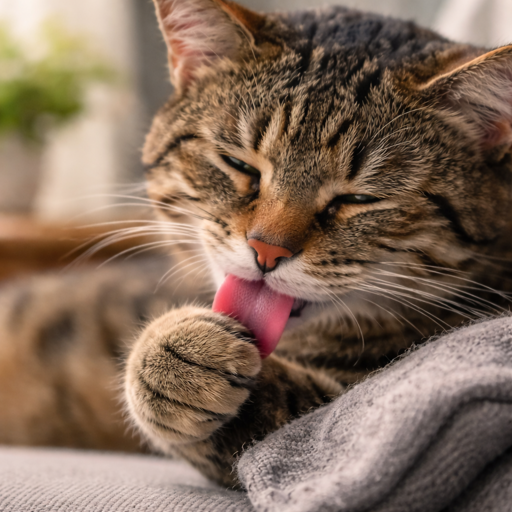
Cats are also fastidious groomers. Oil molecules that settle on fur from diffuser mist get ingested when they groom. This creates a secondary exposure route beyond inhalation alone.
Oils to Avoid Diffusing Around Cats
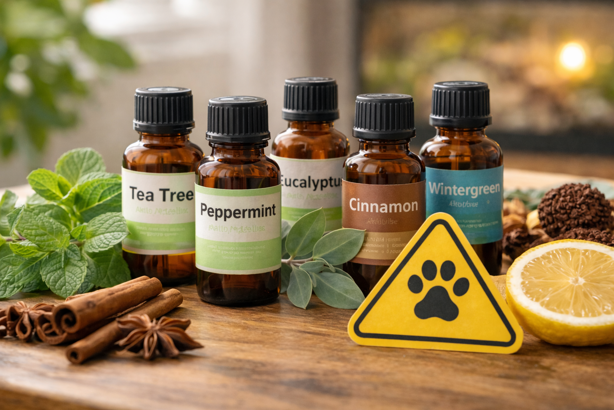
The following oils are commonly cited by veterinary toxicology resources as higher risk for cats. This list is not exhaustive, and new research continues to emerge. A conversation with your vet matters more than any checklist.
- Tea tree (melaleuca): One of the most commonly cited causes of feline essential oil toxicity. Even small amounts can cause neurological symptoms
- Eucalyptus: Contains 1,8-cineole, which cats may not metabolize effectively, increasing toxicity risk
- Peppermint and spearmint: High menthol content makes these higher risk for cats, particularly with concentrated or prolonged exposure
- Wintergreen: Contains methyl salicylate, chemically similar to aspirin, which is toxic to cats
- Ylang ylang: Associated with toxicity and respiratory irritation in cats
- Cinnamon and clove: Phenol-heavy oils that cats metabolize less efficiently
- Pine and thyme: Both can pose toxicity risk for cats with concentrated or repeated exposure
Lower Risk Options for Cat Households
Some oils are considered lower risk for cats, though “lower risk” is not the same as safe. Short, well ventilated sessions still matter regardless of which oil you choose.
Frankincense, cedarwood (specifically Cedrus atlantica, not thuja based), and Roman chamomile are among the oils most commonly cited as better tolerated. Lavender occupies a middle ground. It appears in both “safer” and “use with caution” lists depending on the source. When in doubt, treat it as a use-with-caution oil around cats.
The most important variable in any case is ventilation. A cat that can leave the room is in a fundamentally different situation than a cat that is enclosed with a running diffuser.
Are Essential Oils Safe for Dogs?
Sometimes, with caution. Dogs tend to tolerate more oils than cats, but they’re still far more sensitive to concentrated scent compounds than humans are. Essential oils can often be used more safely around dogs, but diffuser type, ventilation and session length are still important.
Dogs have a greater capacity for metabolizing essential oil compounds than cats do. Their sense of smell is still widely cited as thousands to tens of thousands of times more acute than ours. An oil concentration that smells pleasant to you may be genuinely overwhelming to a dog.
Oils to Avoid Around Dogs
- Tea tree: Toxic to dogs as well as cats, though dogs can tolerate slightly higher thresholds before symptoms appear
- Pennyroyal: Historically used as a flea repellent but genuinely toxic to dogs, even in small amounts
- Pine: Can cause gastrointestinal and kidney issues with repeated exposure
- Wintergreen: Same salicylate concern as with cats
- Cinnamon and clove: Irritating to mucous membranes and potentially toxic at higher concentrations
Generally Better Tolerated by Dogs
Lavender, frankincense, chamomile and cedarwood tend to appear on lower risk lists for dogs. Some veterinary aromatherapists use diluted lavender for anxiety support in dogs. That’s very different from running a diffuser continuously in a closed room.
As with cats, the ability to leave the room is the most important safety variable. A dog that chooses to move away from the diffuser and does so without difficulty is self-regulating. One that is crated or confined nearby has no such option.
Other Pets: Birds, Small Animals and Reptiles
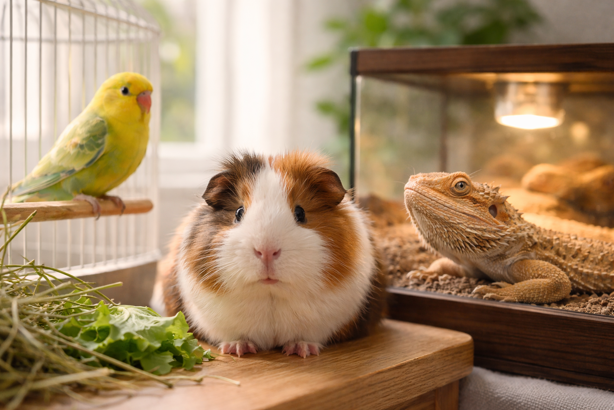
Birds are in a category of their own. Their respiratory systems are designed for exceptional oxygen extraction efficiency, which also makes them exceptionally sensitive to airborne compounds. Birds have historically been used as early warning systems for toxic air in mines for this exact reason. Most avian veterinarians recommend avoiding essential oil diffusion entirely in homes with birds, not just the high risk oils. If you keep birds, treat any diffuser use as requiring explicit veterinary clearance first.
Small mammals including rabbits, guinea pigs, hamsters and ferrets have limited research behind them. Their small body size and rapid respiration rates may make them vulnerable to concentrations that larger animals would tolerate. Keep diffusers out of rooms where small animals are housed, and ensure those rooms are well separated from diffusion areas.
Reptiles have different metabolic systems. Research on essential oil effects in cold blooded animals is very limited. Most reptile specialists recommend avoiding diffusion in reptile rooms as a precaution rather than waiting for clearer evidence.
Smart Diffuser Strategies for Pet Households
This is where smart home technology gives pet owners a genuine advantage over basic plug-in diffusers. Scheduling, intensity control, and automation features make diffusers significantly easier to use safely around animals.
Room Setup and Ventilation
The most important rule to remember is that pets must always be able to leave the room where a diffuser is running. Check that doors are ajar, that your pet hasn’t followed you into a closed room, and that their usual resting spots aren’t directly in the diffuser’s mist path.
Elevate your diffuser so mist disperses upward rather than settling at floor level. Run it in larger, well ventilated spaces rather than small rooms. Open a window where possible to prevent concentration building up over long sessions.
Using Scheduling to Protect Your Pets
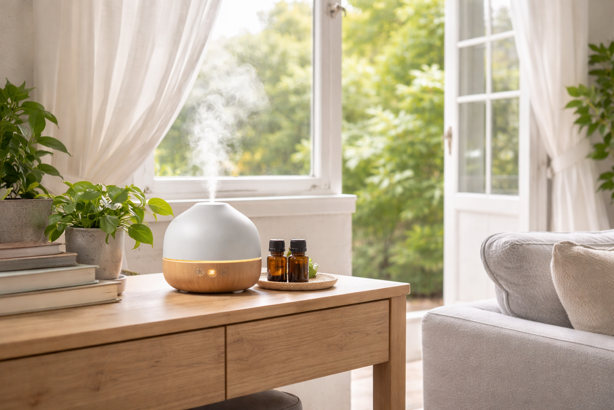
Smart diffusers like the ASAKUKI and Pura 4 allow you to set precise schedules through their apps, rather than running continuously. For pet households, this scheduling capability is genuinely useful beyond just convenience.
Consider the difference. Lavender overnight in a closed bedroom while your cat sleeps under the bed, versus 20 minutes in a large living room with a window cracked open. Same oil, completely different exposure profile. Smart scheduling makes the safer scenario the default.
Run diffusers in short cycles rather than continuous sessions. 15-30 minutes on, followed by a break, allows the air to clear. Schedule diffusion when you can actively monitor your pets rather than overnight or while you’re out. If you use away mode, make sure it pauses when you leave. The drop counts and dilution ratios for human aromatherapy are a reasonable starting point, but err toward the lower end in pet households.
Waterless vs. Ultrasonic Diffusers for Pet Safety
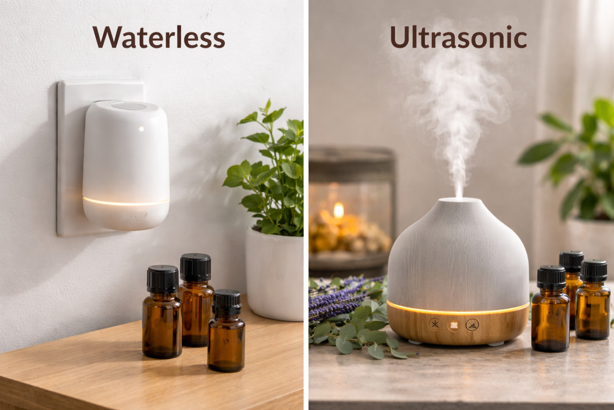
Waterless diffusers like the Pura 4 and Aera use proprietary fragrance cartridges instead of pure essential oils. Their output is generally a finer, drier dispersion than ultrasonic mist. They’re not automatically safe for pets, as the fragrance compounds still enter the air, but they do greatly reduce the wet mist that settles on fur and gets ingested during grooming.
Ultrasonic diffusers give you more control over what’s being diffused and at what concentration, since you’re choosing the oils and measuring the drops yourself. Both approaches can work in pet households, with appropriate care. The key factors are oil selection, session length, ventilation, and whether your pet can freely leave the area.
Pet Household Diffusing: Quick Safety Checklist
- Higher risk oils for cats: Tea tree, eucalyptus, peppermint, spearmint, wintergreen, ylang ylang, cinnamon, clove, pine, thyme
- Higher risk oils for dogs: Tea tree, pennyroyal, pine, wintergreen, cinnamon, clove
- Avoid nebulizing diffusers: In pet households, they disperse undiluted oil and typically produce the strongest output
- Run short sessions only: 15-30 minutes with breaks, not continuous
- Ventilate the room: Open a window or ensure airflow
- Elevate your diffuser: Mist should disperse upward, not settle at floor level
- Pets must always be able to leave: Keep doors ajar, no confinement near the diffuser
- Never diffuse unsupervised overnight or while away from home
- Birds require veterinary clearance before any diffuser use
- Consult your vet before starting any aromatherapy routine in a pet household
Warning Signs Your Pet Is Reacting to Essential Oils
Knowing what to watch for counts just as much as prevention. Symptoms can appear quickly after acute exposure or more gradually with repeated, low level exposure over time. If your pet has asthma, chronic respiratory disease or liver disease (or is very young or very old), treat any diffuser use as higher risk. If you notice any of the following, stop diffusing immediately, move your pet to fresh air, and contact your veterinarian or a poison control hotline.
In cats and dogs:
- Excessive drooling
- Pawing at the face or mouth
- Watery eyes, vomiting, lethargy, unsteady gait or loss of coordination
- Difficulty breathing or rapid shallow breathing
- Tremors or unusual behavioral changes such as sudden hiding or agitation
In birds:
- Open mouth breathing
- Tail bobbing
- Feather fluffing outside of normal preening
- Loss of balance or sudden collapse
Birds can deteriorate very rapidly, so any respiratory symptoms in a bird require immediate veterinary attention rather than a wait-and-see approach.
The ASPCA Animal Poison Control Center (888-426-4435) operates 24 hours and can advise on individual cases of exposure. There is a consultation fee, but the guidance is from veterinary toxicologists with access to a comprehensive exposure database. The Pet Poison Helpline (855-764-7661) is a second 24 hour option (also fee based) if you can’t reach ASPCA.
Frequently Asked Questions
Can essential oils harm pets even if I don’t diffuse them directly in the pet’s room?
Yes, in some cases. Oil molecules can migrate through open floor plans and HVAC systems. Residue from mist may also transfer via fabrics and settle on surfaces your pet contacts later. The risk is lower in separated rooms with good ventilation, but “not in the same room” is not the same as “no exposure”.
Does the type of diffuser affect how much risk my pet faces?
Yes, in meaningful ways. Nebulizing diffusers (which atomize undiluted oil directly) typically produce the strongest, most intense output and pose the greatest risk in pet households. Ultrasonic diffusers dilute oil in water before dispersing it, decreasing concentration. Waterless plug-in systems like Pura use proprietary vials, which greatly reduces the wet mist that can settle on fur and get ingested during grooming. If you have cats specifically, avoiding nebulizing diffusers altogether is a reasonable precaution, regardless of which oil you’re using.
Are “natural” or “organic” essential oils safer for pets than standard ones?
No. The organic certification of an oil relates to how the plant was grown, not to the toxicity profile of the compounds it contains. Organic tea tree oil is just as toxic to cats as conventional tea tree oil. A higher quality, more concentrated oil can increase exposure dose, and additives or undisclosed ingredients in lower quality oils can introduce their own risks. Oil selection and session management are far more important than organic status.
My vet said essential oils are fine around my pet. Should I trust that?
Veterinary opinions on essential oils vary, and not all vets have specialist training in toxicology or aromatherapy. A general reassurance that oils are “fine” may not account for certain oil types, diffuser technology or your pet’s health status. If you want a thorough assessment, ask specifically about the oils you plan to use and your pet’s individual health history.
Are essential oil diffusers safer than candles or plug-in air fresheners for pets?
Not exactly. Candles produce combustion by-products and particulate matter that stress respiratory systems – a particular concern for birds. Many plug-in fresheners use synthetic fragrance compounds whose safety profiles are often less documented than pure essential oils. A well managed smart diffuser using lower risk oils in short sessions may compare favorably to those alternatives, but the comparison depends enormously on how you’re using it.
Scent-sible Living
Essential oils and pets can coexist. But the difference between relaxing and risky usually comes down to how you diffuse. Short sessions, good ventilation, and an easy exit for your pet change the exposure picture dramatically.
A quick rule of thumb before you switch the diffuser on: Can your pet leave the room? Is the space ventilated? Are you running it briefly rather than all day? If the answer to any of those is no, skip it.
And if your pet suddenly seems off and exhibits behavior like drooling, hiding, unsteadiness or irregular breathing, turn the diffuser off and get them into fresh air. With scent exposure, time is crucial.
Enjoy the scent if you like it. Just make sure your pet can choose not to.
Looking to choose the right smart diffuser for your home? Our complete smart diffuser guide covers the best options at every price point, including hands-on testing of the ASAKUKI. For oil selection guidance, our essential oils guide covers drop ratios, blending and brand recommendations.