Many fitness trackers demand charging every day or two, turning what should be a set-and-forget health tool into another device competing for outlet time. If you’re tired of battery anxiety interrupting your workout data or forgetting to charge before a weekend trip, fitness trackers with genuinely long battery life solve this problem without sacrificing the metrics that matter. This guide covers five trackers that last anywhere from 10 to 35 days on a single charge, explaining what enables their longevity and which trade-offs are worth accepting.
Note: This guide includes both fitness bands and fitness focused watches, since the longest battery life often comes from hybrid designs and sports watches optimized for endurance over smartwatch features.
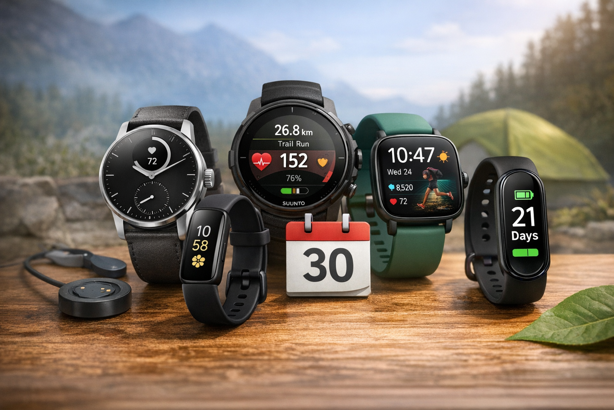
Quick Picks: Best Long Battery Fitness Trackers at a Glance
🏆 Best Overall: Withings ScanWatch 2 – $349-399
Up to 35 days battery life, hybrid analog design, comprehensive health tracking
💎 Best Premium Multi-sport: Suunto Race S – $299-349
Up to 9 days daily use (HR on), multi-band GPS, serious training tools
⚖️ Best Mid-Range Value: Amazfit GTS 4 Mini – $100-130
Up to 15 day battery, compact design, essential smart features
💰 Best Budget Pick: Fitbit Inspire 3 – $80-100
Up to 10 day battery, established ecosystem, solid core tracking
🎯 Best Ultra-Budget: Xiaomi Smart Band 10 – $40-50
Up to 21 days typical (9 days AOD), outstanding value, basics done right
30 Second Selector: Which Fitness Tracker Should You Buy?
Answer these 3 questions to find your match
1. What’s your budget?
- Under $60 → Xiaomi Smart Band 10 (unbeatable value)
- $80-130 → Fitbit Inspire 3 or Amazfit GTS 4 Mini (brand trust vs. features)
- $300-400 → Suunto Race S or Withings ScanWatch 2 (serious athletics vs. hybrid style)
2. What matters most to you?
- Longest battery possible → Withings ScanWatch 2 (up to 35 days)
- Multi-sport GPS tracking → Suunto Race S (comprehensive athletics)
- Brand ecosystem trust → Fitbit Inspire 3 (established platform)
- Maximum features per dollar → Amazfit GTS 4 Mini (impressive specs)
- Absolute lowest price → Xiaomi Smart Band 10 (under $50)
3. What’s your use case?
- Serious runner/cyclist → Suunto Race S (training metrics)
- General wellness tracking → Fitbit Inspire 3 or Amazfit GTS 4 Mini
- Style-conscious fitness → Withings ScanWatch 2 (looks like a watch)
- Budget exploration → Xiaomi Smart Band 10 (try before investing more)
Long Battery Fitness Tracker Comparison
| Model | Price | Battery Life | GPS | Display Type | Water Resistance | Best For |
|---|---|---|---|---|---|---|
| Withings ScanWatch 2 | $349-399 | Up to 35 days | Connected GPS (via phone) | Hybrid analog | 5 ATM (50m) | Style + longevity |
| Suunto Race S | $299-349 | 9 days (HR on) | Multi-band GPS | AMOLED touchscreen | 5 ATM (50m) | Multi-sport athletes |
| Amazfit GTS 4 Mini | $100-130 | 15 days | Built-in GPS | AMOLED | 5 ATM (50m) | Value seekers |
| Fitbit Inspire 3 | $80-100 | 10 days | Connected GPS (via phone) | AMOLED | 5 ATM (50m) | Ecosystem buyers |
| Xiaomi Smart Band 10 | $40-50 | 21 days typical | Connected GPS (via phone) | AMOLED | 5 ATM (50m) | Ultra-budget |
Battery life based on manufacturer specifications with typical use patterns. Actual results vary with GPS usage, screen brightness and notification frequency.
Best Fitness Trackers With Long Battery Life for 2026
Battery life in fitness trackers comes down to a straightforward engineering trade-off – larger batteries and lower power components extend runtime, but add weight, cost and size. The devices below navigate these constraints differently, from hybrid watches that minimize screen power consumption to budget bands that skip energy-hungry features entirely.
Withings ScanWatch 2
Best Overall | $349-399 | View on Amazon
Rating: 4.8/5
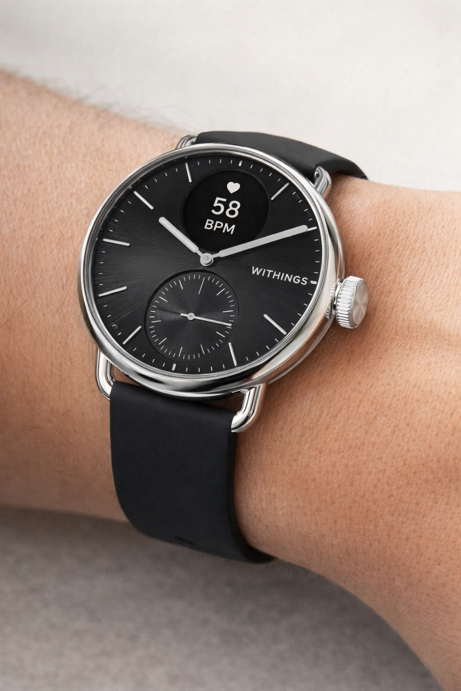
The ScanWatch 2 achieves its exceptional battery life (rated at up to 35 days under ideal conditions) through a hybrid design that pairs a traditional analog watch face with a small OLED display window. This approach eliminates the constant power drain of always-on screens while maintaining full health tracking capabilities. The analog movement requires virtually no power, and the OLED only activates when you need to view metrics. For people who want a device that looks like a traditional watch rather than an obviously tech-forward wearable, this delivers both aesthetics and practical endurance.
Key Features
- Up to 35 Days Battery Life: Industry leading endurance from hybrid analog-digital design
- Comprehensive Health Monitoring: Heart rate, SpO2, skin temperature, sleep tracking with advanced sleep stages
- ECG Feature (Region Dependent): On-demand single-lead ECG with atrial fibrillation detection, where available
- Connected GPS: Uses smartphone GPS for outdoor activity tracking (conserves battery vs. built-in GPS)
- 5 ATM Water Resistance: Swim tracking and shower-safe (50 meters)
- Withings App: Clean interface with trend analysis and Apple Health/Google Fit integration
Worth Knowing
Connected GPS means you must carry your phone for accurate outdoor tracking. The small OLED window limits what data you can view at once compared to full screen trackers. ECG and some advanced health features may not be available in all regions due to regulatory requirements. Some Android users have reported the Withings app draining phone battery in background use, though updates have addressed many of these issues.
Best For
Anyone prioritizing maximum battery life with professional aesthetics, those already invested in iOS or Android ecosystems who don’t need platform-specific features.
Suunto Race S
Best Premium Multi-sport | $299-349 | View on Amazon
Rating: 4.6/5
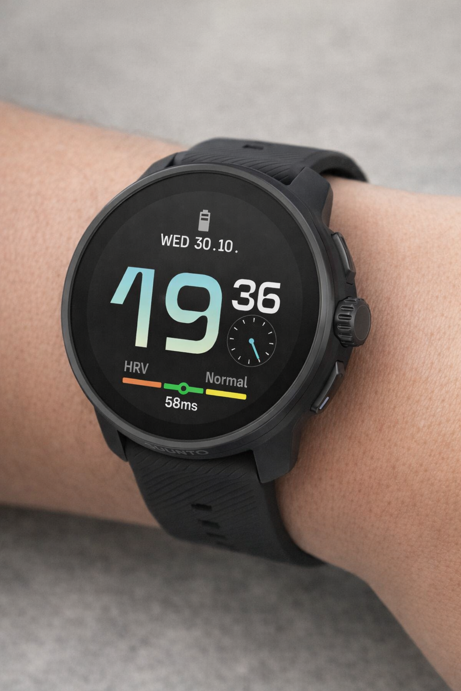
The Race S targets serious athletes with training analytics typically found in $500+ watches. Its up to 9 day battery life in daily use (with heart rate monitoring enabled) results from efficient AMOLED display management and intelligent GPS modes that balance accuracy with power consumption. When GPS is active, expect around 20-30 hours, depending on whether you use single or dual frequency mode. For marathon training, century rides or multi-day hiking trips, this runtime handles events that would kill most smartwatches.
Key Features
- Up to 9 Days Battery (Daily Use with HR On): Up to 30 hours with GPS active in performance mode
- Multi-Band GPS: Dual frequency positioning for accurate tracking in challenging environments (urban canyons, dense forests)
- 95+ Sport Modes: Comprehensive activity profiles with sport-specific metrics for running, cycling, swimming, hiking and strength training
- Training Analytics: VO2 max estimates, training load tracking, recovery time recommendations, performance condition assessment
- AMOLED Touchscreen: Bright, responsive display
- 5 ATM Water Resistance: Suitable for swimming (50 meters)
- Offline Maps: Download routes for navigation without phone connection
- Suunto App Integration: Connects with Strava, TrainingPeaks and other platforms
Worth Knowing
Real world battery life with always-on display typically delivers 3-5 days rather than the advertised 9 days (without always-on display and daily HR monitoring). Turning off AOD extends battery to 5-7 days with daily GPS workouts. The interface has a learning curve with many features and customization options. Some users report occasional heart rate inaccuracies during high intensity intervals, with sporadic spikes to 130 BPM while sitting. Step counting can be less accurate than competing devices. At 45mm, the case size may feel bulky on smaller wrists.
Best For
Serious runners, cyclists and triathletes who need training analytics with multi-day battery life, outdoor enthusiasts requiring reliable GPS for hiking or trail running, athletes transitioning from basic trackers who want performance insights.
Amazfit GTS 4 Mini
Best Mid-Range Value | $100-130 | View on Amazon
Rating: 4.4/5
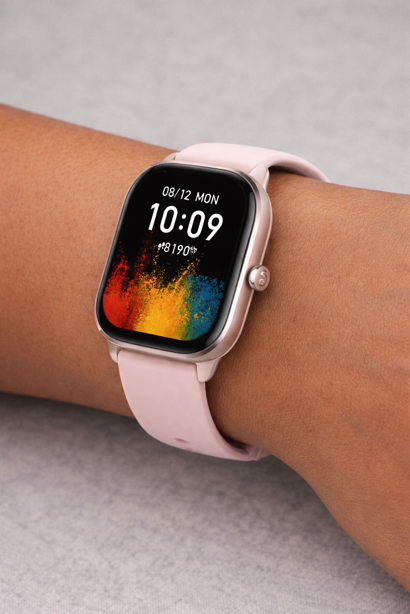
The GTS 4 Mini proves you don’t need premium pricing for genuinely useful battery life. Its 15 day endurance comes from a relatively large 270mAh battery in a compact form factor, combined with an efficient processor and display management. Amazfit achieves this by focusing resources on core fitness tracking rather than smartwatch features like app stores or voice assistants. For someone who wants reliable health metrics without ecosystem lock-in or subscription fees, this delivers surprising capability.
Key Features
- 15 Day Battery Life: Genuine two week runtime with typical use including sleep tracking and notifications
- Built-in GPS: Independent position tracking without phone (reduces battery to ~5 days with frequent GPS use)
- 120+ Sport Modes: Comprehensive activity tracking including automatic workout detection
- Health Monitoring: 24/7 heart rate, SpO2, stress tracking, sleep analysis with REM stage detection
- 1.65″ AMOLED Display: Clear, colorful screen with always-on option (reduces battery life)
- Alexa Built-in: Voice commands for weather, timers, smart home control
- 5 ATM Water Resistance: Swim tracking with stroke recognition (50 meters)
- Zepp App: Cross-platform compatibility with no subscription required for core features
Worth Knowing
Real world battery life with continuous heart rate monitoring and daily GPS workouts usually delivers 6-10 days rather than the advertised 15 days. Step counting accuracy can be inconsistent, with some users reporting the tracker logging steps while sitting. The proprietary charging cable is short, making it difficult to charge on elevated surfaces. Mixed reviews on customer support quality.
Best For
Budget conscious buyers wanting legitimate battery life without sacrificing essential features, people who prioritize fitness tracking over smartwatch capabilities, Android and iOS users seeking platform-agnostic devices, those avoiding subscription based fitness platforms.
Fitbit Inspire 3
Best Budget Pick | $80-100 | View on Amazon
Rating: 4.5/5
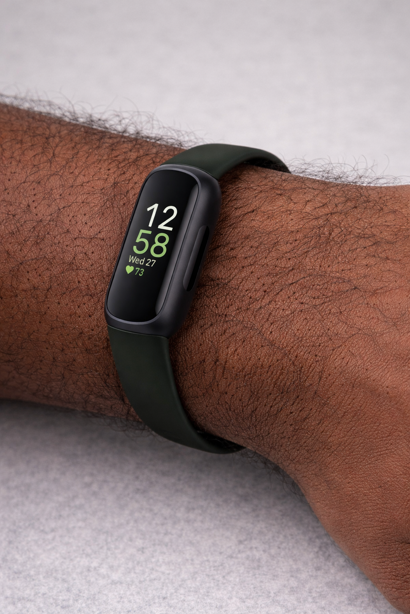
The Inspire 3 represents Fitbit’s focus on what really matters for most users. While competitors chase feature lists, Fitbit’s strength remains its mature ecosystem and polished user experience. The 10 day battery life is the result of years of optimization across hardware and software, with power management that balances active tracking against standby efficiency. For someone buying their first fitness tracker or replacing a smartwatch they never used beyond fitness features, this delivers the essentials without complexity.
Key Features
- 10 Day Battery Life: Reliable runtime with daily wear including 24/7 heart rate and sleep tracking
- Connected GPS: Uses smartphone GPS for outdoor activity tracking (conserves battery vs. built-in GPS)
- Active Zone Minutes: Personalized heart rate zones show when you’re truly working at effective intensity
- Stress Management: Daily Stress Management Score with guided breathing sessions and mindfulness content
- Sleep Tracking: Comprehensive sleep stage analysis with Sleep Score and sleep profile assessment
- AMOLED Display: Clear screen with customizable clock faces (smaller than smartwatch style trackers)
- 5 ATM Water Resistance: Water resistant to 50 meters
- Fitbit App Integration: Mature platform with social features, challenges and optional Premium subscription
Worth Knowing
Many advanced features require Fitbit Premium subscription (~$10/month or ~$80/year) to access full functionality. No built-in GPS means carrying your phone for accurate outdoor tracking. The small display limits what information you can see at once compared to larger smartwatch screens. The proprietary charging cable with pins can be frustrating to align properly. Some users with sensitive skin report irritation from silicone bands during extended wear.
Best For
First time fitness tracker buyers wanting proven reliability, existing Fitbit users invested in the ecosystem, people who value user experience polish over maximum features, those seeking social motivation through challenges and leaderboards.
Xiaomi Smart Band 10
Best Ultra-Budget | $40-50 | View on Amazon
Rating: 4.2/5
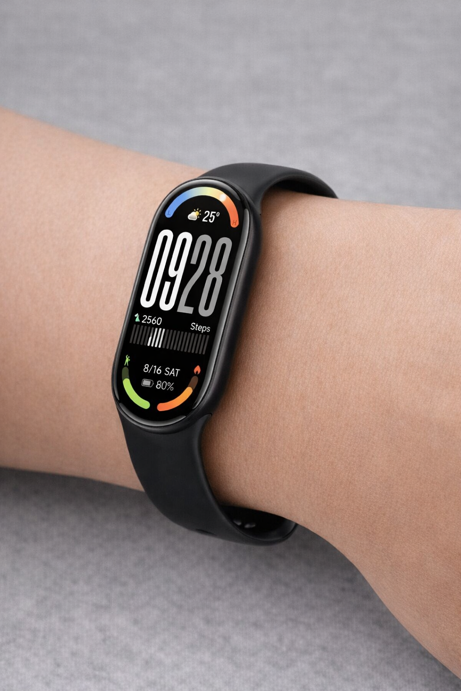
The Smart Band 10 delivers shockingly capable tracking at a price that substantially lowers the risk of trying fitness tracking for the first time. Its 14-21 day battery life (depending on features enabled) comes from a large 233mAh battery relative to the band’s minimal size, plus aggressive power management that disables non-essential features by default. Xiaomi achieves this price point through high volume manufacturing and minimal marketing, focusing engineering resources on core tracking rather than ecosystem development. For someone exploring fitness tracking without financial commitment, this proves the concept before upgrading.
Key Features
- Up to 21 Days Battery Life: Typical use runtime (otherwise 9 days with always-on display enabled, 8 days with heavy use)
- 1.72″ AMOLED Display: Surprisingly large, bright screen (upgraded from 1.62″ on previous model)
- 150+ Sport Modes: Comprehensive activity tracking
- 24/7 Health Monitoring: Heart rate, SpO2, sleep tracking with basic analysis
- Connected GPS: Uses smartphone for outdoor activity tracking
- 5 ATM Water Resistance: Swim tracking capability (50 meters)
- Mi Fitness App: Cross-platform app with no subscription requirements
- Always-On Display Option: Available but reduces battery life considerably
Worth Knowing
The Mi Fitness app lacks the polish of Fitbit or Garmin platforms, with cluttered interfaces and occasional rough English translations. No built-in GPS means bringing your phone with you for outdoor tracking. Optical heart rate accuracy becomes inconsistent during high intensity exercise. Sleep tracking accuracy for specific stages “leaves a lot to be desired” according to detailed reviews. Customer support is essentially non-existent.
Best For
Budget conscious buyers testing whether they’ll actually use a fitness tracker, people who only need basic step and sleep tracking, those seeking backup devices for travel or secondary use, anyone hesitant to invest heavily before knowing their commitment level.
Understanding Battery Life in Fitness Trackers
Battery longevity in wearables might seem like magic. But in reality, it’s the result of deliberate engineering choices about what to include, what to automate and what to sacrifice. Understanding these trade-offs can help you select a device that matches your individual usage patterns, rather than chasing maximum specs on paper.
What Drains Battery Most
GPS Tracking: Built-in GPS consumes more power than any other single feature. Devices with GPS can drop from 14 day battery life to 20-30 hours when continuously tracking outdoor activities. This is why budget trackers and hybrid watches use “connected GPS” that leverages your smartphone’s GPS chip instead.
Display Technology and Usage: Always-on displays, frequent screen wake-ups and maximum brightness settings drain batteries faster than anything except active GPS. AMOLED screens are more efficient than LCD for fitness trackers since they only light individual pixels, but keeping them always-on can still cut battery life by 40-60%.
Heart Rate Monitoring Frequency: Continuous 24/7 heart rate tracking uses much more power than periodic sampling. Most devices now default to continuous monitoring since the data improves sleep and recovery insights, but earlier trackers offered 1 minute or 5 minute interval options to extend battery life.
Notifications and Connectivity: Every notification vibration, screen wake and Bluetooth data sync consumes power. Heavy notification users may see 20-30% shorter battery life than advertised. Enabling smartphone notifications for dozens of apps creates constant power drain.
What Extends Battery Life
Hybrid Designs: Devices like the Withings ScanWatch 2 use analog watch movements that require almost zero power, reserving battery only for health sensors and the small digital display. This architectural choice enables a potential 35 day battery life that pure digital displays can’t match.
Efficient Processors: Newer chipsets process sensor data using less power. The jump from earlier generation fitness tracker processors to current models often adds 2-3 days of battery life with identical feature sets.
Connected GPS vs. Built-In: Offloading GPS to your smartphone dramatically extends battery life. The trade-off is you must carry your phone during outdoor workouts, which many runners and cyclists already do.
Larger Physical Size: Bigger devices accommodate larger batteries. This is why compact bands like the Fitbit Inspire 3 achieve 10 days while larger watches like the Suunto Race S reach around 9 days (with typical use), despite having built-in GPS and AMOLED screens.
Smart Power Management: Modern trackers intelligently decrease sensor sampling rates during sleep, disable features you’re not using and throttle display brightness based on ambient light. These background optimizations can add 3-5 days of runtime without user intervention.
Setting Realistic Expectations
Manufacturer battery life claims assume certain use cases that may not match your behavior. “Up to 15 days” usually means:
- No GPS usage
- Moderate notification volume (50-100 per day)
- Screen wake-ups 50-80 times daily
- Default brightness settings
- Sleep tracking enabled
- Standard heart rate monitoring
If you run with GPS three times weekly, enable always-on display and receive 300+ daily notifications, expect 40-60% of advertised battery life. This isn’t deceptive marketing, just physics.
Fitness Tracker Battery Life Buying Guide
Assess Your Usage Patterns
Before prioritizing battery life, honestly evaluate how you’ll use the device. If you charge your phone every night anyway, docking a fitness tracker at the same time won’t be burdensome. But if you travel frequently, work long shifts or simply hate charging routines, extended battery life offers real value.
Heavy GPS Users: Runners and cyclists who track outdoor workouts 4-6 times weekly should focus on GPS battery life, not standby time. The Suunto Race S handles 20-30 hour activities, while devices advertising 21 day standby might only provide 6-8 hours of GPS tracking.
Notification Dependent: If you rely on wrist notifications throughout the day, expect battery life 30-40% below manufacturer claims regardless of device. Consider whether you need vibration for every email or just critical apps.
Casual Trackers: If you primarily want step counts and sleep data with occasional workouts, even budget options provide adequate battery life. The Xiaomi Smart Band 10’s 14-21 days easily covers this use case.
Built-in GPS vs. Connected GPS
Built-in GPS enables phone-free outdoor workouts, which matters for runners who prefer leaving phones behind. The battery cost is substantial but worthwhile if this freedom matters to you. Connected GPS forces you to carry your phone but can triple overall battery life. Most cyclists and many runners already carry phones for safety and music, making connected GPS a sensible trade-off.
Display Considerations
If you need to check metrics frequently during workouts, prioritize screen size and brightness over minor battery differences. A readable display that drains battery 10% faster beats squinting at a dim screen to preserve charge. Always-on displays deliver convenience at the cost of roughly halving battery life.
Ecosystem Lock-In
Fitbit requires staying within their ecosystem, which matters if you switch between iOS and Android or prefer third-party apps. Platform-agnostic options like Amazfit and Xiaomi export data more freely but lack the polish of closed ecosystems. Consider whether you’re buying just a tracker or committing to a platform long term.
Price per Year of Use
A $350 tracker lasting five years costs less annually than a $80 tracker replaced every 18 months. Premium devices use better materials, receive longer software support and maintain resale value. Budget options work fine for testing commitment levels before upgrading, but can represent poor long term value if you know you’ll use the device consistently.
Frequently Asked Questions
Which fitness tracker has the absolute longest battery life?
The Withings ScanWatch 2 leads with up to 35 days of battery life, achieved through its hybrid analog-digital design. For budget buyers, the Xiaomi Smart Band 10 offers exceptional value at 21 days for under $50. Real world usage typically delivers 20-30 days for the Withings and 14-18 days for the Xiaomi.
Which trackers work without carrying my phone?
Only the Amazfit GTS 4 Mini and Suunto Race S have built-in GPS for phone-free outdoor tracking. The Withings ScanWatch 2, Fitbit Inspire 3 and Xiaomi Smart Band 10 use connected GPS, requiring your smartphone for accurate route mapping during runs, rides or hikes. All five track steps, heart rate and sleep independently without a phone.
Do I need a subscription to access my fitness data?
No subscription is required for core tracking features on any of these devices. The Fitbit Inspire 3 offers an optional Premium subscription (~$10/month) for advanced insights, personalized workouts and mindfulness content, but all basic health metrics remain free. Withings, Amazfit, Suunto and Xiaomi provide full access to your data without monthly fees.
Are these trackers suitable for swimming?
Yes, all five trackers are rated 5 ATM (50 meters water resistance), making them safe for swimming, showering and water sports. The Suunto Race S offers the most advanced swim tracking with automatic stroke detection and interval recognition. The Fitbit Inspire 3 and Amazfit GTS 4 Mini also provide detailed swim metrics. None are suitable for scuba diving or high pressure water activities.
Making Your Decision
Choose based on your charging tolerance and feature priorities rather than purely maximum battery numbers. A device that lasts 30 days but lacks GPS might frustrate runners more than a 10 day tracker with accurate route tracking.
- For maximum battery life without compromise: The Withings ScanWatch 2 delivers up to 35 days in a sophisticated hybrid design that doesn’t look like fitness tech.
- For serious athletic training: The Suunto Race S provides up to 9 days of daily use with comprehensive multi-sport analytics and reliable GPS that handles marathon training and century rides.
- For balanced value: The Amazfit GTS 4 Mini gives you 15 days plus built-in GPS at less than half the premium device cost.
- For ecosystem trust: The Fitbit Inspire 3 offers 10 days within the most mature fitness tracking platform, with social features and proven reliability.
- For minimal investment: The Xiaomi Smart Band 10 proves you don’t need to spend much to get up to 21 days of capable tracking.
The right fitness tracker fits your life without constant attention. Battery life matters, but not more than actually using the device consistently. A tracker you forget to charge but remember to wear beats a perfectly optimized device sitting in a drawer.
Charge Less, Train More
Long battery life changes how a fitness tracker fits into your routine. Devices that need regular charging interrupt habits and create gaps in your data. When charging becomes a weekly task instead of a daily one, tracking fades into the background and consistency improves.
A fitness tracker with long battery life reduces friction, keeps data flowing and makes long term patterns easier to spot. Over time, those uninterrupted trends matter far more than any single feature or metric.
All in all, the best fitness tracker is the one that stays on your wrist – not on the charger.