
You’ve seen the marketing claims. HEPA filters capturing 99.97% of particles, smart sensors detecting pollution in real-time, apps promising cleaner air at your fingertips. But your allergies persist, dust still accumulates and you’re left wondering if that expensive box in the corner is actually doing anything.
Air purifiers measurably reduce airborne particles when properly sized and equipped, but effectiveness varies considerably based on specifications most people don’t understand. HEPA purifiers can reduce particle concentrations by 30 to 80 percent in real homes when CADR is adequate and the unit runs continuously, but your home isn’t a sealed laboratory, and that “covers 1500 square feet” claim on the box probably doesn’t mean what you think it means.
This guide examines what air purifiers do, what the research says about health outcomes, and which specifications matter versus marketing fluff. We’ll decode CADR ratings, explain what HEPA filters capture and what they miss, and establish realistic expectations about what these devices can and cannot accomplish.
Do Air Purifiers Measurably Reduce Airborne Particles?
In controlled testing, the evidence is clear. AHAM verified CADR testing shows how much clean air a purifier delivers for smoke, dust and pollen under standardized conditions. Multiple studies show HEPA purifiers reduce airborne particle concentrations by roughly 30 to 80 percent in real homes, depending on air changes per hour, room leakage and continuous operation.
Real world performance differs substantially because your home isn’t sealed. Open windows introduce outdoor pollution faster than purifiers can clean it. HVAC systems mix cleaned and uncleaned air from different rooms. Continuous pollution sources like cooking, pets and outdoor air infiltration mean purifiers constantly work against new particle introduction rather than simply cleaning a fixed amount of dirty air once.
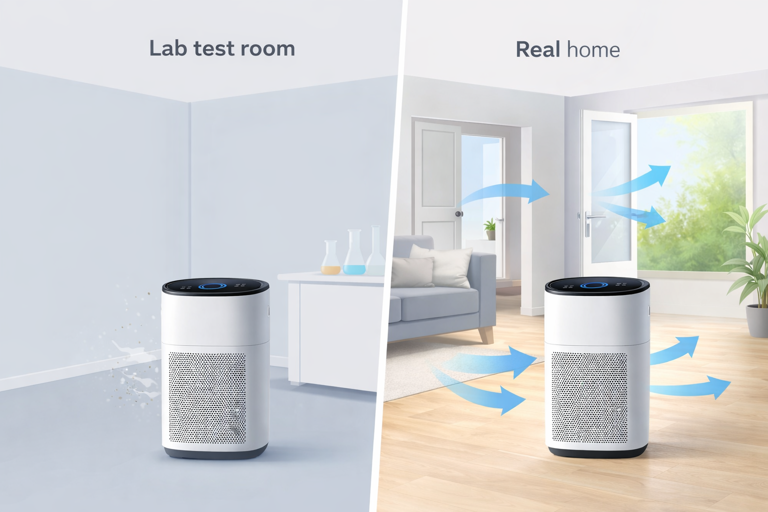
Room size matching creates the biggest performance gap. A purifier rated for 300 square feet won’t effectively clean a 600 square foot space regardless of how long it runs. The unit physically cannot move enough air through the filter to achieve adequate air changes per hour. Undersized units run constantly at maximum speed, creating noise and energy consumption without delivering the results promised.
Understanding what “works” means preventing disappointment later on. Air purifiers lower particle concentrations but don’t create sterile environments. A purifier might decrease pollen levels by 70 percent, which meaningfully helps allergy sufferers but doesn’t eliminate exposure entirely. Turn it off and particle levels can rebound within hours, depending on your pollution sources.
Understanding CADR: The Specification That Really Matters
Clean Air Delivery Rate (CADR) quantifies how much clean air a purifier delivers per minute for smoke, dust and pollen. A CADR of 250 means the unit delivers about 250 CFM (Cubic Feet per Minute) of clean air at the tested setting. This single number tells you more about performance than vague claims about room coverage or filtration percentages.
AHAM verification provides the most reliable CADR numbers because testing follows standardized protocols. When comparing purifiers, prioritize verified CADR over manufacturer claims.
The room size numbers many manufacturers advertise assume single air changes per hour, which can be insufficient for allergy or smoke situations. AHAM’s guidance targets roughly 4-5 air changes per hour for allergy and asthma performance, meaning the purifier should completely filter all air in the room nearly five times every hour. Most “coverage area” marketing specs assume only one complete air change hourly, drastically overstating effective room size.
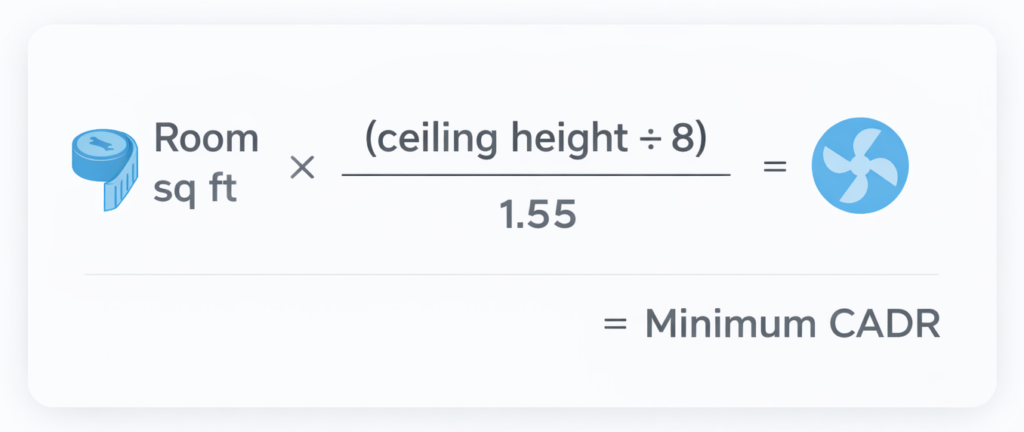
Calculating what you need requires simple math. Measure your room in square feet by multiplying length times width. For ceilings above eight feet, multiply that result by ceiling height divided by eight. A 300 square foot room with ten foot ceilings equals 375 square feet effective size. Divide by approximately 1.55 to get minimum CADR needed (in this example, 242 CFM).
That “1500 square feet coverage” claim typically represents one air change per hour. For the same unit to achieve roughly 5 air changes per hour, divide that coverage number by 5. Suddenly that 1500 square foot claim becomes 300 square feet of effective coverage for meaningful health benefits.
If you remember only one thing: CADR matters more than brand names, smart features or filter marketing claims. A properly sized unit with basic features outperforms an undersized premium model every time.
HEPA Filtration: What It Captures and What It Doesn’t
True HEPA filters capture at least 99.97 percent of particles 0.3 microns in diameter, the size where particles are hardest to capture. Larger particles get trapped more easily, while smaller particles move erratically and impact filter fibers more frequently.
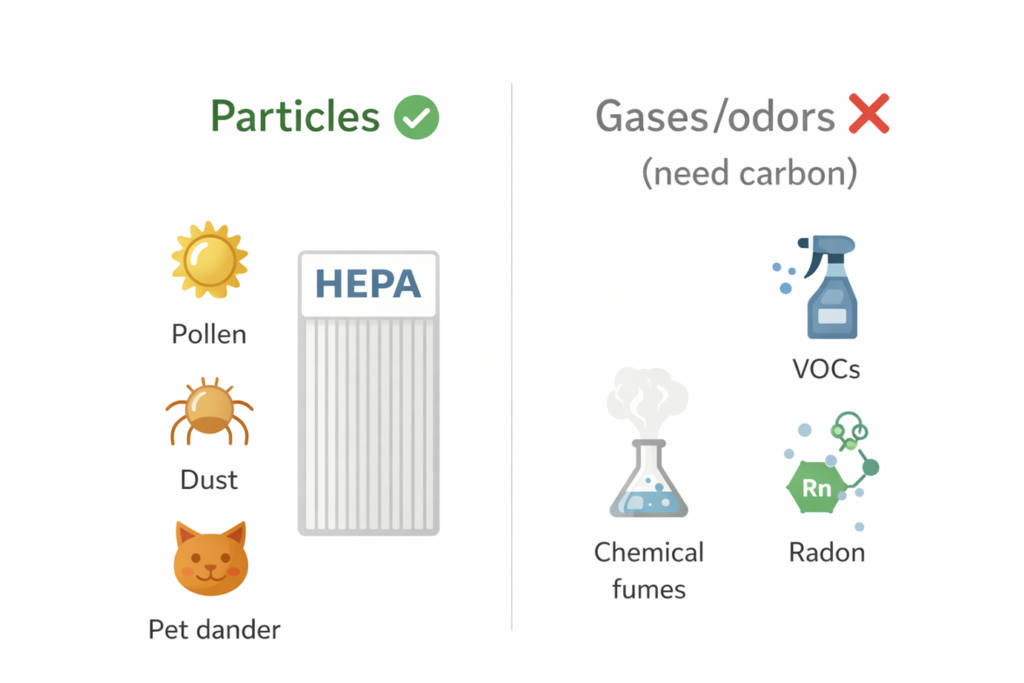
HEPA effectively filters common indoor particles. Pollen (10-100 microns), dust mite debris (5-20 microns), pet dander (2.5-10 microns) and mold spores (3-100 microns) are captured efficiently. Smoke particles (0.01-1 micron) get captured at varying rates, with ultra-fine particles requiring adequate CADR for meaningful reduction. Bacteria and many virus particles are captured when attached to larger aerosols and droplets.
What HEPA doesn’t handle includes gases and odors because molecules are too small for mechanical filtration. VOCs from cleaning products, furniture and paint require activated carbon. Formaldehyde needs specialized catalytic filters. Carbon monoxide and radon are unaffected by portable air purifier filtration. People buying purifiers to eliminate cooking smells or chemical odors often find HEPA-only units disappointing because the filter captures particles while odor causing gases pass straight through.
“HEPA-type”, “HEPA-like” or “HEPA-grade” have no standardized definition. These marketing terms often describe filters capturing 85 to 95 percent of particles, which sounds high but represents meaningfully less protection than True HEPA. A filter capturing 90 percent of particles allows more than three times as many particles through compared to True HEPA at 99.97 percent.
Carbon Filters and Odor Removal: Separating Fact from Marketing
Activated carbon adsorbs gas molecules and VOCs onto its surface through chemical attraction. Unlike HEPA’s mechanical particle capture, carbon captures gaseous pollutants until it becomes saturated, at which point the filter stops removing additional gases, even though it looks perfectly clean.
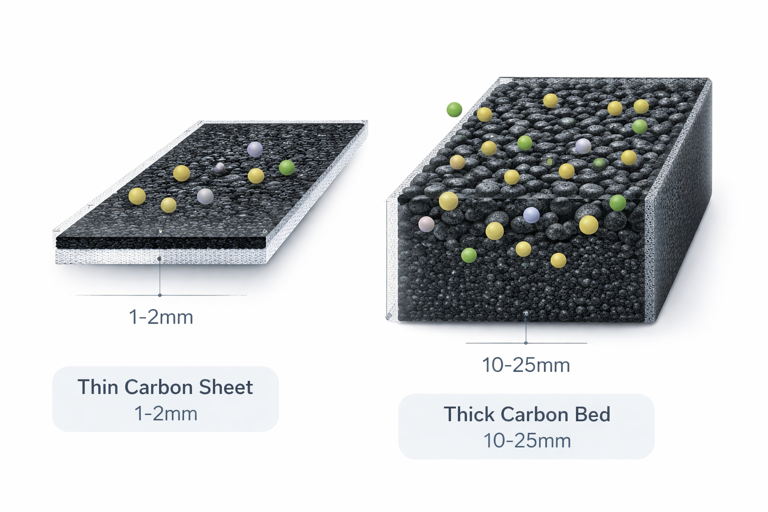
Weight and thickness matter enormously. Thin carbon sheets (1-2mm thick) saturate within weeks of continuous use, while thick carbon beds (10-25mm deep) last months. Budget purifiers often include token amounts of activated carbon – a few grams of carbon powder coating a filter offers almost no practical odor removal despite letting manufacturers claim “activated carbon filtration” on the box.
Humidity decreases activated carbon effectiveness because the material preferentially adsorbs water molecules, reducing the capacity for target pollutants. A carbon filter that works well in winter when indoor air is dry may show noticeably degraded performance in summer when humidity rises.
Formaldehyde requires specialized treatment because standard activated carbon captures it poorly. Catalytic filters chemically destroy formaldehyde rather than adsorbing it, and don’t saturate because they continuously break down formaldehyde into harmless compounds. If you have genuine smoke or cooking odor concerns, enhanced carbon is worth the premium, but for households primarily needing particle filtration where odors are occasional and minor, skip the premium carbon.
How Effective Are Air Quality Sensors?
Most smart air purifiers include PM2.5 sensors that detect particles 2.5 microns and smaller using optical sensors that estimate particle concentration by measuring light scattering.
Sensor accuracy varies dramatically by price point. Budget models ($80-$150) show general trends but absolute readings can differ from reference-grade monitors by 50-100 percent. Mid-range purifiers ($150-$350) usually include better calibrated sensors with readings within 20-40 percent of reference monitors. Premium models above $350 often feature multi-sensor arrays detecting PM2.5, PM10, VOCs and nitrogen dioxide separately, with more consistent accuracy.
Particle sensors detect concentration but can’t distinguish pollen from smoke from dust. Gas pollutant sensors measure VOC levels generally but don’t identify individual compounds. A low PM2.5 reading doesn’t guarantee your specific allergen trigger is absent.
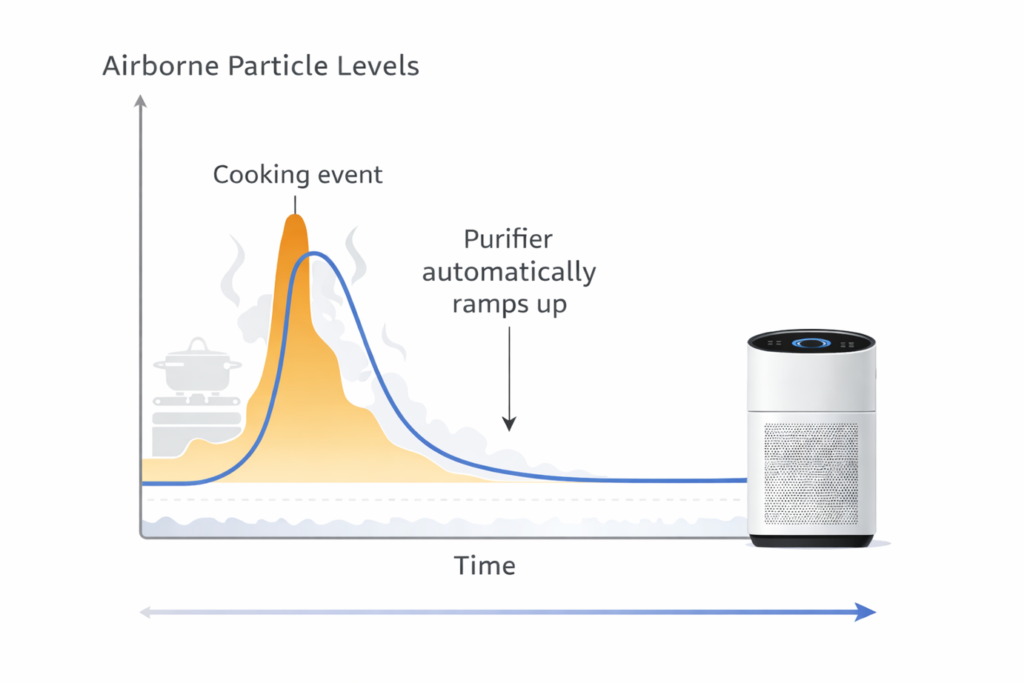
Auto mode effectiveness depends entirely on sensor quality and responsiveness. Budget sensors sometimes react slowly or fail to distinguish between harmless steam and actual particulates. Sensors accumulate dust over time, coating optical components and degrading readings. After a year of use, an uncleaned sensor might read 15 when in reality, levels are 45, leaving the purifier running on low speed when it should be on high.
Air Purifiers and Health: What the Research Shows
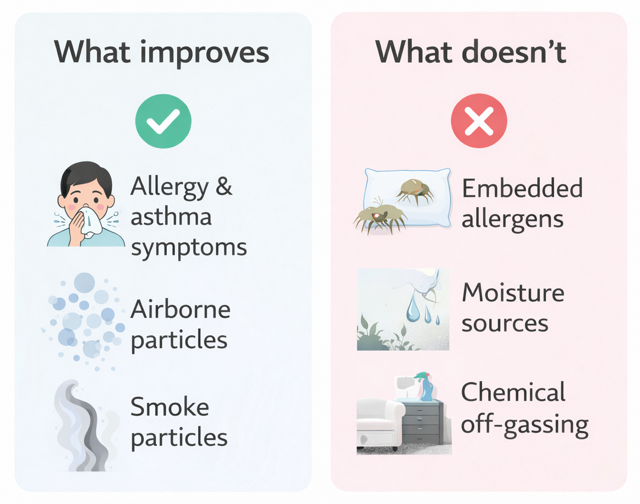
Multiple peer reviewed studies show statistically significant improvement in allergy symptoms when HEPA purifiers run continuously in bedrooms of allergy sufferers. A 2018 study in the Asian Pacific Journal of Allergy and Immunology found bedroom air purifiers reduced rhinitis symptoms and medication use in dust mite allergic patients. A multicenter placebo-controlled study showed medication requirements decreased significantly in households with appropriately sized purifiers running continuously.
The improvement correlates with measured particle reduction rather than placebo effect. Studies using sham purifiers with filters removed showed no symptom improvement, while functional units demonstrated measurable benefit. Effectiveness appears strongest when purifiers are properly sized, run continuously, and are placed in bedrooms where people spend extended periods breathing the cleaned air. Air purifiers work best as part of comprehensive allergen reduction including allergen-proof bedding, regular cleaning and humidity control rather than as standalone interventions.
What air purifiers won’t fix includes allergens embedded in carpets, bedding and upholstery because purifiers only capture airborne particles. Mold growth from moisture problems requires fixing the water source. Chemical off-gassing from new furniture can be more effectively controlled through source removal and ventilation than filtration. Poor ventilation in tightly sealed homes needs fresh air exchange rather than just recirculation through filters.
HEPA filtration can capture virus-containing aerosols and droplets, and research suggests air purifiers can help decrease concentrations of these aerosols in indoor air. However, purifiers supplement but don’t replace vaccination, masking in high risk settings and adequate fresh air exchange. They may reduce airborne viral load but can’t eliminate transmission risk, particularly from direct exposure to infected individuals at close range.
Smart Features: Helpful Automation or Expensive Gimmicks?
Scheduling genuinely improves effectiveness by automatically running purifiers during high pollen hours or before you arrive home. Real-time air quality monitoring through apps helps identify pollution sources and verify the purifier is working, though this value depends entirely on sensor quality. Filter life tracking based on actual runtime prevents premature replacement and also prevents running with saturated filters, with app-based notifications providing more accurate replacement timing than generic “replace every six months” guidance.
Voice control adds convenience but doesn’t improve air quality. Color changing lights visualizing air quality provide the same information available in apps without functional benefit. Integration with smart home ecosystems enables automations but these require setup effort most users won’t maintain after initial enthusiasm fades.
Auto mode offers genuine value only when sensors are accurate and responsive. Budget purifiers with poor sensors might run on high constantly or stay on low when they should increase speed. Mid-range and premium models with quality sensors make auto mode worth using because the purifier genuinely responds to real air quality changes.

What Air Purifiers Can’t Do: Managing Expectations
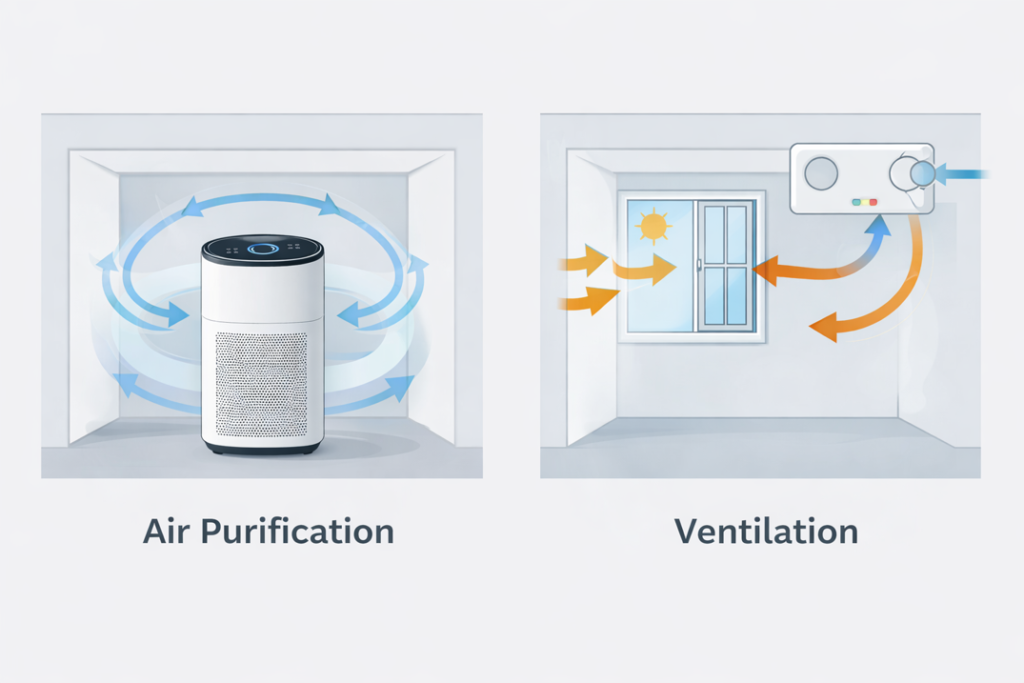
Air purifiers don’t replace proper ventilation because recirculating and filtering the same air doesn’t add oxygen or remove carbon dioxide. Tightly sealed homes built for energy efficiency need fresh air exchange, not just purification of stale air.
Purifiers capture airborne mold spores but don’t reduce humidity or prevent new growth on damp surfaces. High humidity requires dehumidification, and active mold growth requires fixing water intrusion and removing contaminated materials.
Source control always beats filtration. Smoking outside reduces indoor smoke pollution more than any purifier can achieve. Fixing a gas stove or switching to induction reduces VOCs and nitrogen dioxide more effectively than filtration. Regular vacuuming with HEPA-equipped vacuums helps remove settled allergens that purifiers can’t reach. Allergen-proof pillow and mattress covers prevent dust mite exposure more directly than air filtration.
Air purifiers offer localized solutions rather than whole-home coverage. A purifier in your bedroom doesn’t clean air in your kitchen twenty feet away. Open plan spaces need appropriately sized single units or multiple purifiers for comprehensive coverage.
Clearing the Air
Yes, air purifiers work – but only if you ignore the marketing and focus on physics. CADR determines whether a unit can actually clean your space. True HEPA filtration determines what particles get captured. Everything else is secondary.
An expensive smart purifier that’s undersized will underperform a basic model matched correctly to the room. A premium unit without enough carbon won’t eliminate odors no matter how many app features it offers. These aren’t opinions. They’re limitations built into how air filtration works.
Used correctly, purifiers reduce airborne particle concentrations in the room they operate in. They support allergy management and smoke reduction. They do not sterilize air, remove settled allergens, or fix moisture and ventilation problems.
Match expectations to reality, size for actual CADR needs and run purifiers continuously where you spend the most time. Do that, and you’ll see real benefits. Skip any step, and you’re just recirculating disappointment.
If you need help choosing a purifier that matches your room size and specific needs, check out my best smart air purifiers buyer’s guide with verified CADR ratings and honest assessments of what different models truly deliver.