
If you’ve struggled with incompatible smart home devices or juggled multiple apps to control your connected home, Matter aims to make things simpler. This open, royalty-free smart home standard gives devices from different manufacturers a common way to communicate across major ecosystems, cutting down on the fragmentation that has plagued the industry for years.
Launched in October 2022 after years of development, Matter represents a collaborative effort by tech giants including Apple, Google, Amazon and Samsung to create a unified standard for smart home connectivity. But what exactly is Matter, how does it work, and should you build your smart home around it?
This guide explores Matter’s architecture, capabilities and real world adoption to help you make informed decisions about building a smart home in 2026 and beyond.
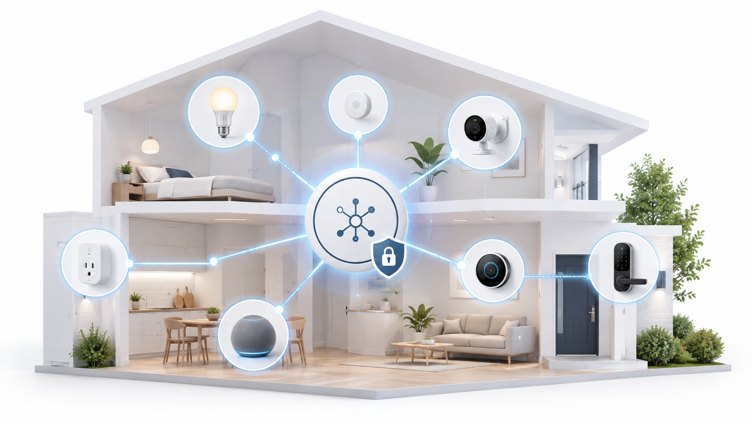
What Is the Matter Protocol?
Matter is an application layer connectivity standard that enables compatible smart home devices to communicate locally and securely across different manufacturers and major ecosystems. Unlike proprietary protocols that lock you into specific brands, Matter creates a common language for smart home devices.
| Attribute | Description |
|---|---|
| Type | Application layer standard |
| Network Transports | Thread, Wi-Fi, Ethernet (Bluetooth LE or NFC may be used during setup) |
| Specification | Open, royalty-free connectivity standard |
| Reference SDK | Open source (Apache License 2.0) |
| Governance | Connectivity Standards Alliance (CSA) |
| Primary Focus | Smart home devices and IoT |
| Operation | Local network, cloud optional |
The Origins of Matter
Matter began as “Project Connected Home over IP” (Project CHIP) in December 2019, announced by the Zigbee Alliance (now the Connectivity Standards Alliance). The founding coalition included Apple (HomeKit), Google (Nest and Google Home), Amazon (Alexa), Samsung (SmartThings) and the CSA itself.
This unprecedented collaboration addressed a fundamental industry problem – the proliferation of incompatible smart home protocols creating friction for consumers and developers alike. Matter’s mission was to establish a single, vendor neutral standard that would work across all major ecosystems.
How Matter Works
Matter’s design centers on three core principles that set it apart from previous smart home standards.
Cross-Platform Interoperability
Matter-certified devices can work across multiple compatible ecosystems, although available features may differ by platform and some products still rely on bridges to connect. Your Google Nest Hub and Apple HomePod can both work with the same supported device, and you can typically add an ecosystem without replacing hardware. For example, a supported Matter bulb can be shared between Apple Home and Alexa, giving household members more choice over which app or voice assistant they use.
Local Operation
Unlike many smart home protocols that rely heavily on cloud services, Matter prioritizes local network communication. Turning lights on and off, locking doors and receiving sensor alerts usually work within your home network without Internet connectivity. If your Internet goes down, your lights and locks can still work locally, though voice assistants and remote access are a different story.
This approach can mean fast response times, better resilience during Internet outages, less dependence on cloud services, and no subscription required for Matter’s core local protocol. Manufacturers may still charge for optional extras like cloud video storage, remote history or advanced app features.
Security by Design
Matter protects its protocol communications through encryption and authenticated, certificate-based device identities. Device attestation helps controllers verify whether a product is genuine and certified during commissioning, while fine-grained access controls limit what each authorized controller can do. Matter also protects your data by only sharing exactly what a device needs to expose for a certain function, rather than granting broad access to everything it knows (though the privacy of any cloud services or companion apps still depends on the platform and manufacturer behind them).
Matter Protocol Architecture
Looking at Matter’s technical architecture gives us an understanding of how it achieves broad interoperability while maintaining security and performance.
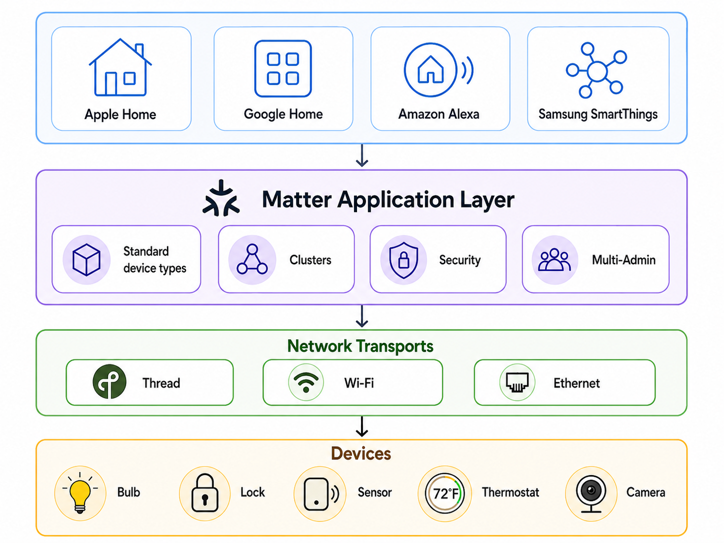
Network Layer
Matter operates over three primary network transports, each suited to different device types.
Thread provides IPv6-based mesh networking designed for low-power devices, with self-healing routing and especially strong suitability for battery-powered sensors and controls. It requires a Thread Border Router, which is built into many hubs.
Wi-Fi uses standard 802.11 networks with higher power consumption but greater bandwidth, making it suitable for mains powered devices without requiring a Thread Border Router or separate wireless bridge.
Ethernet offers wired connectivity for stationary devices, with highly reliable, low latency performance for hubs, bridges and other always-on devices.
Application Layer
Matter defines standardized device types and capabilities through clusters that describe specific functionalities, such as On/Off Cluster (basic power control), Level Control Cluster (dimming and brightness), Color Control Cluster (RGB and color temperature), Lock Cluster (smart lock operations), Thermostat Cluster (HVAC control) and various Sensor Clusters (temperature, humidity, occupancy).
This cluster based approach means that a dimmer switch from one manufacturer can control a smart bulb from another, as both implement the same standardized clusters.
Device Commissioning
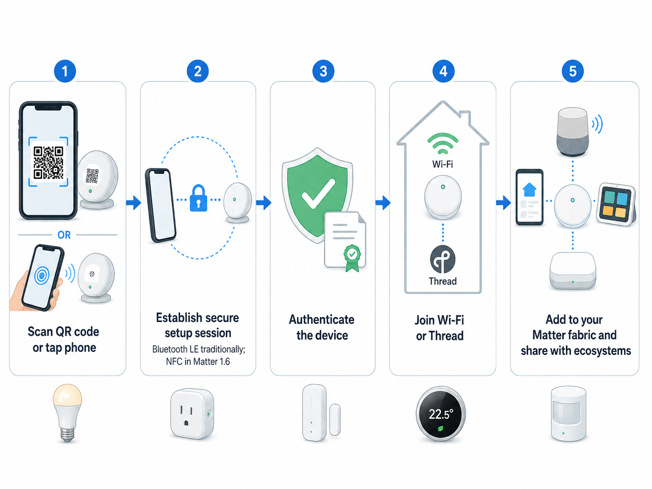
Adding a Matter device usually starts by scanning its QR code or entering a numeric setup code in a compatible smart home app. The phone and device establish a secure commissioning session, traditionally over Bluetooth Low Energy, before the device receives the credentials it needs to join your Wi-Fi or Thread network and your ecosystem’s Matter fabric. From there, you can share the device with additional compatible ecosystems through Matter’s multi-admin feature. Matter 1.6 also defines NFC-based commissioning as an alternative to Bluetooth, though phones, controllers and devices all need to support it before tap-to-pair setup becomes widely usable.
Matter Version History
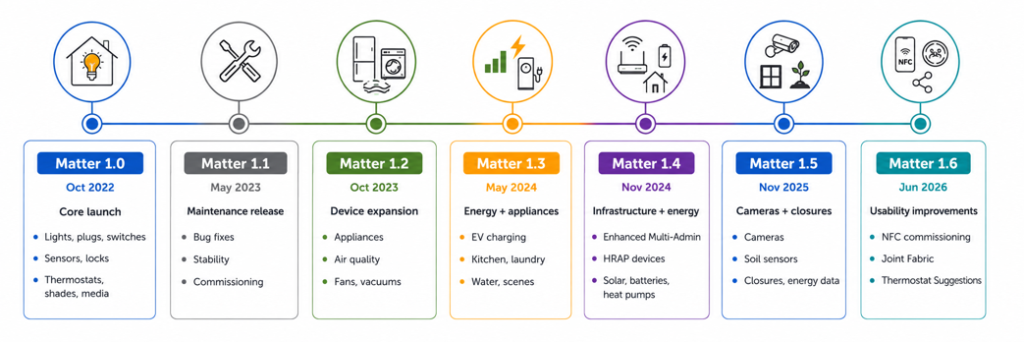
This protocol has evolved rapidly since its initial release, with regular updates expanding device support and capabilities.
Matter 1.0 (October 2022)
The foundational release supported essential device types like lighting (on/off, dimmable, color), switches and dimmers, smart plugs and outlets, sensors (contact, occupancy, temperature), door locks, window coverings, thermostats and basic media controls.
Matter 1.1 (May 2023)
A maintenance release focusing on bug fixes, stability improvements, enhanced commissioning reliability and performance optimizations.
Matter 1.2 (October 2023)
A major expansion adding nine device types – refrigerators, room air conditioners, dishwashers, laundry washers, robotic vacuums, smoke and carbon monoxide alarms, air quality sensors, air purifiers and fans. It also introduced improvements to door locks, device appearance information, operational state reporting and the underlying testing tools. Read the CSA’s Matter 1.2 announcement.
Matter 1.3 (May 2024)
Expanded energy management with device-level energy reporting and support for electric vehicle chargers through a new Electric Vehicle Supply Equipment (EVSE) device type. It also added microwave ovens, ovens, cooktops, extractor hoods and laundry dryers, along with water management support through leak and freeze detectors, rain sensors and controllable water valves. Scenes, command batching and several media device improvements also arrived in this release. Read the CSA’s Matter 1.3 announcement.
Matter 1.4 (November 2024)
Focused on energy management and smart home infrastructure. It introduced Enhanced Multi-Admin (EMA), Matter-certifiable Home Routers and Access Points (HRAP devices that combine a Wi-Fi access point with a Thread Border Router and securely manage Thread network credentials), and new energy device types including solar panels, batteries, heat pumps and water heaters. It also improved thermostat scheduling, occupancy sensing and communication for battery-powered devices. Read the CSA’s Matter 1.4 announcement.
Matter 1.5 (November 2025)
The highly anticipated Matter 1.5 release in November 2025 added cameras with live video and audio streaming, soil sensors for smarter irrigation, and a redesigned, unified approach to closures covering everything from basic blinds to garage doors, gates, awnings and sophisticated smart windows. It also expanded energy management with standardized ways for devices to exchange pricing, tariff and grid carbon data.
Matter 1.6 (June 2026)
Matter 1.6 is the latest version of the smart home standard, released June 17, 2026. It adds no new device categories, focusing instead on NFC-based commissioning, Joint Fabric for easier multi-ecosystem sharing, and Thermostat Suggestions for smarter climate control.
Where 1.5 was about filling device category gaps, Matter 1.6 targets several complaints that have followed Matter and the wider smart home since launch – fiddly setup, shaky multi-ecosystem coordination and devices that respond to commands without enough awareness of context.
Tap-to-Pair NFC Commissioning
A device can now be paired by simply tapping a phone against it, with the entire commissioning exchange happening over NFC, with no need to hand off to Bluetooth partway through. Because NFC can briefly power a device’s chip using energy from the phone itself, a device doesn’t need to be wired in or receiving power to be commissioned. A light bulb can be paired before it’s screwed into a ceiling fixture, or an in-wall switch before it’s wired in, solving the old problem of QR codes becoming inaccessible once a product is installed.
Joint Fabric adds a new way for multiple ecosystems to share one Matter network. Rather than each platform maintaining its own separate copy of device credentials, participating controllers from different ecosystems can co-administer a shared network through a central datastore. Any supported device added to the Joint Fabric can become accessible to every participating controller without being commissioned separately into each ecosystem.
Smarter Thermostat Suggestions
Thermostat Suggestions changes how thermostats handle competing instructions. Instead of blindly executing whatever command arrives last, a thermostat can now weigh an incoming suggestion against a user’s recent manual adjustments and stated preferences before acting, and when it doesn’t follow a suggestion, it can communicate a standardized reason for that outcome. This is most useful for households balancing a utility energy-savings program against their own thermostat schedule, so the two aren’t just fighting for control.
Other Matter 1.6 Improvements
A handful of core enhancements round out the release. Devices can report their own capability limits more precisely, security sensors can make event history available to participating ecosystems, smoke and CO alarms can flag when they’ve been physically removed from their mount, and certificate revocation lists can be updated in smaller partitions instead of one large file – useful as the number of certified devices keeps growing.
Alongside Matter 1.6, the CSA also released Product Security 1.1, an updated certification specification intended to help manufacturers demonstrate a common baseline of product security across multiple markets. It’s separate from Matter itself, but it may eventually provide another useful security signal when comparing connected products.
When Will Matter 1.6 Features Actually Reach Devices?
A specification release is not the same as a feature landing on your devices. The specification and updated development tools are available to developers now, but Apple, Google, Amazon, Samsung and device manufacturers each need to build and ship their own support before you’ll see NFC commissioning or Joint Fabric in your app. That gap has historically run anywhere from several months to well over a year, and as of mid-2026 some platforms are still finishing their rollout of earlier Matter versions. Treat 1.6 as a roadmap rather than something to shop for by name just yet.
Which Smart Home Platforms Support Matter?
Apple Home, Google Home, Amazon Alexa and Samsung SmartThings all support Matter, but implementation differs by platform, controller and device category. A platform may support basic control for a device while omitting newer or manufacturer-specific features, and recently released Matter capabilities can take months to reach consumer products after a specification ships. Check both the device manufacturer’s compatibility information and your chosen ecosystem’s current support before buying.
Matter-certified products are now available across an increasingly broad range of categories from brands including Philips Hue, Nanoleaf, Yale, Aqara and Tapo, although selection and feature support remain uneven across platforms.
Matter smart plugs with energy monitoring represent one of the most accessible entry points into the Matter ecosystem. Affordable multipacks make them one of the least expensive ways to test Matter’s cross-platform promise without major investment. For detailed comparisons of the best Matter plugs with energy monitoring, check out my complete buyer’s guide.
Current Limitations
Feature gaps across platforms: Not every ecosystem supports every Matter feature yet. Feature support varies by platform and device type, with each ecosystem implementing different portions of the Matter specification at different paces.
Specification-to-shelf lag: A newly published Matter version doesn’t mean the features are usable right away. Ecosystems and device makers need time to build against a new spec, so features like Matter 1.6’s Joint Fabric or NFC commissioning may not show up in consumer apps and hardware for months after release. Buy on what a device and your controller can do today, not on a spec version number.
Legacy device compatibility: Older Zigbee or Z-Wave devices won’t become Matter devices. Some manufacturers offer Matter bridges (like the Philips Hue Bridge), but full functionality can vary.
Thread infrastructure required: Matter devices that communicate over Thread need a compatible Thread Border Router, built into products like the HomePod mini, second-generation Nest Hub, fourth-generation Echo or SmartThings Station. Matter-over-Wi-Fi devices don’t require one.
How to Build a Matter Smart Home
Here’s how to start building a Matter based smart home with minimal frustration.
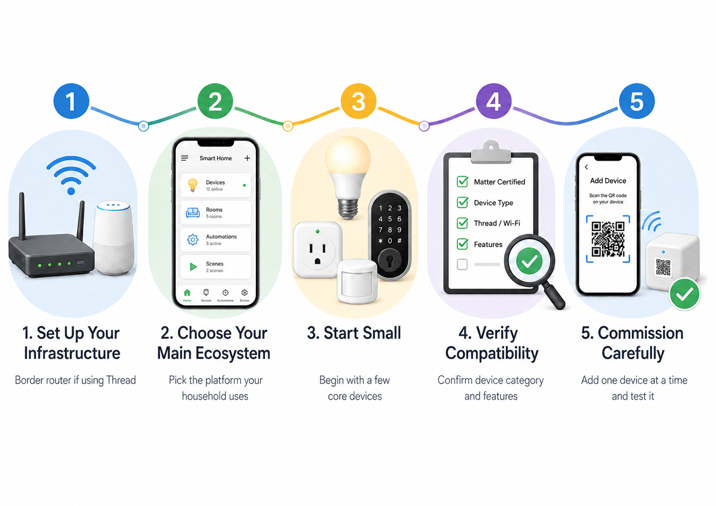
Step 1: Set Up Your Infrastructure
You’ll need at least one Thread Border Router if you plan to use Matter-over-Thread devices. Common examples include the HomePod mini and second-generation HomePod, the second-generation Nest Hub, Nest Hub Max and Nest Wifi Pro, the fourth-generation Echo, third-generation Echo Show 10, Echo Studio (1st generation and newer), and SmartThings Station. The second-generation Apple TV 4K also supports Thread. With the third-generation model, though, only the pricier Wi-Fi + Ethernet configuration includes the Thread radio. The Wi-Fi only version doesn’t. Check the exact model and configuration before buying, since products with similar names don’t all include a Thread Border Router.
Step 2: Choose Your Main Ecosystem
Base your choice on the phones, speakers and services your household already uses. Apple Home integrates closely with Apple devices, Google Home with Android and Google services, Alexa with Amazon’s voice assistant ecosystem, and SmartThings with a broad mix of smart home protocols. Make sure the ecosystem supports the device categories and automations you expect to use.
Step 3: Start Small
Begin with core functions – lighting, thermostat, locks, sensors, plugs. Scale up once everything runs smoothly.
Step 4: Verify Compatibility
Before buying, confirm the product is Matter-certified, that your ecosystem supports its device category and the features you want, and that you have the necessary Wi-Fi or Thread infrastructure. Check both the manufacturer’s compatibility page and your platform’s support documentation, as the Matter logo alone doesn’t guarantee every feature will appear in every ecosystem.
Step 5: Commission Carefully
Add one device at a time, keep setup codes until devices appear in your app and test basic functions before automating.
Matter vs. Zigbee
Matter isn’t the only smart home standard around. Zigbee has been running homes for more than two decades. Here’s how they differ, and when each one makes sense.
| Aspect | Matter | Zigbee |
|---|---|---|
| Role | IP-based application-layer standard | Complete low-power wireless protocol stack |
| Networks | Wi-Fi, Thread or Ethernet | Zigbee mesh over IEEE 802.15.4 |
| Controller needs | Compatible Matter controller, Thread devices also need a Border Router | Zigbee coordinator or hub |
| Multi-ecosystem support | Built-in multi-admin support | Usually determined by the hub or bridge |
| Device selection | Growing across major categories | Large, mature selection |
| Local control | Designed for local IP control | Normally controlled locally through its coordinator |
| Low-power devices | Strong when using Thread | Strong |
| Maturity | Released 2022 | Established for more than two decades |
Matter and Zigbee are separate protocols with no native interoperability, though Matter bridges, like the Philips Hue Bridge, can expose compatible Zigbee devices to a Matter ecosystem. Matter is an attractive default for new purchases when you want broad cross-platform compatibility, while Zigbee remains a strong option for inexpensive sensors, mature device categories, and households that already have a reliable coordinator. The two can coexist in the same home, and you don’t necessarily need to pick just one.
A Matter of What Works Today
Matter has already made choosing compatible smart home devices easier, but the logo should be the start of your buying decision, not the end of it. Platform support, available features and the network your devices use still matter just as much as certification.
The encouraging part is that Matter no longer needs to replace every protocol or solve every smart home problem to succeed. It simply needs to keep making brands and ecosystems work better together.
For buyers, the rule is simpler still – buy for what works today. Let tomorrow’s updates be the bonus.